
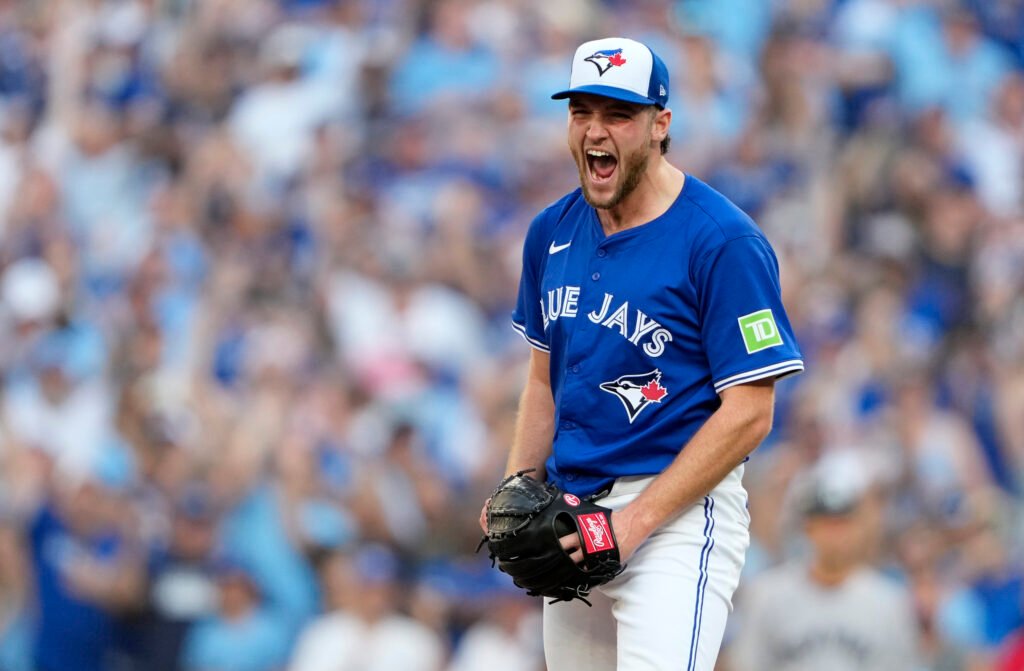
Trey Yesavage had a whirlwind season in 2025. After the Blue Jays drafted him in the first round in 2024, Yesavage opened 2025 at Single-A and immediately impressed with a 2.43 ERA in 33 1/3 innings. He continued that dominance in a brief stop at High-A and reached Double-A in mid-June, striking out 38.0% of hitters against a 9.0% walk rate at that level. Yesavage then held his own at Triple-A, not allowing a home run in 17 1/3 innings and continuing to post a high strikeout rate. His rapid ascent culminated in three appearances with the big-league club in September, followed by six more in the postseason, including two starts and a Game 7 relief appearance in the World Series.
Altogether, Yesavage threw 139 2/3 innings between the regular season and the playoffs, a marked increase over the 93 1/3 innings he threw at East Carolina University in 2024. Coming off his success last year, he will feature prominently in a rotation mix that also includes Dylan Cease, Kevin Gausman, Jose Berrios, Cody Ponce, Max Scherzer, and Shane Bieber (when he returns from an expected stint on the injured list). However, considering Yesavage’s youth rapidly escalating workload, it is reasonable to expect some kind of innings limit in 2026.
At this point in Spring Training, Yesavage is built up to one inning and has not yet appeared in a game, according to Ben Nicholson-Smith of Sportsnet. That is hardly unexpected, as even established starters are built up gradually to a full workload by the end of camp. Manager John Schneider confirmed that Yesavage’s slow build-up is intentional, with the plan being for him to get one more live batting practice session before joining games. Notably, Schneider downplayed the possibility of Yesavage starting the season as a reliever to limit his innings.
“Right now we still view him as a starter,” Schneider said. “And we want to keep that pretty regular. Last year was a year of disrupting a young guy’s routine as much as we could, so we want to be pretty regular with him.” Schneider’s comments bode well for Yesavage’s chance of being a starter for the full season. That said, it would not be surprising for the club to manage the rookie’s workload conservatively in the early going, especially if Berrios, Ponce, and Scherzer start the year healthy behind Cease and Gausman.
Per Schneider’s comments, the club wants to keep Yesavage on a regular schedule. That would seemingly put him in the rotation for the entire season, though with the question of how many innings he’ll be able to handle. Yesavage averaged less than five innings per start during the regular season and just over five in the postseason. At five innings per start, a full season of 33 starts would put him around 165 innings – yet another big increase in workload. A target of 140 innings could make more sense.
In that scenario, Yesavage could piggyback off Berrios or Ponce for the first month or so. That would give him the benefit of making shorter appearances while sticking to a starter’s routine and gradually building up. Of Berrios and Ponce, the former makes more sense partnering with Yesavage in a piggyback role. Berrios made 32 starts per season from 2021-24 but seemed to run out of gas as the 2025 season went on. His first-half ERA of 3.75 was solid, but that rose to 5.15 in 50 2/3 innings in the second half. He was demoted to the bullpen in late September and ended up not appearing in the postseason.
Piggybacking Yesavage and Berrios could help manage the former’s innings while allowing the latter to re-establish himself after his poor conclusion to 2025. In contrast, Ponce came over this offseason on a three-year, $30MM deal after a successful stint in the Korea Baseball Organization. He pitched 180 2/3 innings over 29 starts for the Hanwha Eagles in 2025, posting an excellent 1.89 ERA, a 30.3% K-BB rate, and ultimately winning that league’s MVP award. That recent track record and the magnitude of his contract make a hybrid role unlikely, though Ponce made three relief appearances in Japan last year and was mostly a reliever in his last MLB experience in 2021.
If the team prefers to keep Yesavage as a traditional starter, they might consider having him skip a few starts in the middle of the season. While that would be at least a temporary disruption to his routine, it might make the most sense from a roster management perspective. Six-man rotations are becoming more common as a way to manage workloads throughout the season, but they come with the challenge of having one less reliever. In lieu of giving him five days of regular rest, skipping a few of Yesavage’s starts (ideally around scheduled off days) could be a good compromise that keeps him fresh for the stretch run.
Another (less likely) option is to keep him as a starter for the regular season, then transition him to the bullpen if Toronto makes the postseason. Cease and Gausman are guaranteed spots in a playoff rotation, while Bieber makes a solid No. 3 and Max Scherzer comes with a wealth of postseason experience. Though Yesavage performed admirably as a starter this postseason, using him in a fireman role out of the bullpen could help the team get the most out of him while protecting his long-term health.
How do MLBTR readers think the Blue Jays should manage Yesavage’s workload in 2026? Be sure to let us know in the poll below:
How should the Blue Jays manage Trey Yesavage’s workload in 2026?
Photo courtesy of Kevin Sousa, Imagn Images
