
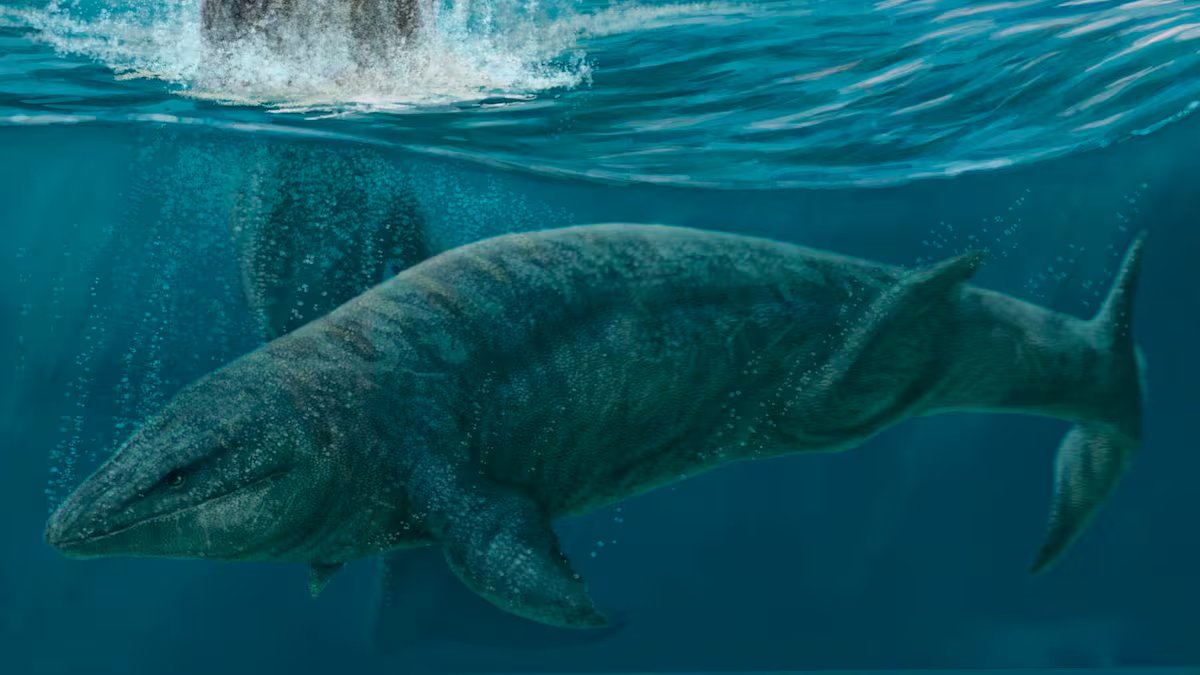
A six-meter-long sea monster with powerful jaws is the latest prehistoric creature found among the fossil deposits of northern Mexico. The Prognathodon cipactli, an aquatic reptile from the mosasaur family that shared the era with dinosaurs but was not related to them, dominated the seas some 70 million years ago in the late Cretaceous period, just before the mass extinction event that ended the age of the dinosaurs.
The long road to identifying Prognathodon cipactli began in 2001 with the discovery of a nearly complete skull in the Méndez Formation in Nuevo León, one of dozens of fossil sites located in northeastern Mexico. Subsequent analyses of the jawbone, conducted in 2007, described it as an unidentified mosasaur species, but now a team of paleontologists from the Desert Museum in Saltillo and the University of Bath (England) has revealed it to be a new species, expanding the diversity of prehistoric reptiles in Mexico.
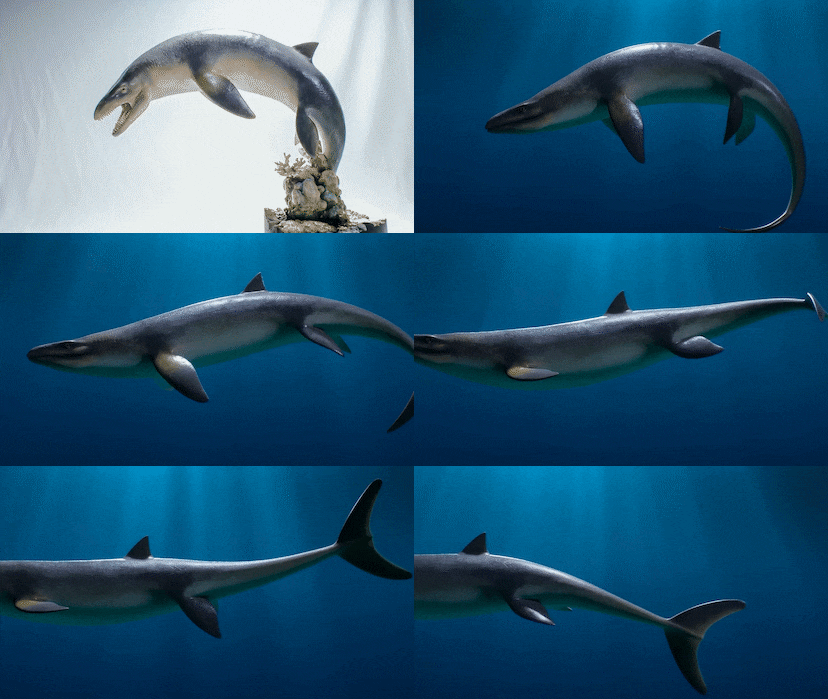
Unlike other, larger mosasaurs, armed with slender teeth and an elongated skull, the newly discovered species measured about six meters in length and its features reflected an adaptation typical of an efficient predator capable of taking on prey of all sizes, such as other marine reptiles, large fish, or shelled animals. “It was a mosasaur with short jaws, with conical and very robust teeth, allowing it to attack large prey,” Héctor Rivera-Sylva, a paleontologist at the Desert Museum and one of the study’s authors, explained to this newspaper. “What we see is that it was an active hunter, which tells us a lot about how we can compare it, for example, to modern-day orcas. The entire genus (Prognathodon) has been found in the open ocean, but it’s likely that it also came closer to the coast, following plesiosaurs or other marine reptiles to attack them there,” Rivera explains, while completing the comparison with orcas, the apex predator of the oceans today: “At that time and in this region, it was the top predator; that was its place in the food chain. There was none bigger or more dangerous than it,” he affirms.
Seventy million years ago, the semi-desert landscape of northeastern Mexico was very different from what it is today, with swamps and shallow beaches surrounded by tropical vegetation that extended to the sea. Over millions of years, sedimentary rocks formed on the seabed emerged to the surface due to tectonic activity. Therefore, the fossil remains found in southern Coahuila and Nuevo León, dozens of kilometers from the Gulf of Mexico, offer a veritable window into the past of primitive flora and fauna, both marine and terrestrial, whose recent study and dissemination have sparked an unprecedented boom in paleontology in Mexico.
“This discovery shows us that the biodiversity at the end of the Cretaceous period was much greater than we knew, both globally and nationally. More species will be discovered in Mexico over time, but recent findings already position our country as an important site worldwide because it’s not just another transitional area; there were also different species and circumstances here that led to a greater amount of speciation,” says Rivera, one of the driving forces behind the fascination with extinct giants in northern Mexico. “When I was a child, we had the idea that dinosaurs hadn’t inhabited Mexico; this whole area was a big question mark. We thought it was something very distant, only in the United States or other parts of the world, but no: they’re here in Mexico too. Now I have kids who are nine, 10, or 12 years old who contact me with great interest, and I tell them, ‘If you want to see Mexican dinosaurs, you can come to the Desert Museum because Mexican dinosaurs are on display here.’”
Sign up for our weekly newsletter to get more English-language news coverage from EL PAÍS USA Edition
