
The province is revamping how the Ontario Student Assistance Program (OSAP) works, slashing the amount that eligible students can get in the form of grants.
Many students have denounced the changes, which the government says are necessary for sustainability, saying they will send them further into debt upon graduating or are making them reconsider their academic plans entirely.
CBC News tried to get clarity from the Ontario Ministry of Colleges and Universities and Economic and Social Development Canada — the two ministries responsible for determining how much money students get — about how these cuts will affect OSAP’s structure, and how the system actually works.
While spokespersons provided some information, they did not get into specifics or explain how the new changes will impact students.
In an effort to get a better understanding of the program, CBC News spoke with higher education experts and reviewed public records, including information posted online by university financial aid offices.
Here’s what we’ve learned:
First things first, what is OSAP?
OSAP is a financial aid program that gives money to current or incoming students in university or college to pay for school.
That money comes in the form of grants (money you don’t pay back) and loans (money you do pay back).
While OSAP is a provincial program, the money you get actually comes from both the provincial and federal governments, according to the program ’s definition on the government of Ontario’s website.
Ontario is giving colleges and universities billions in new funding, while lifting a seven-year tuition fee freeze and cutting back on the amount of student assistance grants.
Who can get OSAP?
Ontario residents of any age who are either Canadian citizens, permanent residents or protected persons are eligible for OSAP, according to its website.
However, this eligibility can get more complicated. OSAP’s main website doesn’t actually identify what makes an Ontario resident an Ontario resident, but financial aid offices for many universities and colleges, such as York, Waterloo and George Brown, note that there’s specific criteria that need to be met.
And even then, there are exceptions. So, to be safe, check with your school’s financial aid office.
How much money can I get?
There’s a bunch of factors that go into this, such as your course load, whether you’re single or married, and what your household income is. OSAP’s website doesn’t detail how exactly the calculation is made.
Since OSAP money comes from both the province and the federal government, they use different policies to determine your funding.
When you get your OSAP, up to 60 per cent of the total money (grants, loans or both) can come from the federal government, said Liana Brault, a spokesperson with Employment and Social Development Canada, in an emailed statement.
By that measure, 40 per cent of student loans and grants would typically come from the province.
Asked to detail the federal and provincial policies used to determine how much aid students can get, Brault did not respond, while Ontario’s Ministry of Colleges and Universities did not provide any specifics on how the changes will affect students directly.
OSAP does provide a calculator you can use to see how much you might get from both the province and the federal government, although there’s a disclaimer on the site that says you may be entitled for more money, or less, depending on your actual application.
There is also a federal aid estimator, but it only shows how much money you could get from the federal portion of your loan or grant.
The different estimators “give you ballpark numbers that may be very drastic from what the institution is able to to put together to help you set foot on the university campus,” said Danny Corral, an assistant professor who studies OSAP at the University of Toronto’s Ontario Institute for Studies in Education (OISE).
“Unfortunately when we are dealing with financial aid systems, they tend to be super complex and convoluted,” he said.

So, can I use the calculator to see how much money I can get factoring in the cuts?
Not yet.
OSAP isn’t updating its calculator for the 2026-2027 academic year until the spring.
It is unclear when exactly in the spring the calculator will be updated, and by springtime many students might have already accepted an offer of admission.
The earliest date that students will be required to accept offers of admissions is June 1, according to the Ontario Universities’ Application Centre, but you should check your acceptance offer for the specific date.
How much could I lose out on with these new cuts?
The announced cuts to OSAP only affect the provincial portion of grants students can receive. That means that the roughly 40 per cent of OSAP funding that comes from the province will be affected.
How much impact this could have per student remains unclear.
The Ministry of Colleges and Universities did not answer CBC News’s questions on how much grant money students can expect to lose out on and when exactly the aid calculator will be updated to reflect the new changes.
“To restore sustainability to the OSAP system that was facing a $2.3 billion pressure and ensure its availability for future generations, our government is aligning our student financial support framework with other jurisdictions across Canada,” said Bianca Giacoboni, press secretary for Ontario’s Colleges and Universities Minister Nolan Quinn.
Students who get maximum aid could see $3,500 of grant money turn into loans in the fall, said Alex Usher, president of Higher Education Strategy Associates in Toronto.
Usher said he expects the changes to particularly impact students returning to school who are older and have families, rather than high school students who remain on a pathway from school to school.
“It’s going to affect enrolment, but it’s not going to affect enrolment for young people,” Usher said.
“It’ll affect them for people who are older students going back [to school].”

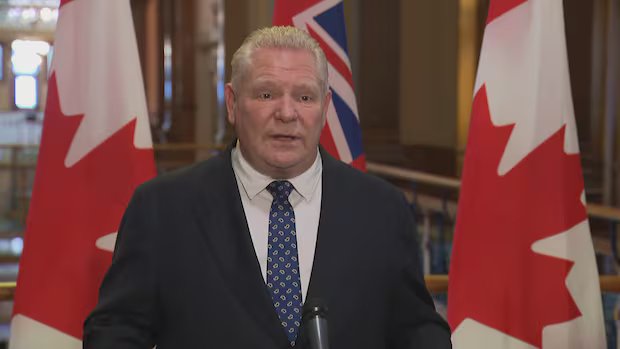
Ontario Premier Doug Ford is doubling down on his comments around changes to OSAP, saying taxpayers expect students to choose fields of study that will ‘drive economic growth.’
It’s also not clear how many students actually get maximum aid from OSAP, according to Ricardo Tranjan, Ontario research director at the Canadian Centre for Policy Alternatives.
“There’s clearly a transparency issue here for researchers … we don’t have enough access to the administrative data that the ministry has,” said Tranjan.
“It’s hard to quantify the impact of the change right now and exactly how many students are going to be directly impacted — and by how much — because we lack access to that [data].”
