
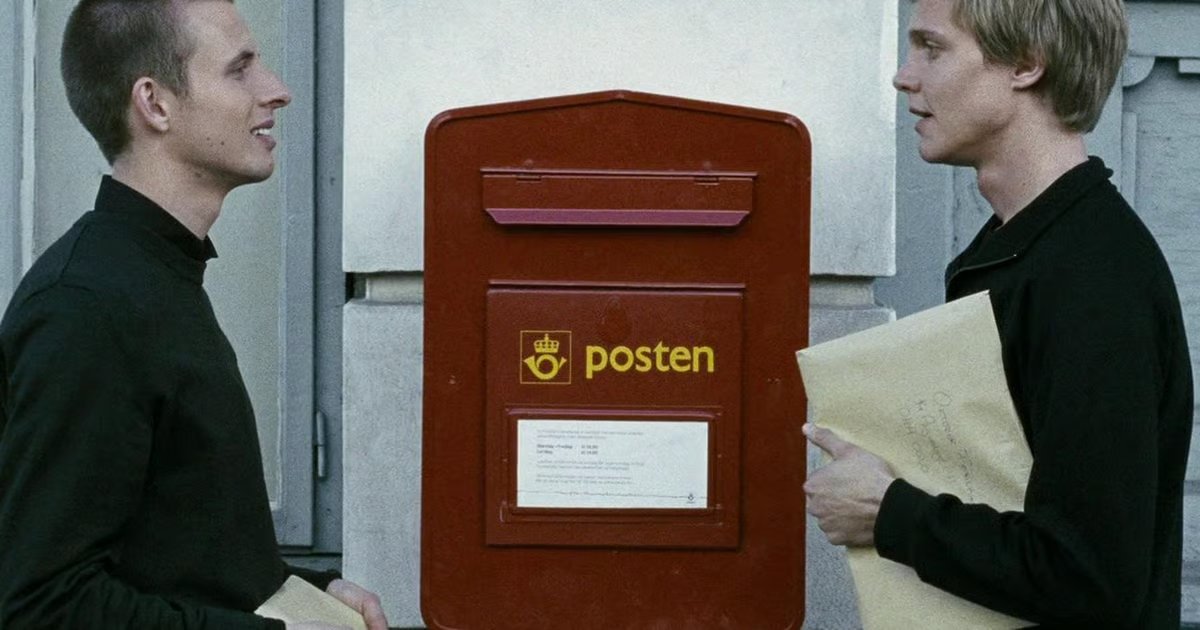
“Girls aren’t cool,” their friend Lars (Christian Rubeck) announces at a party, as if women are an accessory. “They can be pretty or cute and with some serious dieting, even sexy. They can be nice – dumb, but nice.” And if a woman introduces a man to new music or literature? “She got it from her ex, [or] her father.” Women are vapid, uninspired addendums to exceptional men striving for innovation – men that read Nietzsche, listen to The Smiths and perform in a punk band.
Blatant sexism is only one element of an unabashed superiority complex. From the outset, the pair strive to create “cult classics”. They reject anything and everything popular in favour of the recondite and esoteric. Their lodestar is fictional author Sten Egil Dahl, a fringe figure who published his first novel at age 20 before disappearing from public life. Trier stated in a 2008 interview that if Phillip and Erik were musicians, Dahl would be replaced by Morissey – the increasingly bigoted frontman of The Smiths who prides himself on being anti-establishment (to the point of racism and xenophobia).
Yet it is Dahl who exposes Phillip and Erik’s phony ‘intellectual’ personas. The pair repeatedly act, and say, they are Dahl’s “only two fans”, yet when the elusive author arrives at an industry event, Erik is astounded to find that fellow debut novelist Mathis Wergeland (Thorbjørn Harr, in a period-accurate tiny scarf) – who they deem a disgustingly mainstream “superficial imbecile” – is also a “big fan” of Dahl’s.
The same fraudulence governs their relationships with women. While Phillip and Erik happily expound their misogynism in public, in private they are sentimental hypocrites. “Didn’t you say if your book got published you would break up with Lilian?” Phillip asks Erik, who cannot bear to end his three-year relationship. Instead, it is Lilian (Silje Hagen) that unceremoniously dumps Erik, branding him “a damn cliché.” Erik responds sensibly by fleeing Oslo completely, while Phillip’s fate is considerably worse. His obsessive romance with Kari (Viktoria Winge) – whom he wines and dines with a trip to Paris – ends with him back in the psychiatric hospital.
Where its antecedents, like Mike Nichols’ The Graduate (1967) or Peter Weir’s Dead Poets Society (1989), are aligned in their depiction of young men fighting to identify their true passion and purpose, Reprise remains prophetic in its cynical disregard for authenticity. Phillip and Erik rely on arbitrarily devised constructs – the glamorisation of mental health conditions, sexism and being niche – in place of talent or truth. They will succeed by sheer force of will – a determination they now share with the 2.6 million self-publishing authors, self-help culture and even Kim Kardashian.
The pair’s manifesto does not stop their literary adventure (and their friendship) ending abruptly. “This isn’t your best work,” Erik tells Phillip, surprised his psychosis has not bestowed him with great literary skill. In retaliation – and perhaps the first shred of honesty between them – Phillip admits “all I’ve ever done is recycle Sten Egil Dahl,” before insinuating Erik has too. Ending with the pair estranged, Reprise remains a cautionary reminder that not all creative endeavour ends with success and happiness.
So was it worth it for the hapless duo? Only one external perspective on Phillip and Erik is given in Reprise beyond Lilian’s assessment of Erik. Onlookers at a punk concert dismiss them as “just some spoiled rich kids from the West side,” adding witheringly, “I heard one of them wrote this weird book.”
