
– Karl Friis Forchhammer’s doc stands not only as a colourful slice of Danish cultural history, but also as a provocative reminder that alternative visions of community remain possible
Karl Friis Forchhammer’s Christiania arrives in the main competition of this year’s CPH:DOX as both a historical portrait and a reflective meditation on one of Europe’s most enduring social experiments. The freetown of Christiania – founded in 1971, when a group of young idealists occupied an abandoned military barracks in Copenhagen – has long existed somewhere between utopian dream and political headache. Half a century later, the community remains a potent symbol of radical democracy, collective living and resistance to mainstream structures. Forchhammer’s film attempts – with no frills and without sugarcoating – the ambitious task of distilling those 50 years of myth, conflict and reinvention into a coherent cinematic narrative.
On paper, the scope is daunting. Christiania’s history includes hippie communes, religious sects, drugs, internal disputes and clashes with the Danish state. Yet the documentary avoids becoming an unwieldy catalogue of events thanks to sharp writing and skilful editing (courtesy of Michaeal Aaglund) that give the film a clear narrative through-line. Rather than simply recounting the chronology of the commune, Forchhammer frames the story around the central question of tolerance: how far can a society stretch its ideals before they begin to undermine themselves?
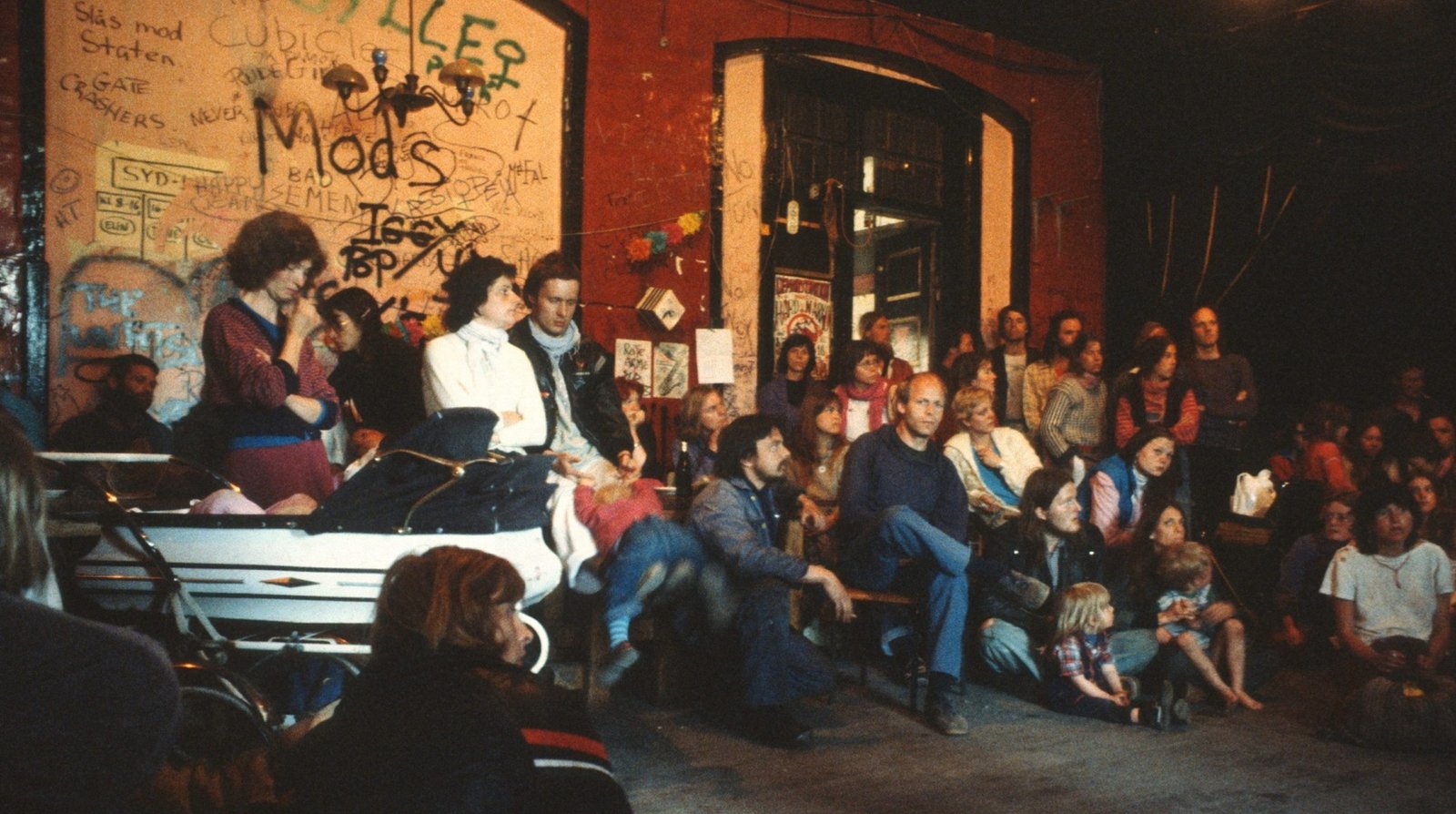
The documentary’s visual strategy plays a key role in sustaining this focus. Drawing on a vast and previously underused archive inside Christiania itself, Forchhammer assembles a vibrant collage of photographs, home movies and recordings that bring the commune’s early decades vividly to life. These archival fragments are seamlessly interwoven with animated sequences that fill narrative gaps and capture the surreal anecdotes that have become part of Christiania folklore – from stories of eccentric residents to the almost mythic atmosphere surrounding the community’s formative years.
The interplay between animation and archival footage is particularly effective. Rather than feeling like stylistic embellishment, the animated passages serve as an imaginative extension of the archive, evoking memories and myths that cannot be documented visually. This technique gives the film an almost storybook-like quality while preserving a sense of historical authenticity. It also reflects the chaotic, improvisational spirit of Christiania itself: a place where myth and reality have always coexisted.
Beyond its aesthetic inventiveness, Christiania remains compelling because it refuses to romanticise its subject. The film acknowledges the commune’s idealism but also confronts the darker chapters of its history. The rise of organised crime around the hash trade, the internal conflicts over the famous Pusher Street and the persistent pressure from Danish authorities all complicate the utopian narrative. These tensions ultimately form the real backbone of the film.
At the heart of Forchhammer’s documentary lies the concept of consensus democracy, the decision-making process that still governs Christiania today. Through footage of resident meetings and testimonies from long-time inhabitants, the film illustrates how confounding and time-consuming this system can be. Yet it also reveals its surprising resilience: a reminder that democracy, even in its most chaotic forms, depends on the willingness of people with radically different views to continue negotiating with one another.
Ultimately, Christiania functions as both a chronicle of a singular place and a broader reflection on the fragility of democratic ideals. In revisiting the commune’s improbable survival, Forchhammer suggests that imperfect experiments in freedom may still hold lessons for societies increasingly torn between tolerance and control.
Christiania was produced by Danish firm Tambo Film.
