
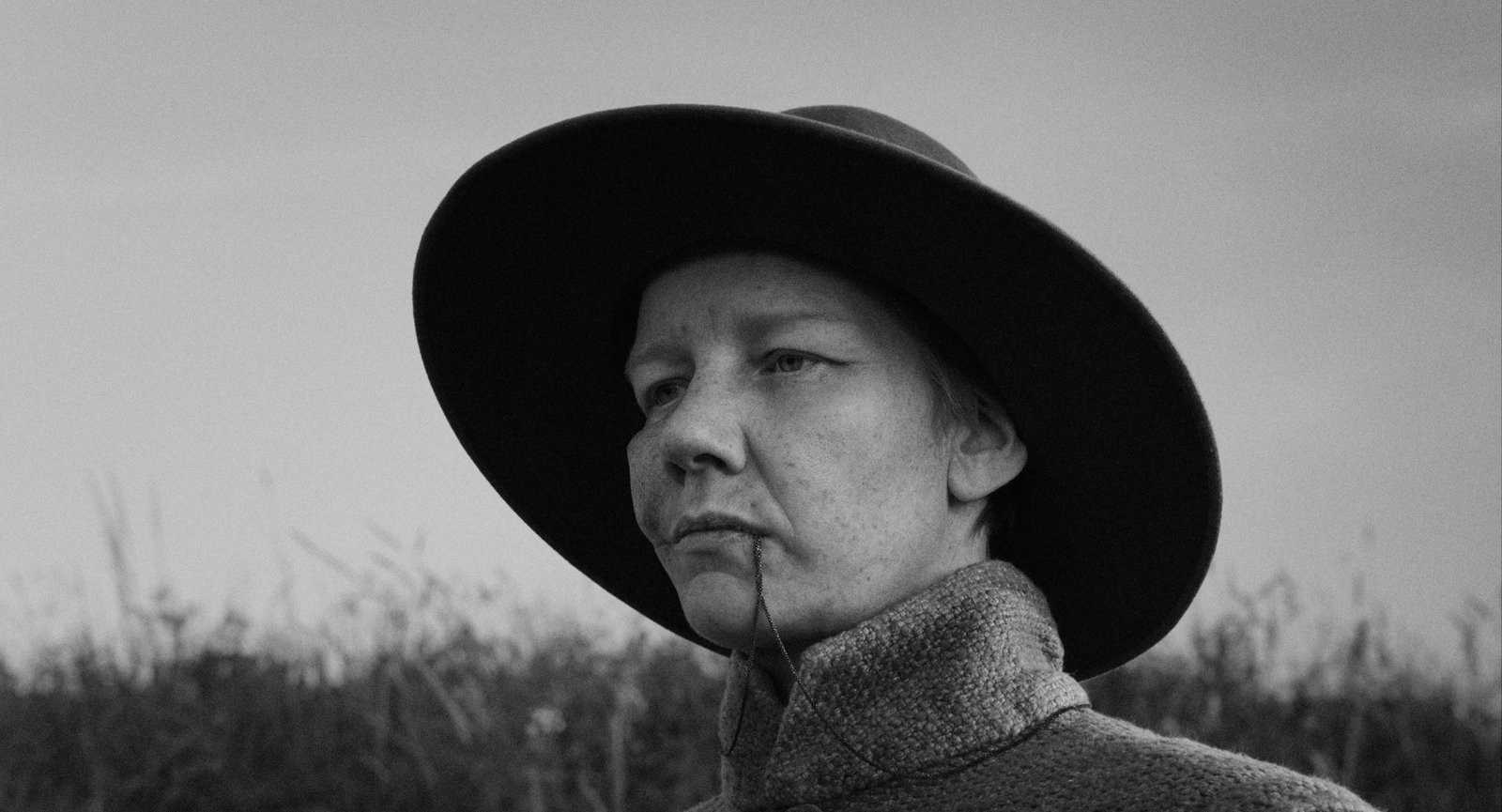
– BERLINALE 2026: Markus Schleinzer casts Sandra Hüller in the role of a man during the Thirty Years’ War, while probing societally ingrained xenophobia and misogyny
Sandra Hüller in Rose
The landscape is barren: scorched earth in grainy black-and-white frames that resemble exquisite paintings fills the screen as an unseen narrator tells the story of Rose (Sandra Hüller), a woman who has “taken up the trousers”. Having fought as a soldier in the war, she one day turns up in a small Protestant community in a German village. In her bag are a deed of ownership entitling her to a plot of land and a farm, as well as a sack of money. The townspeople are suspicious, though not of her gender. Rose is an outsider, a disturbing force to the community. Yet, as the narrator observes, “they were happy to take her money.”
After Michael [+see also:
trailer
film profile] in 2011 and Angelo [+see also:
film review
trailer
interview: Markus Schleinzer
film profile] in 2018, Austrian director Markus Schleinzer shifts his gaze towards a female character. Rose, which had its world premiere in the competition at the 76th Berlinale, also follows a character struggling to fit in while harbouring questionable instincts. The film’s explanation for her cross-dressing is pretty straightforward; “there’s more freedom in pants,” Rose says later in the film, when she is forced to explain herself. Schleinzer drew his inspiration from historical reports of women pretending to be men and being found guilty of crimes like sodomy. Men in the 17th century could access work, avoid rape and forced marriage, live a more self-determined life, and gain access to education. For others, the motivation may have stemmed from queer desire.
But as Rose is settling in, rebuilding the farmland she “inherited” and slowly bonding with some of the village folks, another historically male-coded sentiment takes over. “Greed is intoxicating,” the narrator foreshadows, hinting at events to come. One of the villagers offers Rose the possibility of marrying one of his daughters in exchange for having access to the local river. Suzanna (Caro Braun) becomes the dutiful wife, whom Rose at first never touches and treats with cold distance. But this is where the tide is slowly starting to turn; the lack of intercourse and the absence of an heir is starting to make the townsfolk murmur. Then, the tiniest of cosmic coincidences sparks deep-seated doubt about who Rose really is, and whether she is the “honourable” man she claims to be.
Even as emotions begin to boil over, Schleinzer never abandons his slow narration and his wide-framed observation of land and people. Like a car crash in slow motion, the viewer observes one poor decision follow another, all driven by the belief that spending considerable sums of money on the community, teaching some of its members to read and write, and even saving others from being mauled by a bear might be enough to secure a sense of belonging. But there is no place for those who challenge a society’s perceived superiority.
“You feel like a master, but you don’t belong to yourself,” Rose tells Suzanna about her prospects of sending Rose away. Together, their path may be self-serving, yet it becomes one of self-realisation in a world that offers little value or possibility for a woman’s becoming.
Rose was produced by Austria’s Schubert Film, and Germany’s ROW Pictures and Walker + Worm Film, in co-production with the Austrian public broadcasting company ORF and Germany’s ZDF, as well as France’s Arte. The Match Factory handles international sales.
