
– CANNES 2026: Viesturs Kairišs returns to monochrome for a restrained biopic that honours an overlooked life while raising obvious questions about representation
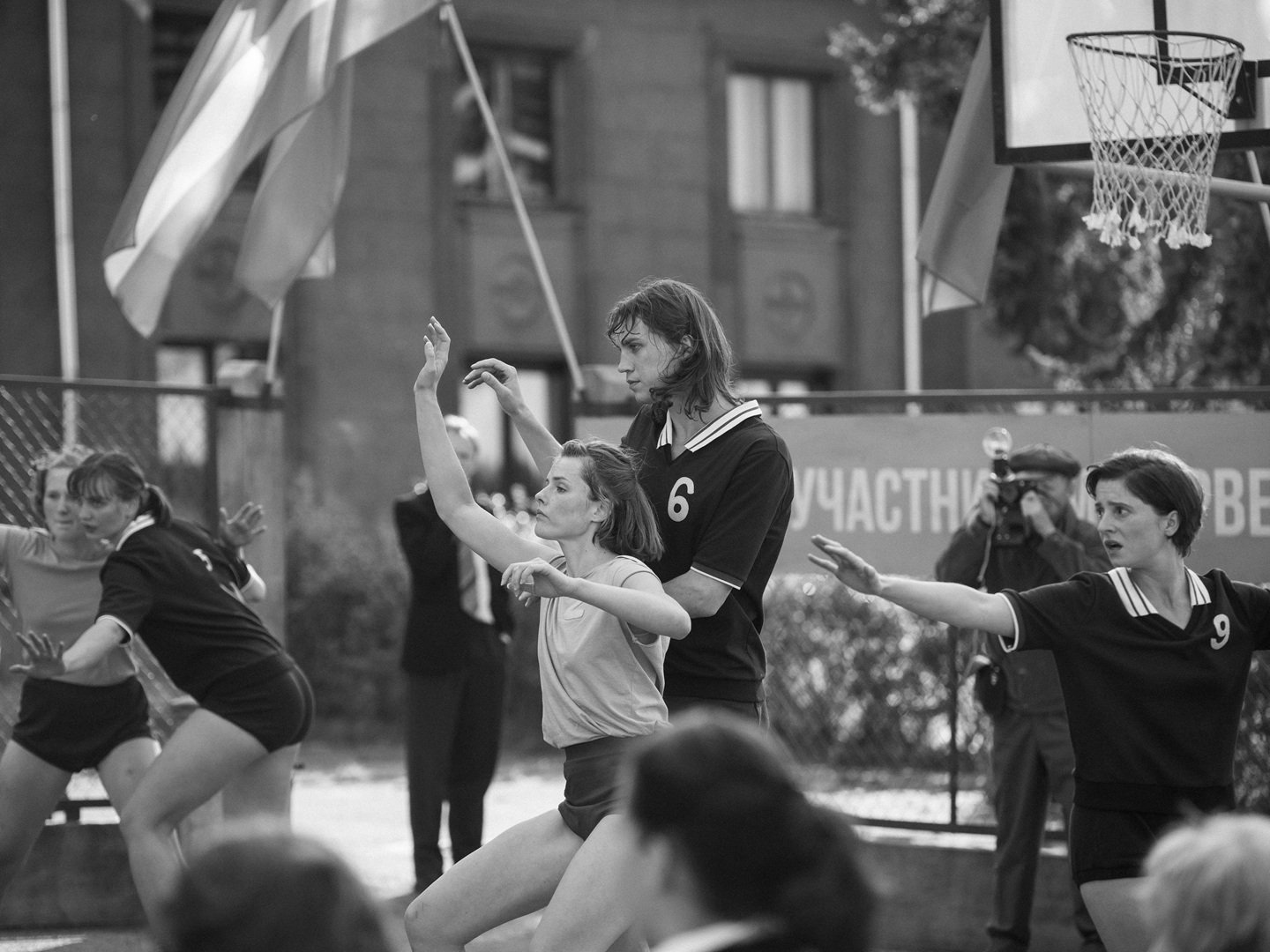
Kārlis Arnolds Avots (centre) in Ulya
After revisiting his country’s traumatic past through the stark visual language of The Chronicles of Melanie and infusing his most recent effort, January, with poetry, Viesturs Kairišs once again turns to black and white for Ulya, a biographical drama unveiled in Un Certain Regard at Cannes. Set in the 1960s under Soviet occupation, the film recounts the life of Latvian basketball champion Ulyana Semenova (1952-2026) – here imagined not as a public icon in the making, but as a young woman coping with a body and a society unwilling to accommodate difference.
The decision to tell this story feels legitimate and timely. In a deeply conservative Baltic context, and within the constraints imposed by Soviet ideology, Ulyana’s existence already carried a degree of social friction. Kairišs approaches the material with seriousness and restraint, avoiding sensationalism and favouring an atmosphere of quiet melancholy. The result is a work that is consistently elegant and often emotionally perceptive.
At the same time, Ulya is likely to prompt debate for reasons that extend beyond its narrative. Its most contentious element lies in the casting of Kārlis Arnolds Avots in the leading role. While cross-gender casting has long belonged to theatrical and cinematic traditions, here the choice struggles to generate an interpretative layer substantial enough to justify itself. The real-life Ulyana Semenova was a woman whose imposing physicality stemmed from a glandular condition, rather than from questions of gender identity or intersexuality.
Avots commits fully to the part and clearly shoots for delicacy, awkwardness and vulnerability. Yet certain elements remain difficult to overlook: the low-pitched vocal delivery, the movement and the physical presence repeatedly foreground a masculine register, rather than allowing him to dissolve into the character. Instead of giving rise to ambiguity, the performance occasionally draws attention away from the emotional trajectory of the protagonist and towards the mechanics of embodiment itself. One cannot help but wonder what a female performer might have brought to the part, and we may feel that the root of the decision lies in Avots’ willingness to take on such a challenging role.
Elsewhere, Kairišs demonstrates the control that has made him one of Latvia’s most recognisable auteurs and stage directors. Technically, there is little to fault. The editing maintains measured rhythms, the production design carefully reconstructs the period without fetishising it, and the cinematography consistently supports the emotional register of the story.
The monochrome palette is more ambivalent. It undeniably contributes to the film’s sombre atmosphere and visual cohesion, but it also introduces a degree of distance that may not entirely serve the material. Where The Chronicles of Melanie used black and white as a means of evoking historical trauma and memory, here, the absence of colour occasionally creates an additional layer of abstraction over a story that arguably needed greater immediacy. It’s also a sports drama after all, filled with scenes set on the basketball pitch.
Still, atmosphere remains one of Kairišs’s strongest assets. The muted interiors, restrained performances and carefully controlled mise-en-scène produce a world suspended between oppression and introspection. One senses a good helping of confidence underpinning how the scenes unfold, and the film never lapses into overt melodrama.
Ulya may not fully resolve the tension created by its central creative decision, but it remains a thoughtful and technically accomplished work: one that restores visibility to a life worth revisiting.
Ulya was produced by Ego Media (Latvia) together with Tremora (Lithuania), Allfilm (Estonia) and Staron Film (Poland). French outfit B-Rated is selling the pic internationally.
