
Opensignal has published the first of its biannual reports on the Canadian mobile network experience.
Rather than a clear winner, Canada’s big three networks are very close in overall ranking, “with resilience, regulatory oversight, and satellite backup emerging as differentiators alongside traditional speed metrics,” according to Opensignal.
To add some context, the report notes that eight of the 15 awards presented by Opensignal are jointly held by two or more telecom companies. Telus also leads the pack with the most awards at 10 (eight jointly, two outright), with Rogers close behind at nine (five jointly, four outright). Bell finished with seven awards (six joint, one outright).
It’s also worth noting that OpenSignal at times issues scores based on customer ratings across several topics (slowdowns, refresh time, buffering, etc.). They use these scores mainly for experience (5G video experience, etc.).
Overall Experience
In terms of overall experience, Rogers and Telus led the way in most of the categories. Rogers and Telus were declared joint winners for video experience, with Telus scoring 73.3 points (out of 100) and Rogers scoring 73.4 points. Bell was a fair bit back, finishing with 67.1 points.
It is a similar story with the mobile gaming experience, as Rogers (81.2 points) and Telus (81.5 points) were declared joint winners, with Bell not far behind at 80.4 points.
Interestingly, the download experience had a wider margin. Bell (91.5Mbps) and Telus (91.9Mbps) were declared joint winners, while Rogers (76.2Mbps) lagged significantly, finishing 15.3Mbps behind Bell.
Upload speed was much closer, with Rogers (13.1Mbps) winning the category, with Bell (12.2Mbps) and Telus (12.5Mbps) finishing with only a 0.3Mbps difference.
5G experience
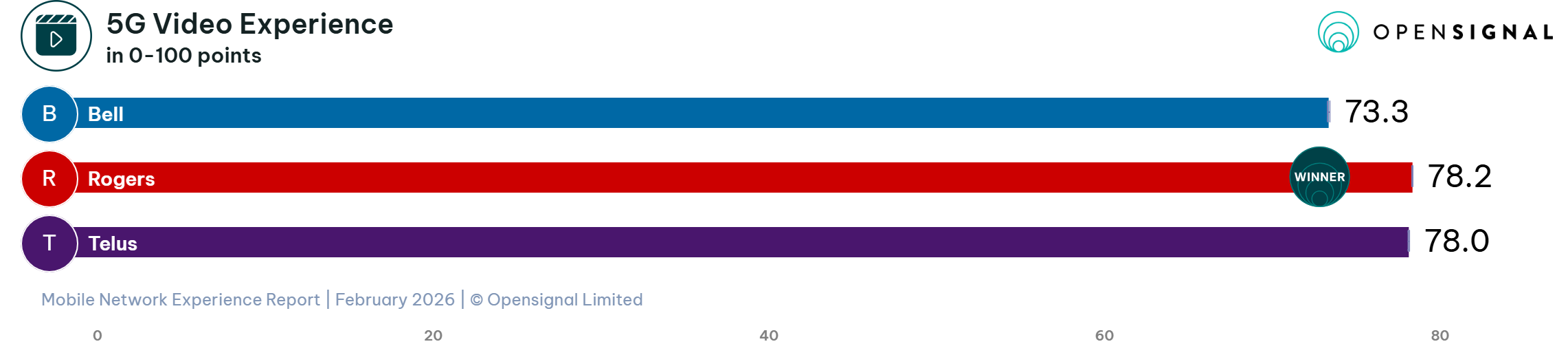
In terms of 5G experience, Rogers took home two categories, while Bell and Telus followed closely behind.
Rogers ranked first in the report with the best 5G video experience, scoring 78.2 points. Telus followed closely behind with 78 points, while Bell fell behind with 73.3 points.
Telus ended with the best 5G gaming experience, scoring 90.1 points. Rogers followed with 89.9 points, and Bell finished with 89.6 mbps.
In terms of 5G download speed, Bell dominated the other two major telecom giants, finishing with a speed of 198Mbps, while Telus finished in second with 170.4Mbps. Rogers was not far behind, with a speed of 166.5Mbps.
Similar to the last upload speed category, Rogers had the highest 5G upload speed at 25.3Mbps. Bell finished in second with 22.3Mbps, while Telus finished 2.2Mbps behind Bell at 20.1Mbps.
Coverage
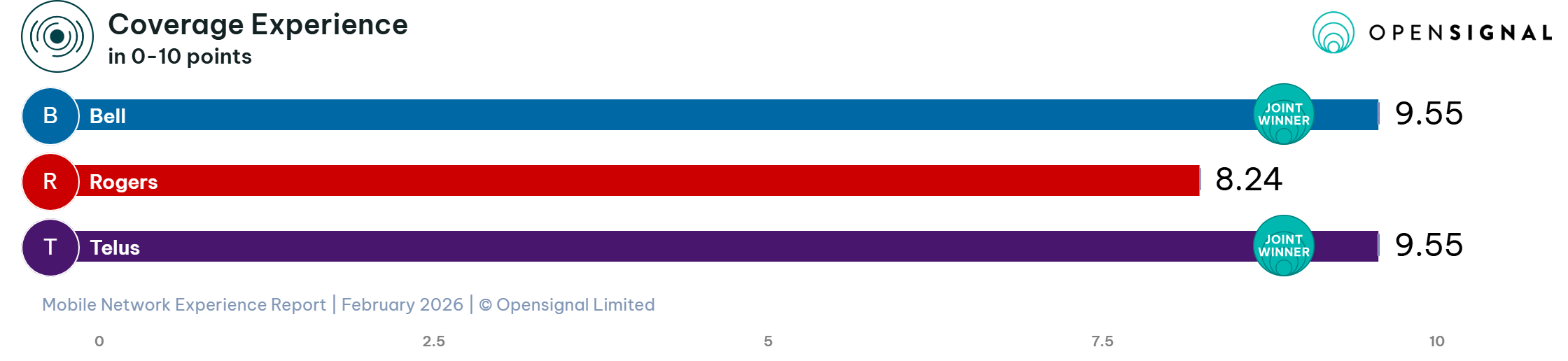
In terms of coverage, Bell and Telus were ranked best in experience, with scores of 9.5/10, while Rogers scored 8.24/10. It was a similar story with 5G coverage, with Bell and Telus ranking 6.58/10, while Rogers finished 5.01/10.
Interestingly, Telus customers spent the most time on 5G, with users reporting they spend 27 per cent of their time on the network. Bell customers reported spending 18.4 per cent of the time on 5G, while Rogers customers reported spending 17.5 per cent on 5G.
With that in mind, Rogers customers surprisingly noted that 5G is available to them 85.9 per cent of the time, while Telus customers reported it being available for only 76.4 per cent of the time. Bell customers noted that they can only get 5G 70.9 per cent of the time.
Consistency, which measures how often a network is capable of supporting common mobile tasks, was by far the closest category among the three telecom giants. Bell customers noted consistent quality in 81.8 per cent of tests, while Rogers and Telus customers noted consistency 82.8 and 82.9 per cent of the time, respectively.
