
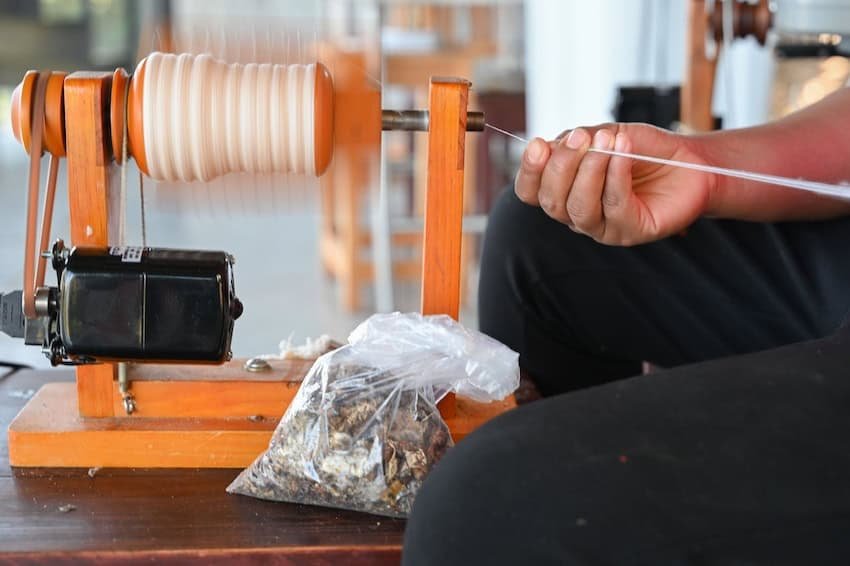
High in the mountains of Oaxaca, Mexico, thousands of worms are thriving. From their discarded cocoons, the artisans of San Pedro Cajonos are spinning reels of the finest silk. This craft dates back to the 1500s, passed down for generations.
Silk represents beauty and refinement, often associated with wealth and power. This symbol of luxury and status has a complex history in Cajonos, challenged by the influx of imports and disease introduced by international trade and later synthetic materials. Fortunately, in recent years, Oaxaca’s silk production (sericulture) has experienced a revival, with the rise of global connectivity, and cooperatives like Yagaa, housed at the Silk Sanctuary in the Zapotec community of Cajonos.
Silk production in Mexico
Yagaa means mountain in Zapotec, which makes sense as Cajonos is nestled amongst the pine forest of Oaxaca’s Sierra Norte, at 10,000 feet above sea level. It is a three-hour drive northeast of Oaxaca City, a drive that takes you out of the central valleys, up steep slopes to a cooler micro-climate, perfect for the silk worms and the mulberry trees that feed them.
Silk was introduced to Mexico by the Spanish in 1523. While the industry initially flourished, it began to fail in the early 1600s. This was due to European plagues and competition from Asian silk. Although the Indigenous communities were forbidden from using Spanish floor looms, they went on to preserve the craft by adapting silk to their traditional backstrap looms.
A significant revival began in 1993 with the formation of groups like the Yagaa collective hosted at the Silk Sanctuary (El Santuario de la Seda) in Cajonos. The collective aims to unify local artisans to help them compete in global markets.
In Cajonos, the community raises a local variety of silkworm they call “criollo” (wild). These worms are noted for their strength and resistance to disease, which has attracted interest from international laboratories.
The mulberry tree and its silkworms
The process begins with the mulberry tree (morera), the sole food source for the worms. These trees require approximately four years to reach their productive stage, at which point they provide enough leaves to feed the silkworms. Tree care includes annual pruning, consistent watering, pest control, and fertilization.

Silkworm rearing consists of five stages, lasting approximately 42 days, depending on the climate. During this time, the silkworms molt every five days and grow from about 3 millimeters at birth to 8 centimeters in their adult stage.

In the fifth stage, the silkworm begins to spin its cocoon, which is the main raw material for making silk thread. Afterwards, the silkworm transforms into a pupa and, after about three days, emerges from the cocoon as a moth. Once this process is complete, the cocoons are cooked, which allows for the winding process and, subsequently, the hand-spinning.
It takes approximately 15 to 20 days to obtain 250 grams of silk thread, enough to make a silk shawl three meters long by 70 centimeters wide.
Ancestral techniques
The Yagaa artisans maintain their ancestral techniques, such as spinning with a malacate (a traditional spindle using a gourd and stick) and weaving on backstrap looms. These methods produce traditional garments, including huipiles (tunics) and rebozos (shawls).
Weaving on a loom is the second process and takes about seven days. The finishing, which consists of interlacing threads or knots to create the intricate geometric figures, can last up to 10 days.
Finally, dyeing with natural dyes takes between one and three days, depending on the desired shade.
There is also a concerted effort to revive natural dyes made from local resources such as cochineal to produce red, indigo for blue and pericon (a small wild marigold) for yellow. From these dyes, Indigenous artisans can make a rainbow of colors.
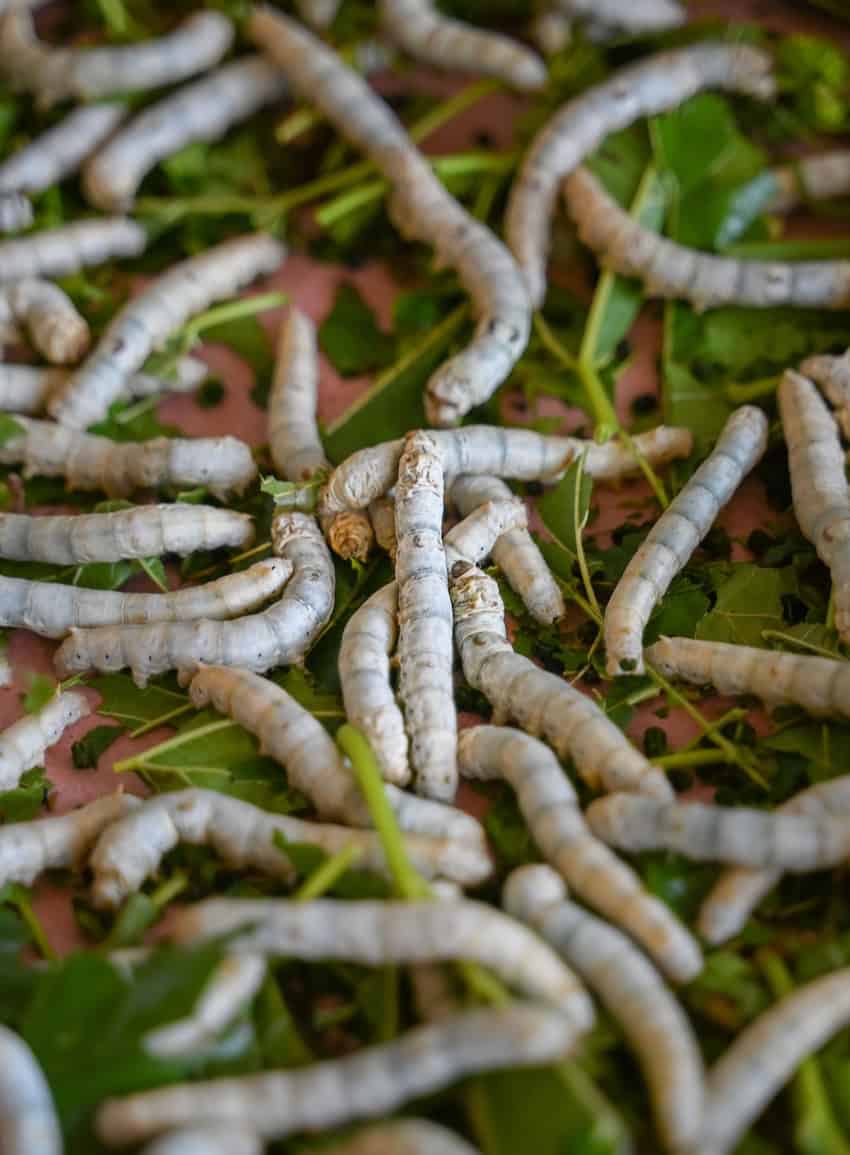
A distinctive feature of silk production from Cajonos is the respect for the silkworm’s life cycle. Unlike industrial methods, where larvae are often killed, Oaxacan artisans allow the moths to emerge from their cocoons before harvesting the silk.
The sound of silkworms eating
Raising silkworms and making textiles have been an important part of the family economy and local artisanal knowledge. Traditionally, families raised the worms inside their homes, often in kitchens or bedrooms, viewing them as part of the household to ensure they receive loving care.
Visiting the sanctuary in Cajonos, I spoke with Lidia Cruz Mendez, an artisan with the Yagaa collective. She clearly loves both working with silk and the worms that support her practice. She encouraged me to pick one up and let it sit on my hand. It was soft to the touch. She then took the worm and held it to her cheek before giving it a little kiss on its head. This deep affection permeates the silk production at the sanctuary in Cajonos.
Lizbeth Isidro Cruz, treasurer for the sanctuary, explains that “as a sanctuary, we raise around 40,000 silkworms per season, which consume about a ton of mulberry leaves, their only food.” This echoes my conversation with Mendez, who described how, during the high season, there are so many worms that the sound of them eating is like a steady downpour of rain.
The sanctuary of Cajonos
The sanctuary is located on the outer edge of a sharp bend just beyond the entrance to Cajones itself. It is a concrete structure, designed to integrate with the natural landscape. The LAMZ architects created a network of diagonal pathways that connect platforms around pre-existing trees, thereby respecting the natural form of the site.
The initial funding for the sanctuary was provided by former Governor Alejandro Murat and his wife, Ivette Morán de Murat. Cruz explains that as a collective, they submitted a proposal, outlining the cultural, social and economic importance of working with silk, as well as its potential impact on the community. “They provided support for the construction of the sanctuary, which was completed in October 2020. Since then, as a cooperative, we have been responsible for its maintenance, growth and promotion of this craft, which is 100% organic and handcrafted by 12 master artisans.”
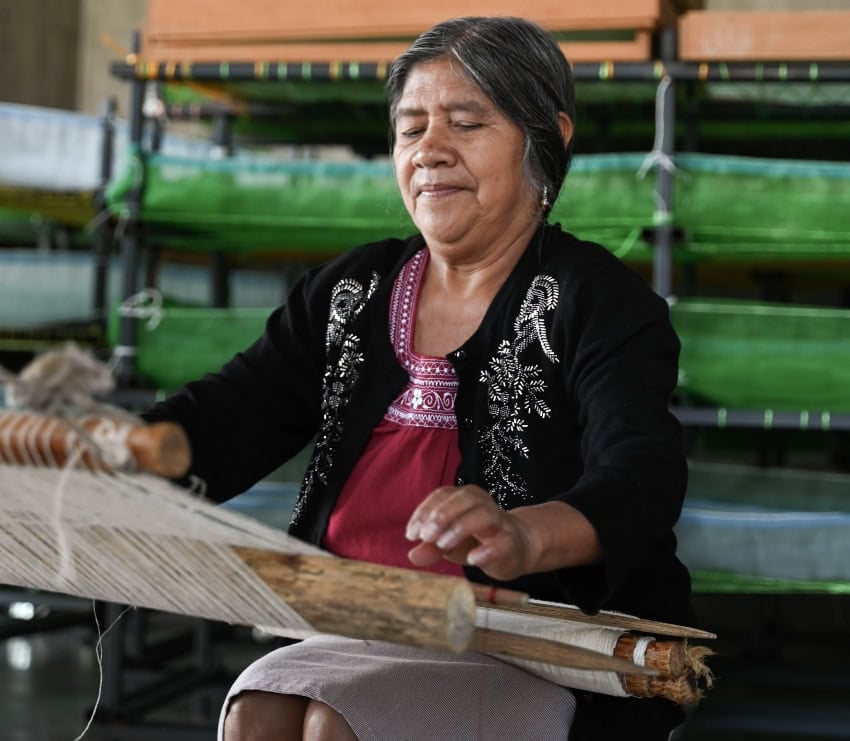
The sanctuary serves as a multifunctional space containing dedicated rooms for silkworm cultivation, a spinning workshop and a museum. This includes a display area for historical artifacts used by ancestors and a section dedicated to the initial stages of silk cultivation.
An intricate tapestry
The history of silk in San Pedro Cajonos is like an intricate tapestry. The community has carefully gathered the delicate strands that weave through their history, interlacing them with a modern infrastructure to create a fabric that is both resilient and beautiful. It is positive to see a revival that connects artisans with the wider world, keen to consume their products. It is also essential that platforms like the Silk Sanctuary and Yagaa celebrate the value of the history and artisanal work going forward.
Anna Bruce is an award-winning British photojournalist based in Oaxaca, Mexico. Just some of the media outlets she has worked with include Vice, The Financial Times, Time Out, Huffington Post, The Times of London, the BBC and Sony TV. Find out more about her work at her website or visit her on social media on Instagram or on Facebook.
