
Investors finally reacted this week with a wave of selling in response to Donald Trump’s expansionist ambitions in Greenland. They had remained almost unfazed by the military attack on Caracas and the arrest of Nicolás Maduro, or the threat of intervention in Iran, but the White House’s determination to annex Greenland and the announcement of tariffs on European countries that had deployed troops to the island proved to be the trigger for selling off U.S. assets. Trump’s policies were once again setting off alarm bells in the markets, with decisions that could not only bring geopolitical tension but also tangible effects on economic growth, inflation—with a further tightening of tariffs—and corporate profits. A Danish pension fund epitomized these concerns and, in a move that was part retaliation and part financial strategy, announced on Tuesday that it was divesting its entire portfolio of U.S. sovereign debt.
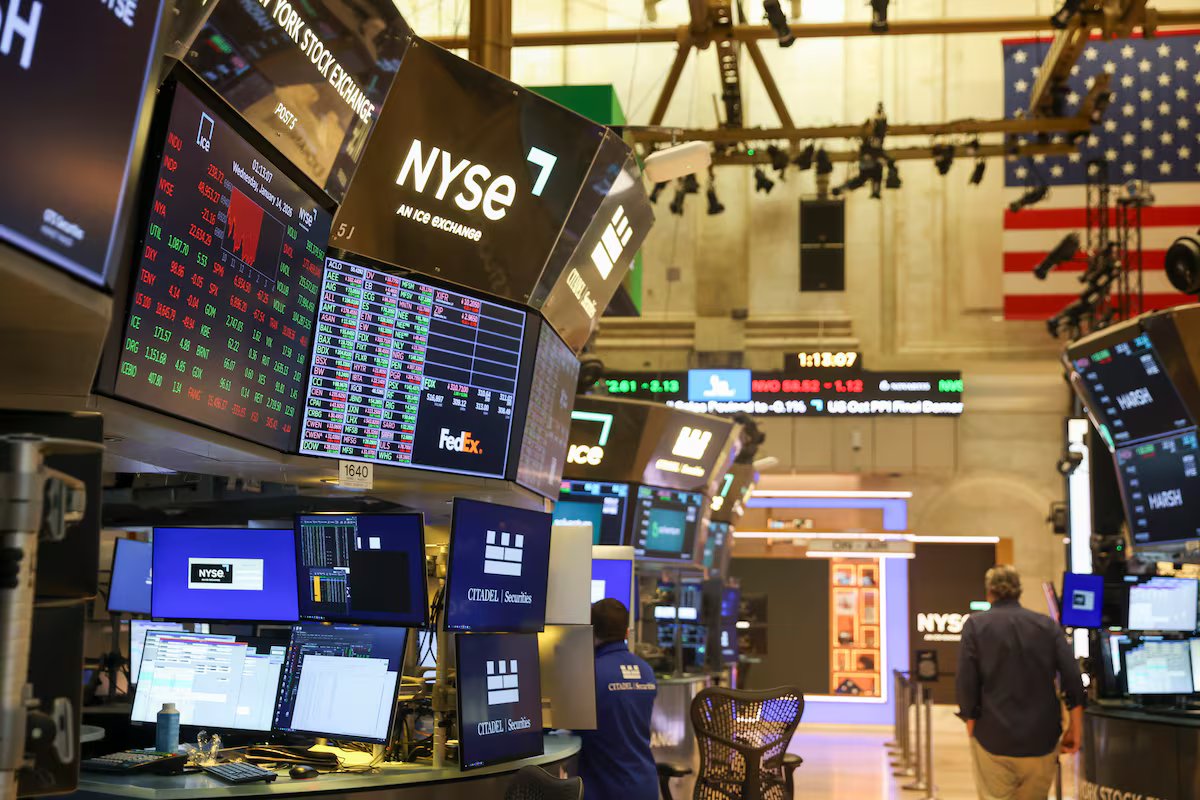
The selling spree was widespread but focused on U.S. assets, which never proved to be a safe haven: the dollar depreciated, the S&P 500 index fell 2.1%, the 10-year Treasury bond yield exceeded 4.3%, and the 30-year Treasury yield climbed dangerously close to 5%. The “Sell America” slogan was once again being used, as it was last April with the declaration of a trade war against the world. Investors were once again taking note that Trump’s new world order, with its use of tariffs as a deterrent—when not outright force—has far-reaching economic consequences. Now, the U.S. president has just crossed another red line by suing the country’s largest bank, JP Morgan, which could further undermine investor confidence. He is accusing the institution and its head, Jamie Dimon, of withdrawing financial services for political reasons after the storming of the Capitol in January 2021. Trump is attacking the very heart of Wall Street and one of its top representatives, who had recently warned of the risks of political interference in the Federal Reserve.
The trade war last April marked the beginning of a turning point in international investors’ views of the U.S., triggering a diversification movement that reduced exposure to the dollar, U.S. sovereign bonds, and, to a lesser extent, Wall Street. At the start of this year, the Greenland crisis was compounded by the criminal investigation into Jerome Powell, further fueling the sell-off. And the possibility, albeit unlikely, arose that Europe might use the sale of sovereign debt as a weapon against Trump, as suggested in a controversial report by a Deutsche Bank analyst.
But beyond these upheavals, a more structural trend underlies the prevailing principle of American exceptionalism—with the U.S. as the unrivaled investment destination—and it is clearly reflected in the dollar’s depreciation, which has exceeded 11% against the euro in the last year. The United States is now a country questioning international law and its own institutions, starting with the Fed, which shows no intention of correcting a high deficit hovering around 6%, leading to growing distrust of the U.S. as a safe haven for investment. This fiscal imbalance is, in fact, the Achilles’ heel of the U.S. economy and the irrefutable argument, from a financial perspective, for why some asset managers are already admitting to selling U.S. sovereign bonds and diversifying beyond America.
“As an investor, you will be dealing with an economy with a higher deficit in the coming years, along with more debt and a worse credit profile after the three rating agencies withdrew the U.S.’s AAA rating. It’s a worrying issue,” says David Ardura, investment director at Finaccess Value, who says he does not hold any U.S. sovereign debt in his portfolio.
The logic is simple: if the U.S. insists on imposing tariffs and pressuring the Fed to lower interest rates, the result will be more inflation. This is already being said out loud by heavyweights in the U.S. financial industry. “While at first glance it may seem tempting to influence the Fed to lower interest rates… an aggressive reduction in the face of strong growth and high inflation will likely lead to higher long-term rates,” Pimco’s chief investment officer, Dan Ivascyn, recently noted. And with higher interest rates, it will be much more difficult to refinance the $10 trillion of U.S. government debt maturing this year, much of it short-term.
In revealing statements to the Financial Times, Ivascyn acknowledged that the world’s largest fixed-income manager is selling U.S. assets and diversifying into other markets, a move that will last for several years given Donald Trump’s “unpredictable policies.” This week, Bon Michele, head of fixed income at JP Morgan’s fixed-income asset manager, suggested that the recent market reaction is a message to Trump. Investors vividly remember how the U.S. president yielded to financial pressure—with the 30-year U.S. Treasury bond yield soaring to 5%—and announced a 90-day truce in his trade war.
Pressure on U.S. bonds eased after Trump announced a preliminary agreement on Greenland within the NATO framework and withdrew his threat of tariffs. Without knowing the details yet, investors reacted with relief, although the strategy of diversifying beyond the U.S. continues to gain traction. “Investment diversification is underway and has accelerated with the Greenland crisis, although not in a disruptive way or for political reasons. Diversifying makes sense, although it is also difficult for investors to forgo U.S. business innovation and growth, and the depth of its market,” explains Nicolas Véron, senior fellow at the Bruegel Institute and the Peterson Institute for International Economics. In fact, investment flow data barely reveal a shift away from U.S. assets, despite the waves of selling that occur in response to Trump’s bold moves. Thus, investors have become accustomed to buying on every stock market dip, fueling a steady recovery that keeps the indices at continuous highs. “Everyone is wondering how the dollar will withstand its role as a safe-haven currency in the face of the deterioration of institutions, the Federal Reserve, and democracy in the U.S., even though a breaking point has not yet been reached,” Véron points out.
Data collected by the U.S. Treasury Department on foreign investors’ acquisition of U.S. assets shows that last April, coinciding with the trade war, there were net sales of $66.9 billion, but in May, net purchases continued at a record $317 billion. The balance between April and November, the last month with available data, shows a cumulative volume of net purchases of U.S. assets by foreign investors of $934.928 billion. This inflow of money was led by private investors but was offset by net sales from public investors, such as governments and pension funds, with withdrawals of $30.407 billion.
Changes in foreign investment
This latter figure is small but aligns with the conclusions drawn from the analysis of the U.S. financial accounts, which comprises the balance of payments, along with the current and capital accounts. As Judit Arnal, senior researcher for Economics at the Elcano Royal Institute, explains, “Foreign investors are increasing their financial exposure to U.S. assets, without a corresponding increase, for now, in their commitment to productive investments that involve corporate control.” Thus, portfolio investment, which is more liquid and financial in nature, increased sharply in 2025, with average quarterly inflows rising from $76.474 billion in 2024 to $164.290 billion in 2025, an increase of 114.8%. These inflows reflect investors’ appetite for risk and the interest generated by U.S. listed companies, which is driving Wall Street into an unstoppable upward trend to record highs.
In contrast, foreign direct investment (FDI)—strategic and long-term—entering the United States has shown a very different trend, stagnating during 2025. “The United States is attracting financial capital in search of profitability, but not necessarily, at least in the short term, long-term productive investment associated with capacity expansion or direct employment,” adds the expert from the Elcano Institute.
In the very short term, with the midterm elections in November, Trump will have powerful reasons this year not to push his policies to the limit and to secure investor favor. “The financial market reaction was what forced the swift reversal of the Liberation Day tariffs, and one could argue that, in an election year, that kind of reversal is even more likely if there are major sell-offs in the market,” explains Derek Halpenny, head of global market analysis at the Japanese bank MUFG.
In contrast, looking to the long term, investors will have to adapt to what Yves Bonzon, chief investment officer at Julius Baer, calls state capitalism, which Trump exemplifies in his decisions to impose tariffs, cap credit card interest rates, and ban dividend payments and stock buybacks from defense companies until they increase their investments in production capacity. “Once government intervention begins to disrupt supply and demand balances and interferes with the allocation of resources in the economy, previously guided by efficiency principles, there is no turning back. Distortions in the system will only increase over time. It is unlikely that the world will return to the order we have known in our lifetimes,” he asserts.
Sign up for our weekly newsletter to get more English-language news coverage from EL PAÍS USA Edition
