
President Claudia Sheinbaum said Wednesday that she has a “plan B” in mind if her electoral reform proposal isn’t approved by Congress, an acknowledgement that the ruling Morena party’s allies might not support the bill.
Unveiled by the federal government last week, the reform proposal, if approved, would reduce the number of federal senators from 128 to 96 by eliminating those elected via proportional representation based on their party’s share of the national vote.
Among other objectives, it aims to obligate candidates seeking to become plurinominal (proportional representation) federal deputies to appear on ballots, allowing voters to directly elect them.
Morena’s allies, the Labor Party (PT) and the Green Party (PVEM), appear unlikely to support the constitutional reform bill in its current form, as they believe that the proposed changes to Mexico’s proportional representation system are not in their interest.
The proposal won’t pass Congress without the votes of PT and PVEM lawmakers, as constitutional bills require two-thirds support in both houses of Congress in order to become law. On its own, Morena has a simple majority in both the Chamber of Deputies and the Senate, but it doesn’t have a two-thirds majority in either house of Congress.
The electoral reform bill is set to be submitted to Congress on Wednesday. Mexico’s next federal election will be held in June 2027, when voters will renew the 500-seat Chamber of Deputies.
‘Plan B’
At her Wednesday morning press conference, Sheinbaum was asked whether she had thought of a “plan B” in case her reform proposal doesn’t receive the two-thirds support required to pass Congress.
“Yes, but that would be later. … Let’s not get ahead of ourselves,” the president said.
Sheinbaum subsequently offered an explanation as to why “people don’t like the plurinominal lists,” which include the names of candidates that political parties have chosen to represent them as proportional representation lawmakers. In past elections, these candidates’ names have not appeared on ballots.
Sheinbaum asserted that people don’t like plurinominal lawmakers “because they are representatives of parties.”
“One can vote for a political party, but the representative has to be elected by the people, not by the leaders of a political party,” she said.
“… Democracy is the power of the people, the representation of the people. … So that there is no doubt, we are not eliminating the proportional representation of parties. We’re recognizing the political diversity of Mexico, there just won’t be lists [of lawmakers] defined by a few people,” Sheinbaum said.
“… Those who want the vote [of citizens in order to become deputies] have to campaign,” she said. “They have to go and ask for people’s votes.”
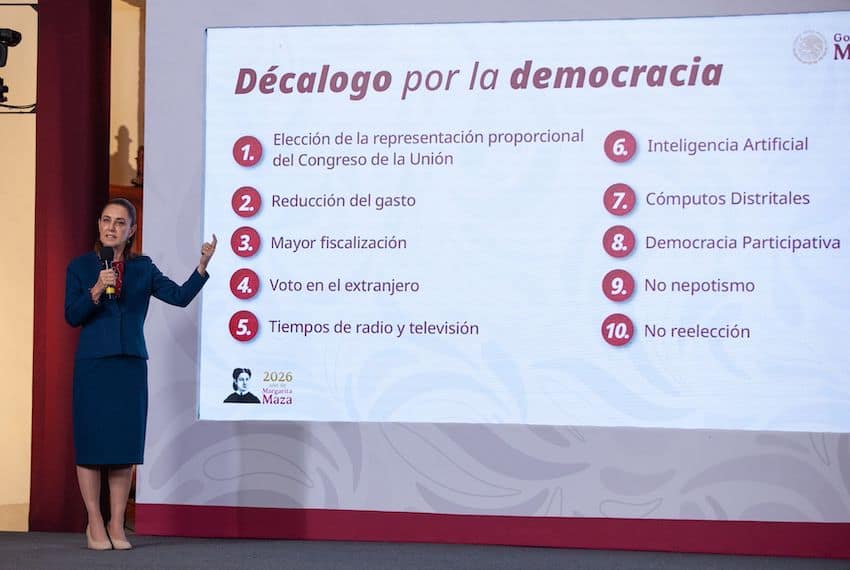
Earlier in the press conference, the president presented what she called a “decalogue for democracy,” which includes the 10 objectives of the proposed electoral reform, among which are to reduce spending on elections, increase oversight of parties’ funding and use of resources, and facilitate the voting process for Mexicans abroad.
By submitting the proposal to Congress, Sheinbaum said she is fulfilling her commitment to the people of Mexico. Indeed, one of the 100 commitments she set out in a speech on the day she was sworn in as president is to “reform the electoral system.”
“I’m fulfilling [my commitment],” the president told reporters on Wednesday morning.
“Whether [the reform proposal] is approved now depends on the deputies or the Senate,” Sheinbaum said.
She rejected what she called “this idea” that the president is going to suffer “her first defeat” at the hands of federal lawmakers.
“For me, it’s a victory because I’m presenting a proposal that the people asked me to present,” Sheinbaum said, adding that lawmakers who support the bill, and those who don’t, “will be seen by the people.”
Parties’ survival instinct kicks in
If the PT and the PVEM vote against Sheinbaum’s electoral reform proposal, it will be the first time that they oppose a legislative initiative supported by Morena since they entered into an alliance with the ruling party.
Morena’s leader in the lower house, Ricardo Monreal, has acknowledged that the party has work to do to convince the PT and PVEM to support the bill. Both parties have benefited from the proportional representation electoral system in its current form. The PVEM is currently the third largest party in the Chamber of Deputies and the Senate, while the PT is the fourth largest party in the lower house and the fifth largest in the upper house.
In addition to opposing the proposed changes to the way the proportional representation system works, the Morena allies have also expressed reservations about the plan to cut electoral funding, including the public money allocated to political parties.
Juan Pablo Navarrete, a political scientist at the University of La Ciénaga in Michoacán, said that neither the PT or the PVEM are willing to support the bill because it seeks to change an electoral system that has allowed them to grow.
Sheinbaum’s proposal “goes against the very nature [of the electoral system] that has allowed their electoral survival,” he told the political podcast of media outlet Expansión.
Therefore, supporting the electoral reform proposal “would be like opposing their own survival strategies,” Navarrete said.
Paula Sofía Vázquez, a lawyer and political analyst, told Expansión that the approval of the reform would lead to the PT and the PVEM losing their capacity to veto constitutional reform proposals supported by Morena.
She claimed that the elimination of plurinominal senators, and the election of plurinominal deputies via a direct vote rather than party lists, would lead to a situation in which “the majority party” — i.e., Morena — “eventually won’t need” its minor party allies to get constitutional reforms through Congress.
“It’s a reform that is eventually condemning you to extinction or to competition [with the ruling party],” Vázquez said.
For her part, Sheinbaum has asserted on repeated occasions that the intention of the reform is not to create a “state party” or “single party” via the creation of a new electoral system that leads to a weakening of opposition parties and smaller parties allied with Morena.
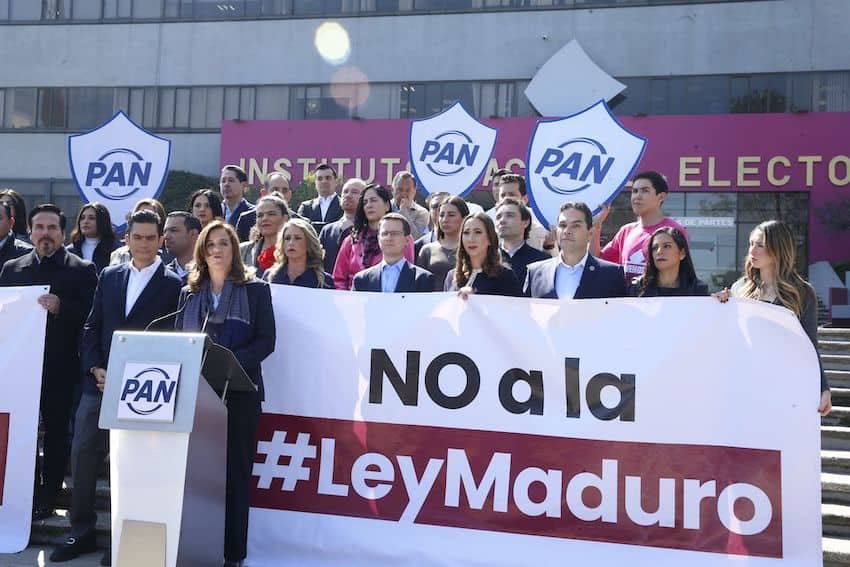
Mexico’s main opposition party, the conservative National Action Party (PAN), is also opposed to Sheinbaum’s electoral reform proposal, as is the Institutional Revolutionary Party (PRI), which ruled Mexico for most of the 20th century in what was essentially a one-party state.
The PAN governed Mexico between 2000 and 2012, while the PRI returned to power at the end of the latter year and remained in office until 2018.
Morena was swept to power after Andrés Manuel López Obrador (AMLO) won a landslide victory in the 2018 presidential election. Both the PAN and the PRI were consequently relegated to far less prominent positions on the national political stage.
In the 2024 elections, Sheinbaum surpassed AMLO’s popularity by winning an even higher percentage of the popular vote, while Morena improved its position in both houses of Congress.
With reports from El Universal, Reforma and Expansión
