
To the beat of son jarocho, huapango and zapateado, activists from across the country gathered at Mexico City’s Alameda Central on Friday to demand that President Claudia Sheinbaum keep her campaign promise to ban hydraulic fracturing, or “fracking” — and to launch what organizers are calling a new phase of national resistance.
The “Fandango por la vida” — organized by the Alianza Mexicana Contra El Fracking, a coalition of more than 40 civil society organizations — drew an animated crowd of environmental, feminist, water defense and human rights activists. They were joined by representatives of communities in Veracruz’s Huasteca region, San Luis Potosí and Coahuila, many of them already living with the consequences of conventional oil extraction near their homes and water sources. Meanwhile, other actions over the weekend in the states of San Luis Potosí, Veracruz and Nuevo León drew at least 500.
The problem with fracking
“Neither in Mexico nor anywhere in the world does sustainable fracking exist,” said Alejandra Jiménez, a member of the Alianza. “Let them go and smell it, let them go and see what life is like in territories that have already been impacted by hydrocarbons and fracking. Let them drink a glass of water like the ones our compañeros have to drink every single day.”
Demonstrators also called on Congress to act on a constitutional fracking prohibition initiative presented in October 2025 that has stalled without debate. The event served as a call to a National Mobilization Against Fracking, set for June 5.
The protest was the most visible sign yet of an expanding opposition movement that has gathered force since Sheinbaum’s government announced on April 8 that it was exploring the possibility of extracting natural gas from non-conventional shale deposits using hydraulic fracturing — a practice she had promised during her campaign not to pursue.
The backdrop of the protests
The Alianza itself is not new to this fight. It was founded in 2013, when Congress was debating the constitutional energy reform that opened the legal framework for fracking in Mexico. “We have more than 10 years in this struggle,” said Arely Sandoval of Espacio DESCA, one of the Alianza’s member organizations. “This is not something we are doing now because the government made an announcement.”
The backdrop to the Friday protest, and similar ones in Veracruz and Nuevo León, is a government decision that has unsettled even some of Sheinbaum’s own supporters. On April 8, her administration announced it was exploring hydraulic fracturing to meet Mexico’s growing natural gas needs — and on April 15, it formalized a commission of 17 academics from the National Autonomous University of Mexico (UNAM), the National Polytechnical Institute (IPN) and other institutions to evaluate the proposal. Sheinbaum herself acknowledged the reversal at that event.

“I myself said no to fracking for many years,” she told reporters, “but when I see the new technologies, the situation of the country in terms of dependence, the worst thing we can say is no.” The commission is expected to deliver its first findings within approximately two months from that announcement, or sometime in June.
The lead-up
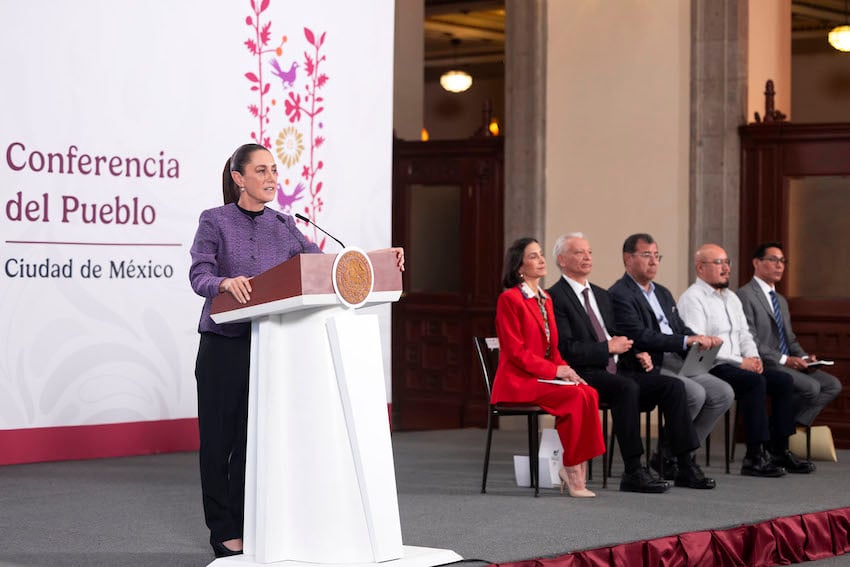
At the April 8 press conference, Energy Secretary Luz Elena González Escobar had said that Mexico’s dependence on imported gas had become a strategic vulnerability. “Today Mexico faces a high dependence on natural gas from abroad,” she said. “We are importing 75% of the natural gas we consume in the country.”
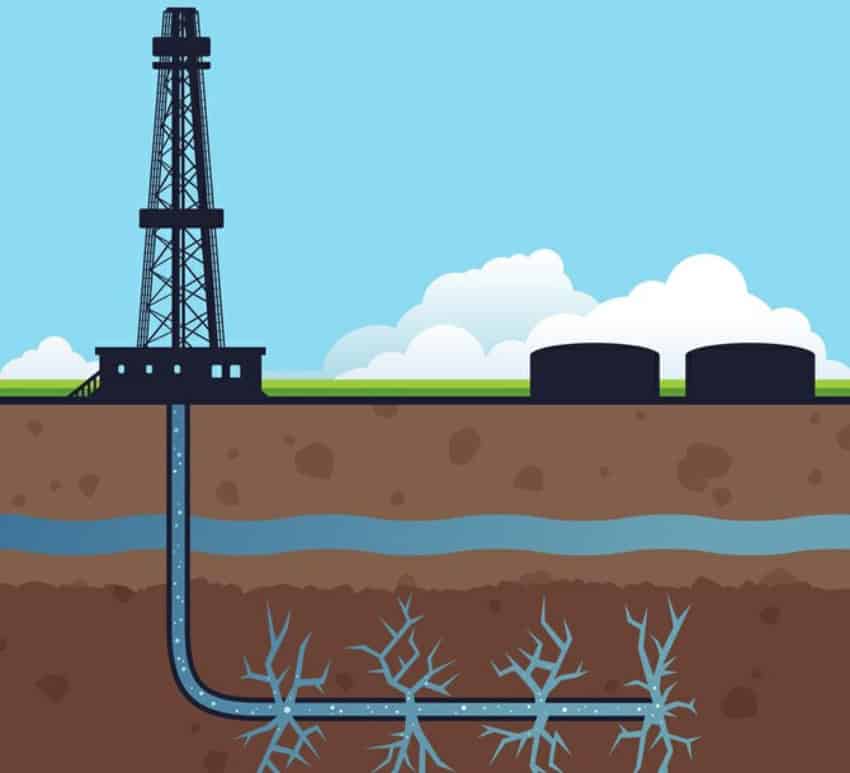
She argued that new technology had changed the equation, saying there is now “important technological development worldwide that allows extraction to be done efficiently, caring for the soil, the aquifers and with efficient water use — water that is not used for human consumption, it is connate water that comes from the deposits themselves.”
Pemex director Víctor Rodríguez Padilla went further on the safety question. “These developments are not superficial,” he said. “We are talking about depths greater than 4,000 meters of rock, such that contamination of aquifers … does not occur.”
An academic opposition emerges
Three days before the Fandango, on May 5, a parallel group of scientists, researchers and community organizations held their own all-day forum at UNAM’s Faculty of Economics — a deliberate counterpoint to the official commission — and reached a starkly different set of conclusions.
Luca Ferrari, a geologist at UNAM’s Institute of Geosciences who co-led the previous administration’s energy research program and is himself a member of the government’s commission, said Mexico’s shale gas reserves would require “at a minimum around 250 new wells every year” to meet the government’s 2035 production targets for the targeted northwestern region alone. Those reserves, he argued, would likely be commercially exhausted within a decade.
“I believe that fracking is not in Mexico’s best interest … it carries a high economic and environmental cost and would merely postpone the problem of decline on a temporary basis.”
He pushed to broaden its membership, and said the commission has since grown to nearly 50 members, now including environmental and social impact specialists. Still, Ferrari warned that if dissenting members’ findings are not reflected in the final report, “we can also step out and publish it separately.”
Water
The water question drew some of the sharpest disagreements with the government’s position. Manuel Llano of the geographic information project Cartocrítica presented calculations showing that fully developing Mexico’s prospective shale resources could require up to 470 billion liters of water — equivalent, he said, to 47 million tanker trucks — drawn largely from aquifers in regions that are already critically stressed. “The question is, where are they going to get it?” he said. “In other words, who are they going to take it from? Who is going to be left without water?”
Engineer Beatriz Olivera Villa, who coordinates the civil society organization Energía, Género y Ambiente, took on the cost argument. In a moderate development scenario of 3,500 wells across all of Mexico’s shale basins, she calculated the investment required at between US $42 and $63 billion — several times Pemex’s entire annual operations budget of roughly US $13 to $14 billion. “We’re not talking about small costs,” she said, “but about very, very large investments.”
The world’s most indebted oil company, she argued, cannot self-finance such a program, making the entry of U.S. private capital not an ideological question but a structural inevitability. The industry, she noted, has been open about this: fracking promoters have called publicly for international partners “with experience and capital” and for fiscal incentives, because “of course it’s going to be very expensive.”
Ceding decision-making power to the US
Economist José Romero Tellaeche, former director of the Centro de Investigación y Docencia Económicas (CIDE), framed the sovereignty argument in the starkest terms. “Mexico can produce more gas and still end up deciding less,” he said, or having less control over the resource. “That is the paradox of the fracking debate that no one wants to name.” Producing gas with U.S. capital, U.S. technology and U.S. service companies operating just across the border would not reduce Mexico’s dependence, he argued — it would reorganize it. “When that capacity depends on external capital, external technology, external equipment and profitability criteria defined outside the Mexican state,” he said, “sovereignty is reduced to a legal fiction. The resource may be in Mexico, but the decision-making power could be somewhere else.”
Mexico News Daily sought comment from Pemex; the company provided a transcript of the April 8 press conference but did not respond to specific questions.
Condemning the population to water scarcity
Opposition has been building since the April 8 announcement. Within days, more than 80 organizations signed a letter to Sheinbaum arguing that sustainable fracking “may sound promising in the discourse, but in practice does not exist.” On April 16, Indigenous community representatives delivered more than 3,000 signatures and formal assembly resolutions rejecting fracking to the Chamber of Deputies, where protesters gathered outside. In Oaxaca, 30 organizations and 55 communities held their own forum, calling the practice part of a neocolonial logic of territorial dispossession. More than 35 organizations mobilized in Coahuila, one of the states most directly targeted for extraction.
At Friday’s Mexico City demonstration, Romualdo García de Luna from the community of Ojital Viejo in Papantla, Veracruz — a region with some 2,500 existing oil wells — offered a blunt summary of communities’ experience with the industry’s promises. “What they told us was progress,” he said, “has been massive destruction for us.” Leslie Sánchez of the collectives Coahuila Sin Fracking and Noreste Sin Fracking warned that dedicating millions of liters of water to fracking in water-stressed states would “condemn the population to scarcity.”
What’s next?
The June 5 national mobilization is timed deliberately — on World Environment Day, and approximately ten days before the two-month window Sheinbaum set when she announced the commission — as a pressure tactic. “We wanted to get ahead of that deadline,” Jiménez said, “and come out on the 5th to pressure the commission to act properly and not present a simulation.”
Tracy L. Barnett is a Guadalajara-based freelance writer and the founder of The Esperanza Project.
