
– BERLINALE 2026: From the controversy sparked by the jury’s statements to the parallel celebration of the Palinale, this year’s festival is marked by politics
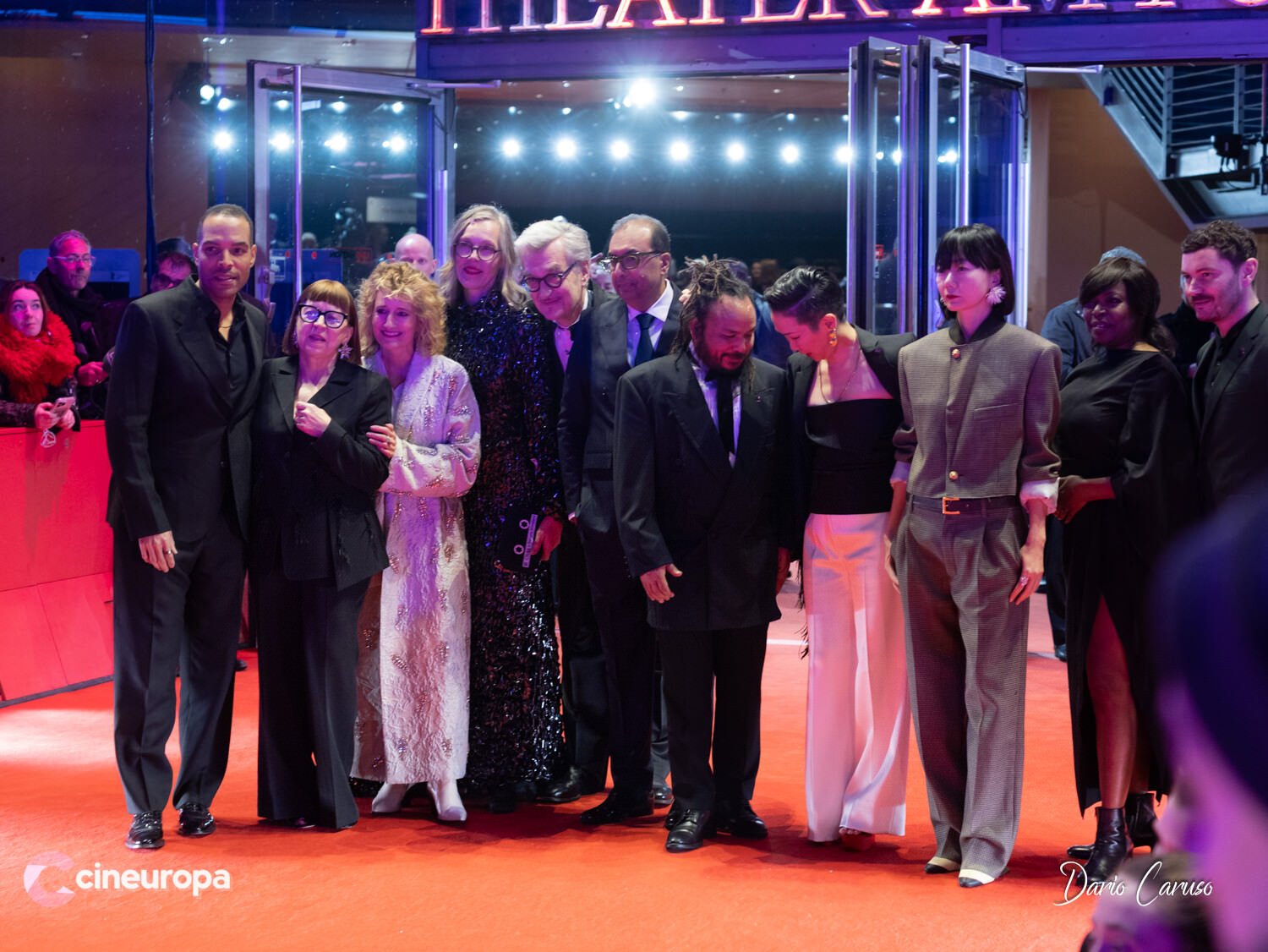
Berlinale festival director Tricia Tuttle and the jury led by Wim Wenders at the opening ceremony (© 2026 Dario Caruso for Cineuropa – dario-caruso.fr, @studio.photo.dar, Dario Caruso)
The 76th Berlinale‘s opening jury press conference sparked controversy when German journalist Tilo Jung mentioned the previous statements of solidarity with filmmakers in Iran and Ukraine by the festival, and asked the jury whether they endorsed this “selective treatment of human rights,” in reference to Gaza and German support to Israel. The livestream feed cut out for the duration of the specific Q&A that followed. Citing a technical fault, Berlinale later posted the full recording. Jury president Wim Wenders responded: “We have to stay out of politics because if we make movies that are dedicatedly political, we enter the field of politics. But we are the counterweight of politics, we are the opposite of politics. We have to do the work of people, not the work of politicians.” Festival director Tricia Tuttle intervened to redirect the discussion toward cinema, a move many observers read as an attempt to shut down the exchange.
It was at the 30th anniversary of the European Film Academy, in 2017, that Wim Wenders gave an emotional – and unapologetically political – speech about the power of cinema (watch here). In angst at the rise of nationalism across Europe, he declared: “We have a common responsibility in Europe, for Europe, a responsibility beyond our national borders. We, the film community, the film family, are in a perfect position to make the difference. With our stories, our imagination, our sounds and images, we carry a greater responsibility than ever.” It seems that the film community should and could make the difference – but what about Gaza?
Immediately after, Booker Prize-winning author Arundhati Roy, who had been due to attend the Berlinale Classics screening of In Which Annie Gives It Those Ones, written by herself and directed by Pradip Krishen, announced her full withdrawal from the festival. “To hear them say that art should not be political is jaw-dropping. It is a way of shutting down a conversation about a crime against humanity even as it unfolds before us in real time. I am shocked and disgusted.” She described the situation in Gaza as “a genocide of the Palestinian people by the State of Israel.” A position welcomed by Ezzaldeen Shalh, president of the Gaza International Women’s Film Festival (read news), who praised Roy’s withdrawal as a decisive moral stance in the face of troubling cultural complicity: she exposed the duplicity of cultural institutions that claim to defend freedom of expression while refusing to condemn the genocide in Gaza, and stressed that art cannot be separated from political reality when the lives of peoples and their fundamental rights are at stake.
Festival director Tricia Tuttle published a lengthy statement titled ‘On Speaking, Cinema and Politics’ (read here). “We do not believe there is a filmmaker screening in this festival who is indifferent to… the immense suffering of people in Gaza and the West Bank, in the Democratic Republic of the Congo, in Sudan, in Iran, in Ukraine, in Minneapolis, and in a terrifying number of places.” The statement insisted that “artists should not be expected to speak on every political issue raised to them.” Critics found this difficult to reconcile with reports that filmmakers who had spoken out for Palestine from the Berlinale stage in previous years had been reprimanded by festival programmers.
As a consequence, an open letter signed by 81 film workers, past or current Berlinale participants, accused the festival of censoring artists who oppose Israel’s ongoing genocide against Palestinians in Gaza and the German state’s key role in enabling it. “We fervently disagree with the statement made by Berlinale 2026 jury president Wim Wenders that filmmaking is ‘the opposite of politics’. You cannot separate one from the other,” the letter reads, before calling on the Berlinale to “clearly state its opposition to Israel’s genocide, crimes against humanity and war crimes against Palestinians, and completely end its involvement in shielding Israel from criticism and calls for accountability.” Tilda Swinton, Javier Bardem, Mike Leigh, Brian Cox, Nan Goldin, Lukas Dhont, Avi Mograbi, Miguel Gomes and Saleh Bakri are among the signatories.
Meanwhile, running in parallel to the Berlinale, from 12 to 22 February, the Palinale offers a deliberate counter-programme: a film festival born out of what its organisers describe as the urgent need to resist the repression of Palestine solidarity in Germany and the silence and complicity of many cultural institutions in the ongoing genocide. The programme includes 70 events across 18 venues with more than 60 films from 20 countries, centring Palestinian and Global South voices. Responding directly to Wenders’ claim that cinema is “the opposite of politics,” the Palinale posted a simple rejoinder on Instagram: “Art is political.”
For many in the film community, the question is no longer whether cinema is political – it is which politics the Berlinale is willing to endorse and which it chooses to suppress. In the words of George Orwell, “the opinion that art should have nothing to do with politics is itself a political attitude.”
