
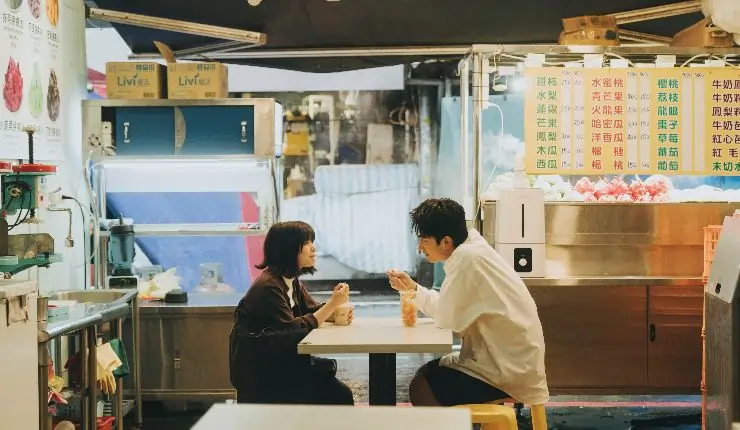
Death is inevitable; the ones we love will eventually pass away, hopefully on their own terms. Yet when we lose someone dear to us, it leaves a void in our hearts, a void that takes time not so much to heal as to learn to live alongside. Sinsin and the Mouse explores this experience of loss through Chizumi Mitsuoka, a young Japanese girl who, three months after her mother’s death, embarks on a trip to Teipai that gradually helps her open up and rediscover life. It’s a beautifully told narrative about grief, resilience, and the quiet ways hope can take root even in the darkest moments.
As mentioned, we follow this tale through Chizumi Mitsuko (Yukino Kishii), who sacrificed everything to care for her sick mother, quitting her job and becoming her full-time carer. When her mother dies, Chizumi’s life is thrown into turmoil, leaving her alone in a house that only reminds her of her loss. So, when a friend invites her to Teipai, she accepts. There, she meets a young man named Shingo Tagawa (Tseng Jing-hua), known as Sinsin, and the two form a tentative friendship that may help Chizumi come to terms with her grief.
Rarely has a film captured the emptiness that loss creates, the way once-flavourful foods become stale and bland, resembling cardboard. Early on, we see Chizumi eat a slice of toast slathered in butter, but after one bite, her expression says everything. For her, the toast has lost all flavour. Throughout Sinsin and the Mouse, this emptiness lingers, reflected in Chizumi herself: a shell of who she once was, drained of life and spirit. In a way, she is a mouse in a vast world, small, easily overlooked, and seemingly insignificant.
The film conveys this narrative beautifully through contextual clues rather than spelling everything out for the audience. Whether it’s Chizumi having to pay a holding fee for dry cleaning that has been in storage for over three months, or the contrast between her bright, cheerful self before the loss and the hollow version of her afterwards, the storytelling remains subtle yet powerful. Without Yukino Kishii’s remarkable performance, the film would lose much of its emotional weight. To contrast Chizumi, there is Sinsin. Although he carries his own emotional burden, he becomes a bright light in Chizumi’s life at the moment she needs it most.
When she feels insignificant and small, Sinsin shows her that she is not, that her life still has purpose beyond her mother’s death. Sinsin often speaks in metaphors throughout the film, and this is where Sinsin and the Mouse falters slightly. While many of these moments are powerful and contemplative, one is rather bizarre and delves into a subject that appears out of nowhere compared with the rest of the film. Even so, Sinsin’s presence allows the story to sidestep familiar romance tropes. Sinsin and the Mouse ultimately feels like a film about falling back in love with life, rather than with another person.
Yukinori Makabe’s previous film, Love, Life and Goldfish, showcased a filmmaker with clear potential, and Sinsin and the Mouse is a genuine step up in quality. Without his confident direction, many of the film’s themes would struggle to resonate, and the way he moves back and forth in time without ever confusing the audience is remarkable. However, the most striking improvement is the cinematography. Working alongside cinematographer Wayne Lo, the film uses the 4:3 aspect ratio to utter perfection, creating a claustrophobic and isolating image that allows us to feel just as small as Chizumi does.
Sinsin and the Mouse is a thematically rich and beautifully told story about loss and the process of falling back in love with life and the world around us. Featuring incredible performances, strong direction, and exquisite presentation. The film resonated deeply with me, prompting reflection on my own experiences with loss and everything that came with it, a genuinely splendid work.
★★★★
Played as part of 2026 Glasgow Film Festival / Yukino Kishii, Tseng Jing-Hua, Kisetsu Fujiwara, Seina Nakata / Dir: Yukinori Makabe / 12
Related
Discover more from
Subscribe to get the latest posts sent to your email.
