
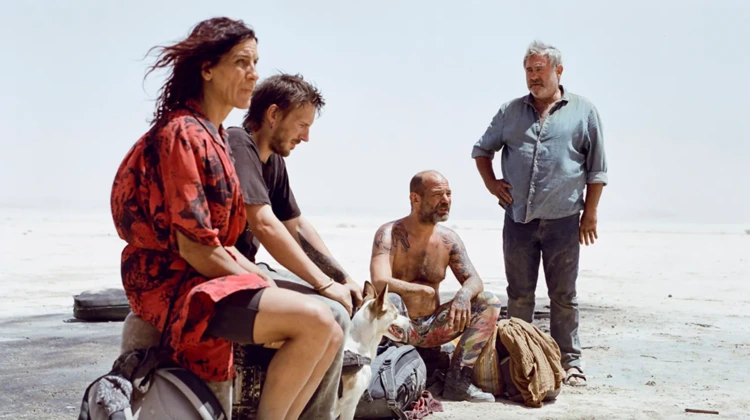
Pounding heart line of the techno beats. Glowing, inked bodies moving within the base. Smiles of content and full freedom spread through the crowd like the sun’s rays. The sands of the desert whisk around from the hundreds of stomping, gliding feet. Total freedom, complete celebration of life for us to be immediately immersed in. In between the dancing, free-spirited rave goers, a father and son thread in and out in search of a long-lost, sorely-missed family member, to no immediate avail. Once there is word that his daughter may be residing in an upcoming rave in another location, the father locks down on joining a group of ravers planning the trip. Despite constant warnings, the road will be virtually impossible for his smaller, town-built vehicle. This is a father who won’t take no for an answer, who will see his goal to the end, no matter the cost
Sirât’s opening scene is introduced alongside a key description and explanation of its title’s place. “There is a bridge called SIRÄT that links hell and paradise. Whoever crosses it is warned that it is narrower than a strand of hair, sharper than a sword.”
Director Óliver Laxe throws all trust in the sound design and visual composition in his quest to display this narrow bridge between Heaven and Hell. Sirât’s story centres around a man named Luis and his son Esteban as they commit to a search for their daughter/sister Mar in the deserts of Morocco, using a series of raves as their red thread. They cross paths with a chosen family of ravers heading to the next potential rave Mar could be at, embarking on a journey through their very own Sirât. Laxe directs a screenplay he co-wrote with Santiago Fillol, directing a stellar cast of Sergi López, Bruno Núñez Arjona, Richard Bellamy, Stefania Gadda, Joshua Liam Henderson, Tonin Janvier, and Jade Oukid.
The film has generated keen award buzz and recognition, taking home the jury prize at the 78th Cannes Film Festival, signalling it achieved critics’ search for “an original work that embodies the spirit of inquiry.” Sirât has also earned an Academy Award nomination for Best International Feature. So what is it about this journey in the desert that’s appearing so captivating and praise-worthy?
As aforementioned, a stand-out component of Sirât’s design and effect is its masterful use of sound, focusing on portraying the atmosphere of rave culture in the desert. The film’s sound is far from just simply decorative and tossed over as a lastly dealt with, surface-level glaze. It’s a prime signifier and deliverer of Sirât’s emotional mass. The sound is consistent and pivotal in its extra role as leading the camera. The score expands with booming base drops to illustrate comparative shots of the huge raver trucks and Luis’s smaller car driving in the vast sands. It also drops and intensifies to signal both route and goal changes throughout the characters’ shared journey. In the opening, Luis’s and Esteban’s dialogue exchanges fade in and out as the speaker’s techno beats overpower, omitting their next stages of scoping the rave for Mar, which can become lost in the overall gathering and celebration of music.
Sirât’s sound is rightfully on the receiving end of non-stop praise, earning the film an additional Oscar nomination for Best Sound at the 98th Academy Awards. It has also made history by presenting the first all-women team to be nominated for the award, thanks to the shared efforts and talents of Amanda Villavieja, Laia Casanovas, and Yasmina Praderas. The immersive soundtrack was also created by French DJ and producer Kangding Ray, providing deep and powerfully gripping techno beats that swallow you whole in the most liberating way possible.
The camera work, provided by Laxe’s direction and by cinematographer Mauro Herce’s talents, is an additional powerhouse in Sirât’s construction. Taking place solely in North African deserts, the film captures the openness and endless possibilities yet pending presence of isolation in scaping, slow-tracking and dolly-out shots. The composition of camera movement is intoxicating and enthralling, slowly wrapping this landscape around you so nothing else can tug at your attention. Sound and camera work dazzle audiences in a tactful, spirited dance through Laze’s feature, taking centre stage.
Additionally, Luxe’s feature works interestingly at incorporating social-political contexts which resonate with our current world. While never explicitly stated or explored start to finish, there is a loosely addressed political undoing scattered throughout the central events like a phantom, delivered through radio sound, quick news segments displayed on occasional TV sets and brief shots of military action which kickstart the film’s intense action. Images of Moroccan locals desperately attempting to escape despite mass crowds and road traffic across borders fly past us as we accompany Luis, Esteban and the ravers when in need of fuel, disappearing once the journey continues.
Thanks to Cristóbal Fernández, Sirât also conjures up some amazing editing, which was unfortunately snubbed at the upcoming Oscars with no nods. Graphic match cuts and mirrored fading masterfully tie sequences and pivotal narrative stages together through the film, gelling swiftly with the score to provide a profound and unique cinematic experience.
When it comes to the performances of the ensemble cast, naturalism and consistent social realism thread everything together. There is no under-or overstriding in the acting in Sirât; these people feel as real and personalised as those who sit next to you in the cinema, basking in the emotional turning points alongside the characters we see directly experience them onscreen. We can feel the bond which forms between the father/son duo and the ravers over narrative, witnessing one chosen family slightly grow to take in a blood one to create something new.
Sirât bursts and sails as a prodigious kaleidoscope of emotion, pulling you along in the journey in which sometimes you glide through and other times you stagger with the characters. It is definitely one of 2026’s most memorable and effective cinematic experiences, utilising its expressive, immersive, signature creative elements of visuals, performances and sound to help prove that film can be and is an experience of various walks of life under one unified medium.
It takes an intriguing route of stressing the journey more than the ending destination, a narrative strategy that can read as divisive in handling and progression of subject matter, despite its objectively incredible work of visual and audio efforts. This is amplified when considering how easy it is to visualise how a mainstream, American attempt would lay out such a pulling narrative, working from tried and true, familiar cliches that leave audiences with something digestible and satisfactory in a conventional sense.
Nonetheless, Sirât is a work that will stick in your mind long after viewing, echoing how the techno base drums ring in your ears after a rave.
★★★★
In cinemas 27th March / Sergei López, Bruno Núñez, Richard Bellamy, Stefania Gadda, Joshua Liam Henderson, Toni Javier, Jade Oukid / Dir: Óliver Laxe/ Altitude / 15
Related
Discover more from
Subscribe to get the latest posts sent to your email.
