

It’s Thursday morning and Spain’s prime minister, Pedro Sánchez, 53, arrives at the Miró Room in La Moncloa, the seat of government, dressed in a blue suit and in good spirits. He seems eager to continue the fight. Neither the fierce legal pressure nor the withdrawal of parliamentary support by the Catalan separatist party Junts per Catalunya (Together for Catalonia), announced just an hour earlier, appear to have affected the Socialist Party (PSOE) leader. On the contrary, during the interview he affirmed that he will run again in the 2027 general elections, and even allowed himself a touch of sarcasm regarding the new memoir by Spain’s emeritus king Juan Carlos I: “I haven’t read it yet, but I’ll also tell you that it won’t be one of the books I recommend this Christmas, given what’s happened.”
Question. No prime minister has ever served an entire term without a budget, nor experienced a parliamentary deadlock like the one announced by Junts [whose support for the governing coalition is key to pass legislation inside the Congress of Deputies, where Junts has seven seats]. Is that sustainable?
Answer. First, parliamentary complexity is a result of the will of the people as expressed in the elections. Second, the only option for governance is the one that exists today with a progressive coalition holding a parliamentary minority. Third, this parliamentary complexity is not a problem; it is a reality in Europe, Spain, and Catalonia. Fourth, parliamentary complexity can be aligned with good governance. The economic and social data of the last seven years bear this out.
Q. And you haven’t considered calling elections to break the deadlock?
A. I insist, we are not in that situation right now. We are fulfilling our agreement. We have more than 40 legislative initiatives approved in Congress. On the issues that fall entirely within our jurisdiction, we have honored our pledges with Junts and the other parliamentary groups, and on those that do not, we are working to ensure compliance.
Q. You have spoken about the bid to make Catalan an official language in the European Union with the chancellor of Germany. Did he give you any assurances?
A. There is a dialogue process underway with the German government, and we have a clear, unequivocal, and total commitment to achieving the full normalization of the political situation in Catalonia. This government opted for pardons and the Amnesty Law [passed last year to acquit those who participated in the failed October 2017 breakaway bid led by Catalan separatists]. We are recognizing political actors who, after 2017, due to mistakes made by themselves and by others, placed themselves outside the political arena. We are very aware that there is a political crisis and conflict, which is why we reached the Brussels agreement with Junts, and we are prepared to honor it. Regarding the use of co-official, or rather constitutional, languages in EU institutions, it is part of our national identity, and I have explained this to the other member states. It is a debate that must take place sooner or later.
On the issues that fall entirely within our jurisdiction, we have honored our pledges with Junts
Q. Things may have become normalized in Catalonia, but elsewhere the mood is highly polarized, something that benefits the far right. Why is a policy of agreements with the [mainstream conservative] Popular Party (PP) not possible?
A. I agree that it is necessary to forge more agreements with the main opposition party. But reality is stubborn. For example, after the summer wildfires, I proposed a national pact to address the climate emergency, but what we saw is [PP national leader Alberto Núñez] Feijóo making deals with the far right to deny that very climate emergency. The PP has surrendered to the far right and embraced absurdity. This is the reality we have to work with. But the government’s willingness to reach agreements is absolute. And every time an agreement has been possible, it has been reached; for example, with the renewal of the General Council of the Judiciary.
The right wing is running its smear campaign to cover up the fact that the country is booming economically
Q. But hasn’t that agreement been a failure? The General Council of the Judiciary is currently divided and dominated by the right wing.
A. Failure would have been to continue the paralysis. There are sufficient elements to foster a culture of state agreements. We did it, for example, in the fight against terrorism. We did it in the past and also in this political term with the renewal of the State Pact against Gender Violence. And I believe we must do it also in the face of the climate emergency. But precisely in the Valencia region, which has been a victim of the climate emergency, what we are seeing is Feijóo leaving the solution in the hands of [ultranationalist Vox leader Santiago] Abascal, who is a climate change denier…
Q. When was the last time you spoke with Feijóo?
A. A long time ago…
Q. And would you be willing to discuss these issues directly with him?
A. The climate emergency, of course. It is not only urgent, but also important. The government is open to dialogue with all political forces: we are in a parliamentary minority and, therefore, obliged by both conviction and necessity to reach agreements with multiple parties. This complexity, I insist, is not a problem, and can go hand in hand with good governance, as demonstrated by the fact that Spain is reducing unemployment and driving 40% of the Eurozone’s growth.
Q. The macroeconomic data is looking very good, and even the stock market is breaking records. But 15% of the population suffers from chronic poverty, according to Eurostat, and just today we published a study by Caritas indicating that social exclusion in Spain has doubled since 2007 and has trapped 2.5 million young people. There is an underlying discontent that is fueling anti-establishment sentiment. What is happening? Why hasn’t this been fixed after seven years of government?
A. These reports indicate the stark reality of inequality in our country and how much remains to be done. But we have accomplished a great deal in the last seven years. Thanks to our redistribution policies, poverty levels are lower than they were before the 2008 financial crisis. In any case, I ask myself, and I also ask the readers of EL PAÍS who may read this interview, how is it possible that, if this central government has given regional authorities 45% more public resources to spend [€300 billion more than former PP prime minister Mariano Rajoy], this has not translated into improvements in social services and the fight against poverty in some of them? Well, I’ll say it clearly: because it’s not just a matter of public resources, it’s also a matter of conviction and your model of society. And what regions governed by the PP, such as Madrid, Andalusia, Extremadura and Valencia, have done is to provide tax breaks for the elites. How is it possible that some regional governments, driven by ideological dogmatism, reject debt relief that would alleviate their financial burden? How is it possible that they refuse to implement the Housing Law, which would allow them to address the main crisis facing young and not-so-young people alike? Mr. Feijóo’s main contribution has been to open the regional governments wide to the far right.
More agreements with the PP are needed. But it has surrendered to the far right and is committed to absurdity
Q. And why do you think Vox is rising in the polls? Some argue that this radicalization benefits them, because it activates their vote.
A. It’s not good news in any democracy that the far right is growing. But I also say that the political, media, and intellectual [mainstream] right, in its goal to prevent progressive forces from governing, is capable of whitewashing the far right’s rhetoric. For example, when the far right says that eight million migrants in our country should be deported, the right, instead of confronting them with arguments and data that refute this absurdity, simply bows to that claim, equates migration with crime, or claims that our country is suffering an invasion. All of this is false, and, for example, in the last year alone we have reduced irregular immigration by 35%.
The European context, so heavily tilted towards the far right, has convinced me and my family that I should run for re-election in 2027
Q. You speak of the right’s responsibility for the rise of the far right. But can the left also offer some self-criticism? What has happened to the left to make young people more right-wing than ever, according to the polls?
A. I don’t entirely agree with this analysis. Young people are overwhelmingly committed to solidarity, to addressing the climate emergency, to immigration, and to democratic values. This new reality must be attributed to social media, which these days doesn’t spread the truth, but rather misinformation. It doesn’t promote coexistence, but rather polarization. And that has a lot to do with the political aims of tech oligarchs who are clearly influencing electoral processes. We’ve seen it in the United Kingdom, Germany, France, Hungary… And I’m convinced that we’ll also see it in Spain when those elections take place. There’s a well-organized far-right international movement, and what we progressive forces must do — I’m discussing this with Boric, Lula, Orsi and many other progressive governments — is to provide a positive response to this entire far-right phenomenon. The Spanish path is inspirational for many other progressive governments and societies. Furthermore, this reactionary wave is beginning to show signs of exhaustion, as we have just seen in the U.S., in several states, and in the financial capital of the world, New York. These are symptoms of a resurgence of progressive options.
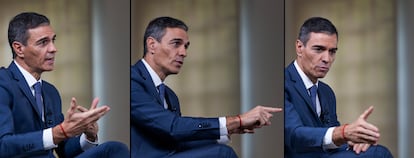
Q. You opened a TikTok account in September. Abascal has had one since 2022; Vox since 2020. Is the left late to social media? Zohran Mamdani [the newly elected Democratic mayor of New York] has secured victory for the left with a very powerful social media campaign.
A. I think it’s more about algorithms than about having a presence. It’s about what debates are fostered on social media and which ones are prioritized over others. Originally, social media was an open door to democratization processes. Today, it’s a cesspool, places where even the most basic rules of civility are disregarded.
Q. Let’s move on to the legal issue, which is increasingly important in Spanish politics. You yourself have said that last July you considered resigning because of the Santos Cerdán case [involving a former senior government official under investigation over a corruption scandal]. And a year earlier you said something similar regarding the investigations into your spouse. If your wife and brother are convicted [in a separate case brought by a far-right group] will you remain in your position?
A. Look, I trust in justice and I believe that the truth will ultimately prevail in these two cases. And in the case that is currently dominating the headlines and the debate, which is the trial of the attorney general [Álvaro García Ortiz, on trial for allegedly leaking confidential information] the government continues to believe in his innocence, even more so after everything that has come to light.
Q. If the attorney general is ultimately convicted, will you still consider him innocent?
A. I insist, the government of Spain believes in the innocence of the attorney general and, after what has been heard and seen this week, even more so.
Q. But if he is convicted, will you still maintain that position?
A. I respect your question, but I believe the truth will ultimately prevail. And the truth is that the attorney general is innocent.
Q. And if he is innocent yet he is in the dock, is it because the case has been politically exploited?
A. I leave that to your analysis, as well as to public opinion. But I insist, I believe I have been clear in stating that the government trusts in the innocence of the attorney general, especially after what we have seen this week.
Q. And would it not have been better for the process if he had resigned from the position to avoid the contradiction of the prosecutor in the case being his own subordinate?
A. That would mean that the presumption of innocence is not upheld. I honestly believe that the government has supported an innocent person with arguments and reasons, and that we trust in the justice system.
Q. You say you trust in the justice system, yet you filed a complaint against Judge Peinado and even went so far as to say in an interview that some judges are engaging in politics. Do you think these judges are being manipulated by the PP or Vox?
A. These cases affect family members, and therefore I have to be very scrupulous and respectful of these legal proceedings. Citizens are informed enough to know the difference. The only thing I want to emphasize is this: the moment these proceedings were initiated, I criticized the smear campaign that the right and far right have set in motion. And I did so because far-right pseudo-unions like Manos Limpias and Hazte Oír file complaints based on cuts, and what the opposition, the right and the far right, do is amplify them with statements, going on television programs and to digital tabloids to say that all of this is a scandal. Then they create ad hoc committees like the one in the Senate, where the goal isn’t accountability, but rather the spread of misinformation. The strategy is to make noise to cover up the reality. This country is booming in economic terms, in job creation, in economic growth, and also, of course, in everything related to the legacies of the past, whether it be the territorial crisis or the social resistance to the counter-reforms implemented by the right. The Spain of 2025 is much better than the one I found in 2018. My theory is that we are witnessing a political and intellectual collapse of the center-right in Spain and in Europe. They have no project; they have become mired in noise, defamation, and the spread of misinformation.
Why did Koldo get so far? That’s a question you’ll have to ask Ábalos
Q. And don’t you think that the noise surrounding all these processes, which is heard on one side of the political spectrum, but also sometimes on the other, leads to a loss of public trust in the institutions?
A. Polarization is asymmetrical. Completely. I don’t insult anybody, I don’t threaten anyone. You haven’t heard me say that a leader of a political party should go to prison or be hung by their feet. In the last seven years, the Socialist Party has suffered more attacks on its municipal headquarters than any other political organization. We have over 200 of them recorded, if memory serves. And when we proposed in the Senate to condemn acts of vandalism against the headquarters of any political organization, the PP voted against it, with its absolute majority, claiming it was freedom of expression. And look, anti-politics breeds anti-politics. And the intellectual, political, and even stylistic whitewashing that the political right has carried out with the far right to justify its regional and municipal agreements with Vox is the ultimate explanation for why the far right is growing in our country. Look at what happened in the Valencia region following the biggest institutional crisis and the biggest catastrophe caused by the regional government’s negligence [regional premier Carlos Mazón of the PP has decided to resign, a year after the devastating floods that killed 229 people]: the PP is not offering to give back their voice to the citizens of Valencia so that they can choose their own future, but rather is handing that capacity over to the far right and Abascal.
Q. And how are you personally handling the judicial investigation of your brother and your wife?
A. With confidence; I am convinced that everything will fall into place and that the truth will prevail. And I certainly have the conviction and determination that underhanded tactics cannot triumph. And those of the PP, Vox, and the right-wing media outlets should not be the future offered to the Spanish people.
Q. You have acknowledged that you once considered resigning because of your wife’s case. What has happened to change this, and to make you consider running for re-election?
A. I am aware of the responsibility I have. The positive results of policies in Spain and in the European context, so heavily skewed towards the far right, make it clear that we need to continue consolidating social democratic policies. This has led me to reflect, not only with my party, but fundamentally with my family, who directly suffer the consequences of this commitment and responsibility, and to announce that I am indeed taking this step and that I will run for re-election in 2027.
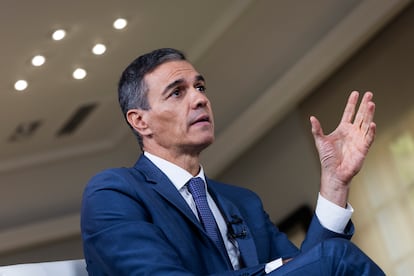
Q. And aren’t you afraid that the cases involving [former minister José Luis] Ábalos and Cerdán, and what might be discovered in court, could end up affecting your plans to run in the 2027 elections?
A. First, let’s see how this whole investigation ends. Second, the PSOE and I have taken responsibility for acting decisively and resolutely. We have cooperated with the justice system and, of course, we are implementing measures both internally and institutionally, with the Anti-Corruption Plan developed with the OECD.
Q. Doesn’t the fact that two PSOE Organization Secretaries have had to resign consecutively due to serious judicial investigations support the theory that there may have been illegal financing in the party?
A. The data is there. We have explained it and shared it with the courts. I can guarantee to the public that there has been absolutely no irregular financing. The Socialist Party is financed through legal channels. In 2024, 75% of our income came from public subsidies and the remaining 25% from membership dues and the fees paid by senior officials. Where there was indeed irregular financing with a final court decision was in the PP.
Q. But how could someone like Koldo García [a former adviser to ex-minister Ábalos now under unvestigation over contracts for facemasks during the Covid-19 pandemic] get so far? Did no one tell you that this man was negotiating directly with regional presidents?
A. Well, that’s a question you’d have to ask José Luis Ábalos, who was minister at the time. What I have seen, in the case of Ángel Víctor Torres [regional head of the Canary Islands from 2019 to 2023], is that it shows the Canary Islands government did everything legally at a time of maximum pressure, with all administrations searching for facemasks and ventilators.
Q. Do you still have confidence in Torres?
A. Without a doubt.
I had political confidence in Ábalos. I was unaware of a personal aspect of his life that has caused me deep disappointment
Q. And do you understand why citizens might be shocked to hear those conversations between Koldo and Torres now coming to light, and wonder how a government can function like that?
A. Excuse me, a government doesn’t work that way. For the peace of mind of the public, a government has many, many guarantees, both ex ante and ex post. There’s the State Comptroller’s Office and the Court of Auditors. In all those contracts that are currently under investigation, the law has been followed. If there have been individuals who have committed illegal acts, as is being investigated in the case of José Luis Ábalos and Koldo García, then it will be up to the courts to determine those responsibilities. We, from a political point of view, unlike other parties, have acted decisively.
Q. The question many citizens are asking is why you kept Ábalos on the electoral lists after dismissing him as minister.
A. Because people’s political careers don’t end when their institutional or, in this case, party responsibilities end. José Luis Ábalos was well-liked among the rank and file, and also among the party leadership. That was certainly acknowledged. But this isn’t something that only happens in the Socialist Party. How many people in other organizations have previously been organizational secretaries or ministers, and have gone on to become senators, members of parliament, or members of the European Parliament?
Q. And in retrospect, was it a mistake?
A. From the point of view of political trust, it is clear that I had it in José Luis Ábalos, but I was also unaware of a personal facet of his everyday life that, of course, has caused me a deep disappointment.
It is good to acknowledge the lights and shadows we have with Mexico in our history in order to understand each other better
Q. You have begun a diplomatic thaw with Mexico. What are the next steps? Would Spain be willing to apologize to the Indigenous peoples of Mexico, along with the president of Mexico?
A. We are at a moment in which diplomacy demands, even requires, a certain discretion. But I can guarantee that for Spain, normalizing our relations with a country we consider very close in every way is a priority. Furthermore, I have always conveyed to Mexican officials that the Spanish government, in this long, deep, and close historical relationship we share, has always emphasized the positive aspects. For example, during the Spanish Civil War, a Mexican president like Lázaro Cárdenas sent ships to welcome and protect the exiles from that war. But indeed, our history has its lights and shadows, and it is good to acknowledge these lights and shadows in order to understand each other better and, therefore, continue building these relations on much more solid foundations.
Q. Your government didn’t congratulate [Venezuelan opposition leader] María Corina Machado on her Nobel Peace Prize. This was viewed by some sectors as a sign of neutrality towards a regime that is in power through electoral fraud. Was it a mistake? Would you do it again?
A. I don’t have a tradition or a habit of acknowledging the winners of Nobel Prizes, but I’ll give you some figures. Compared to when Mariano Rajoy was prime minister [2011 to 2018], we have granted more than 200,000 permits for humanitarian reasons to reside in Spain. With Rajoy, it was less than 10,000.
Do we want to leave our young people a world armed to the teeth by spending 5% of GDP on defense?”
Q. What do you think of Donald Trump? What is your relationship with him?
A. He is the president of the United States, and beyond our ideological and political differences, which are obvious and clear, what I want is to have the best possible relations from an institutional, economic, and social point of view. Many Spanish investments are contributing to the economic development of the United States.
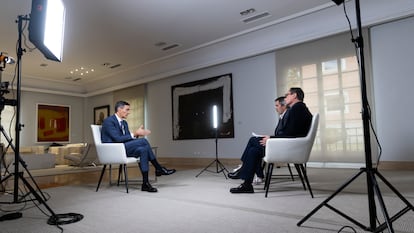
Q. At the NATO summit, you stood firm on 2.1% of GDP to meet Spain’s military obligations. Others signed on for 5%. Don’t you think that 2.1% generates misgivings in countries that are closer to the war in Ukraine, like Poland or the Baltic states?
A. Those countries know that Spain is present. The deployment of Spanish armed forces on the eastern flank of Europe, and therefore involved in the protection of Bulgaria, Romania, Lithuania, Estonia… affected by Putin’s neo-imperialism, is the best proof that Spain is a reliable country from the perspective of the Atlantic Alliance and from the perspective of capabilities. I have a fundamental disagreement, which is that I believe the commitments of allies are not measured so much in terms of GDP, but in terms of capabilities, and Spain fully meets those capabilities.
Q. Does it make sense to spend 5% of GDP on defense when you don’t even reach 5% on education?
A. What kind of world do we want to leave for our young people when they reach our age? A world where European countries allocate 5% of their budgets to defense? We need to do diplomatic work so that by 2035 we don’t have a Europe armed to the teeth, but rather one of solidarity and a guarantor of international law. But we can’t be naive either. The geopolitical reality is changing. If Europe wants to gain autonomy, we will have to increase our defense and security budgets. The opposition criticizes me for fulfilling a commitment I didn’t make, a commitment that was finalized in 2014, which is 2% of GDP, and which I have implemented.
We are pragmatic about nuclear energy. If they guarantee safety and don’t ask us to pay for it with taxes, we are willing to study the proposal
Q. Nuclear energy is gaining ground lately in the debate on emissions reduction. Are you in favor of extending the lifespan of nuclear power plants?
A. Spain’s commitment is to renewable energy. Its development has allowed us not only to grow and reduce greenhouse gas emissions, but we have also managed to lower electricity prices by 50% compared to 2017. This makes us more competitive and helps us attract investment. What we need to do is change how electricity prices are determined at the European level. And then, regarding nuclear energy, the Spanish government does not have a dogmatic position at all, but a pragmatic one. What do I mean by that? I mean that if the owners of nuclear power plants guarantee the safety of the territories and the energy supply, and don’t ask Spaniards to pay more taxes so they can make a profit, then we are willing to study their alternative, their proposal. But they have to meet these three requirements which, in my opinion, are pure common sense.
King Juan Carlos’s book is not one I will recommend. Democracy didn’t fall from the sky; it was the fruit of the struggle of the Spanish people
Q. What do you think of what’s coming out in Juan Carlos I’s memoir? Should he return to Spain for his final years [he abdicated in favor of his son Felipe in 2014, and now lives in self-imposed exile in the United Arab Emirates]?
A. I haven’t read the book yet. But I’ll also tell you that it’s not going to be one of the ones I recommend for Christmas, given what I’ve seen. The current head of state is doing a commendable job. I’ll answer some of the things that have surprised me, about who did or didn’t usher in democracy. Democracy didn’t fall from the sky; it was the fruit of the struggle of the Spanish people, of ordinary people, of the pedestrians of history, as [writer Manuel] Vázquez Montalbán said.
Sign up for our weekly newsletter to get more English-language news coverage from EL PAÍS USA Edition
