
The life of K.S., a Gambian citizen who uses a pseudonym for security reasons, changed abruptly on September 4, 2025. In the middle of the night, U.S. Immigration and Customs Enforcement (ICE) agents unexpectedly removed him from his cell at the Louisiana detention center where he was being held. He was not given any explanation: he was not allowed to call his lawyer, nor did agents provide him with any documentation.
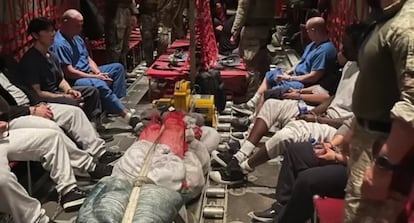
“They chained my hands, waist and ankles and put me on a military plane,” K.S. describes. He’s one of 14 people deported by the United States to Ghana, as part of an aggressive deportation strategy promoted by the Trump administration.
At the time, the detainees didn’t know what was happening. “Four of them were put in straitjackets, because they refused to board [the military planes] without speaking to their lawyers,” the Gambian recalls. And 16 hours later, the group landed in the Ghanaian capital, Accra. It’s a part of the world that’s completely foreign to them. Since then, the group’s future remains a mystery… even to themselves.
As part of its mass deportation campaign, the Trump administration has secretly pressured at least 30 African governments to accept migrants. This is according to an investigation by The New York Times, which matches information that has trickled out from those countries. Washington has already persuaded five African nations to sign some kind of agreement: Ghana, Eswatini, South Sudan, Rwanda and Uganda.
Muzaffar Chishti, a senior fellow at the Migration Policy Institute in Washington, D.C., highlights the Trump administration’s lack of transparency, asserting that fear is a central component of the strategy. “It’s about killing several birds with one stone,” he asserts.
Chishti explains that the policy is meant to sow anxiety among those residing in the United States without documentation. This will encourage so-called “self-deportation” — leaving the country on one’s own initiative — and deter those who seek to migrate irregularly.
“It’s a drop in the ocean,” the specialist sighs. He compares the dozens of people who have arrived in Africa in recent days with the 400,000 people who have been deported from the U.S. in the last eight months, according to official data. The Trump administration has carried out 1,563 deportation flights as of September, according to a report published by the organization Human Rights First. And, in the last six months, six flights are known to have transported migrants to African countries which they don’t hail from. “It’s not about numbers,” Chishti emphasizes, “but about creating an environment of cruelty.”
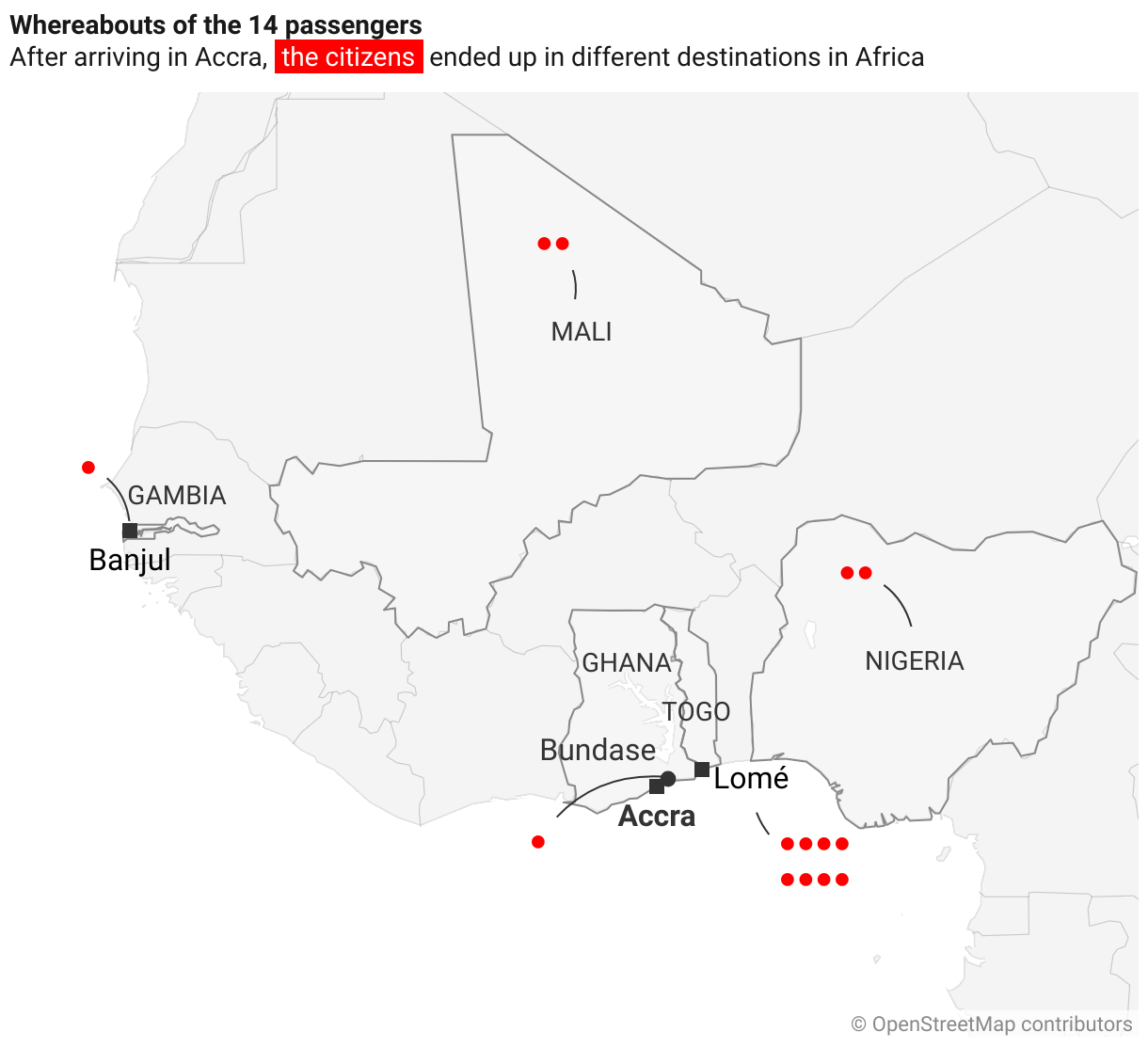
The flight that K.S. traveled on was kept secret for almost a week. It wasn’t until September 10 that the Ghanaian government acknowledged that it had reached an agreement with the White House, in an “act of pan-African solidarity.” Of those who were transferred, two went missing the same day they arrived in Accra. K.S. believes that they were taken to Nigeria.
K.S. had previously obtained humanitarian parole to remain in the U.S., after leaving his country for being a member of the LGBTQ+ community. In Gambia, this is punishable by up to life in prison. He expressed his fear of returning to his homeland in conversations with Ghanaian officials. However, he explains that immigration authorities went ahead and returned him to Gambia, the same country he fled. He’s currently in hiding.
The case is fraught with contradictions. A Ghanaian government spokesperson initially said that the group consisted of 13 Nigerians and one Gambian. But according to Oliver Barker-Vormawor — one of the group’s lawyers — there were actually 11 detainees in total: four Nigerians, three Togolese, two Malians, one Liberian and one Gambian.
Furthermore, Ghanaian authorities made assurances that all had been returned to their countries of origin. But the deportees told their families that they were still there. “They sleep in tents and the supply of food and water is irregular,” says Noah Baron, a member of the U.S. legal team representing K.S. and four other deportees. He spoke with EL PAÍS via video call.
The lawyer indicates that the deportees were held at the Bundase Military Camp, which had never previously been used to receive migrants.
On September 23, Ghana deported eight of the 11 individuals to Togo, according to Barker-Vormawor. “The government gave each of them 1,500 cedis (about $100) and abandoned them at the border. They have no family or friends in Togo. They were forced to cross illegally and were stranded there,” he tells EL PAÍS by phone.
Barker-Vormawor believes that two of them were taken to Mali and another remains in Ghana. He also denounces mistreatment by the authorities. “The officers told them that if they tried to flee, they would be shot,” he details. One of the Nigerians told the BBC that they were tricked into going to the Togolese border. They had been promised accommodation in a hotel.
Washington maintains that all those deported were “illegals,” some even “heinous criminals.” The lawsuit challenging this deportation has also made no progress: the judge hearing the case maintains that she lacks authority in the matter.
Whereabouts unknown
On July 5, the White House announced it had sent “eight barbaric, violent illegal criminal aliens” to South Sudan, a country ravaged by civil war and with minimal safeguards for detainees. Among those deported were two Burmese nationals, two Cubans, a Laotian national, a Vietnamese national, a Mexican national, as well as a South Sudanese national. The group spent more than six weeks in a shipping container at a U.S. military base in Djibouti, waiting on an appeal filed by their lawyers in the U.S. Even the ICE agents who transported them described the living conditions as “outrageous.”
About 10 days later, five more deportees from Jamaica, Cuba, Laos, Vietnam and Yemen arrived in Eswatini. Formerly known as Swaziland, it’s Africa’s last absolute monarchy. And 10 more migrants were received on October 6, although their names and nationalities are unknown. “It’s a punishment,” says Alma David, during a video call with EL PAÍS. She’s the lawyer for one of the people deported to South Sudan and for two others who were deported to Eswatini. “The message it sends is ‘don’t come here.’”
Several lawyers handling these migrants’ cases have denounced the precarious detention conditions, as well as the legal limbo that their clients face. They have also highlighted the difficulties they experience when they attempt to contact them.
Alma David says that she doesn’t know where six of the deportees to South Sudan are, even though they’re still in custody. She suggests that they may be imprisoned at the Blue House, the headquarters of the African country’s National Security Services. Sources close to the case report that one of the deportees — Mexican citizen Jesús Muñoz — was repatriated to his home country in early September. Another individual — South Sudanese citizen Peter Domach — was released.
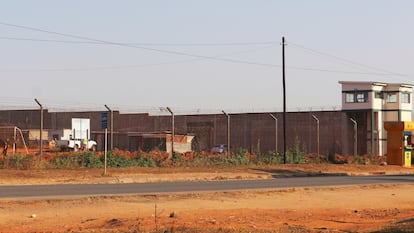
In Eswatini, the deportees were sent to the Matsapha Correctional Center, the country’s main maximum-security prison. This is according to Mzwandile Masuku, one of the group’s lawyers. Jamaican national Orville Etoria was able to return to his country at the end of September. But Masuku claims that the other four remain detained and don’t have permission to receive visitors.
Other countries — such as Denmark and the United Kingdom — have also attempted to deport migrants to Africa in the past. However, in both cases, the courts blocked them. Such a policy, according to Chishti, is a way of externalizing countries’ responsibilities for immigration and border control: “The logic is to export detainees to countries where it’s cheaper to hold them.”
Neither party has made public the agreements or the terms negotiated. EL PAÍS has obtained the agreement signed between Eswatini and the U.S., which provides for the transfer of 160 deportees in exchange for $5.1 million. It also provides for the relocation of the deportees to other countries within one year of their arrival, without specifying which countries or individuals will be responsible for their transfer.
The Ghanaian government has stated that it anticipates the arrival of approximately 40 more deportees, although officials have stressed that the country will not receive “a single dollar” in return. Rwandan authorities have agreed to receive 250 deported migrants and have acknowledged that seven arrived in August. However, the first — Omar Abdulsattar Ameen, an Iraqi citizen — arrived last April. The identities, origins and legal status of the seven deportees, as well as Ameen’s fate, are currently unknown. The Ugandan government also acknowledges the existence of an agreement, but hasn’t provided details. “These men are pawns in this kind of twisted game being played by the governments,” David sighs.
A policy that’s legal, but aggressive
Third-country deportations are provided for in U.S. immigration law when it’s impossible, impractical, or inadvisable to return migrants to their countries of origin. This is the legal argument that supports the strategy. And the experts consulted by EL PAÍS agree that the Trump administration has pushed the limits of the law to the limit. “They’ve used every tool at their disposal to push this agenda,” Chishti says.
Tariffs, immigration bans, cash payouts for each immigrant received, or the promise to avoid criticism of African countries’ domestic politics — as well as the opportunity to curry favor with Washington — are all tools that the U.S. has at its disposal. “It is easier to negotiate with these types of countries,” Chishti points out, since they’re “more vulnerable to diplomatic pressure or economic incentives.”
Ghana is the clearest example of a country being subjected to these techniques. On September 27, the U.S. lifted the visa restrictions it had imposed back in June. Ghanaians were previously eligible for a single-entry visa lasting only three months. They can now apply for five-year multiple-entry visas.
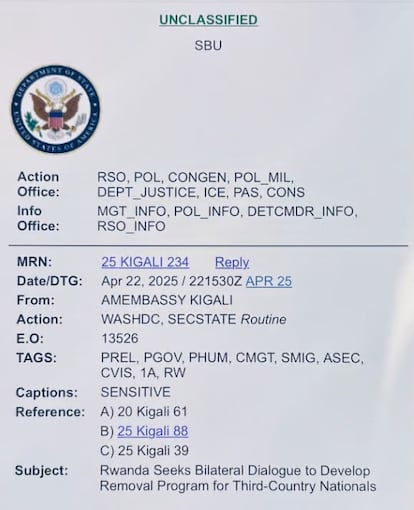
Regarding Rwanda: on March 13, a diplomatic cable was sent by the U.S. Embassy in Kigali to the State Department. It notes that the country is open to receiving deportees. It adds a “wish list” in return, ranging from political concessions to a payment of $100,000. “Rwanda’s motivation […] is to improve relations [with the U.S.],” the document reads. It was published by the specialized media outlet The Handbasket.
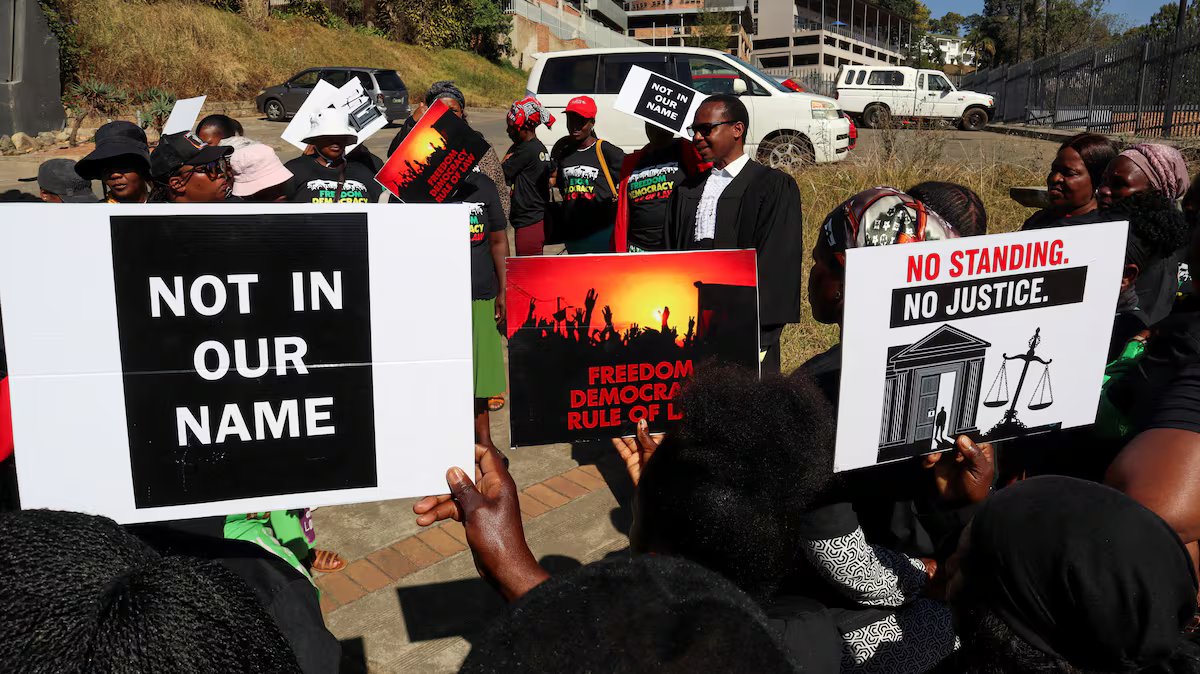
“We don’t trust these countries or their rule of law, yet we send them people,” Chishti criticizes. The agreements have also been questioned in the countries that receive migrants, sparking protests and criticism in Eswatini, Ghana and Uganda. The African Union has criticized the U.S. for outsourcing its responsibilities to other countries. However, many families of deportees are afraid to speak out, for fear of reprisals.
Ada — a friend of Cuban national Roberto Mosquera, who was deported to Eswatini — compares the limbo he’s experiencing to being kidnapped. “They told us that they had returned him to his country, but it was a lie,” she says. “We don’t understand how a man who was free for years — who had a life here [in the United States] — ended up imprisoned in a country he didn’t know and where he never committed a crime, without rights and without access to a lawyer.”
Sign up for our weekly newsletter to get more English-language news coverage from EL PAÍS USA Edition
