
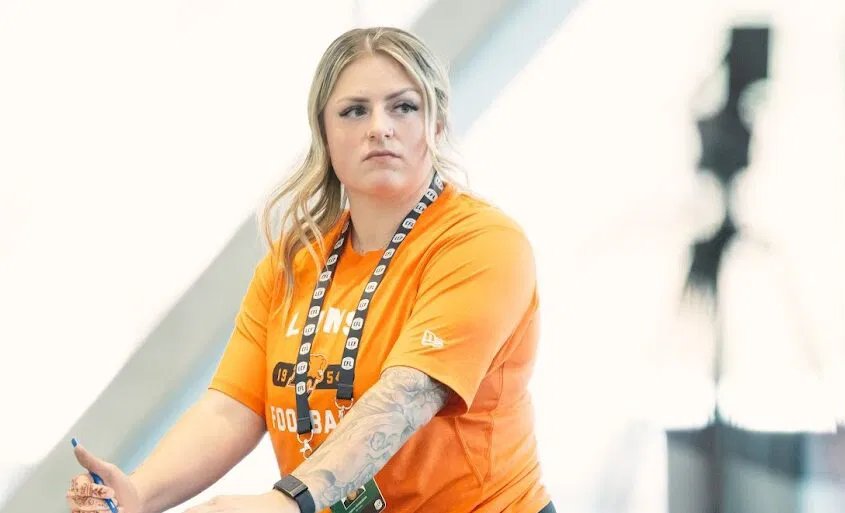
The application of the CFL’s gender-based violence and harassment policy remains controversial, but the league’s first female coach believes critics have focused on the wrong area.
Tanya Henderson was entering her second season on the sidelines when news broke in 2024 that Toronto Argonauts’ starting quarterback Chad Kelly, the league’s reigning Most Outstanding Player at the time, was being sued by a former team trainer for alleged sexual harassment.
Speaking publicly on the topic for the first time, she told 3DownNation that it was the lack of consequences for the team that she found most troubling.
“It’s something that I personally battled with how I felt about it for a very long time,” Henderson acknowledged. “The league only has so many resources, I think you can only hold the league so accountable for certain things, and you need to look more to the teams. Because the reality is, if a team is letting things like that happen — and I’m not even talking about Toronto in this situation, but if something is happening under a team’s roof — someone is contributing to that.”
The lawsuit against Kelly was eventually settled out of court to the satisfaction of all parties. However, an independent investigation launched by the CFL corroborated three of six claims made against Kelly by the trainer, including “sexual harassment as defined by the Ontario Occupational Health and Safety Act.” That resulted in a precedent-setting nine-game suspension for violating the league’s gender-based violence and harassment policy.
The timing and severity of the discipline levied by then-commissioner Randy Ambrosie were divisive. Multiple female employees criticized the league for its handling of the situation, while defenders suggested that losing half a season was too harsh a punishment for a situation in which no criminal charges were filed.
The Argos, for their part, emerged largely unscathed, despite facing claims of wrongful termination as part of the same lawsuit. It is unknown if the organization was reprimanded in any way, as the CFL refuses to publicly disclose information regarding team or staff discipline.
While Henderson acknowledged that there is no singular action that the CFL could take that would satisfy people on all sides of the issue, she believes that the burden of leadership should come with an expectation of responsibility.
“As much as the people or player or the staff or whoever that it actually involves needs to have consequences, I think there needs to also be ownership and consequences put on the people that are leading those people. Because when people lead a certain way, things don’t happen a certain way under them,” she said.
“People that make decisions and are in positions of power are allowing behaviour like that to be accepted, for things like that to transpire. Those things don’t just happen out of the blue. It’s not just something tragic happens when everything’s been completely normal and fine. It’s a culture that comes with it.”
Argonauts’ general manager Michael ‘Pinball’ Clemons publicly accepted the blame for the situation in its aftermath, though he has maintained that he was unaware of allegations of harassment until the lawsuit was filed. He remains in the same role with the organization today.
Then-assistant general manager John Murphy, who was named in the lawsuit as having been informed of the situation by the plaintiff, served two more years before parting ways with the team. Head coach Ryan Dinwiddie also continued in that capacity before leaving for an improved title with the Ottawa Redblacks this offseason.
Under the CFL’s gender-based violence and harassment policy, incidents are supposed to be reported directly to the club president, general manager, head coach or head of human resources. The person hearing the complaint must then immediately report the incident in writing to the CFL’s chief football operations officer or associate vice president of football operations. However, the league does not specifically detail punishments in cases where that protocol is not properly adhered to.
Henderson notes these situations are highly complex and by no means limited to professional football.
“I don’t think you can force safety. These things are happening in every workplace; this isn’t specific to the CFL. These get broadcast more because these are (public) figures, they’re in the media and whatnot. I think sometimes we might blow things a little bit out of proportion, and I’ve very much been guilty of that before,” she admitted.
“Specific to the Chad Kelly situation, it’s a conversation I’ve had with a lot of women and a lot of men on how they feel about it. Honestly, there is more men upset about that than there is females. That was something that helped me feel a lot more comfortable and safe in the CFL, was actually seeing and having conversations with men that were like, ‘Yeah, I don’t agree with that. These things weren’t right.’ Having those conversations, I felt safer because I know who I’m surrounded by because of the people that I associate with.”
While the Kelly situation highlighted one of the most extreme challenges that women can face when entering professional football, the 34-year-old coach and podcaster says her three seasons with the B.C. Lions were an overwhelmingly positive experience. While she has empathy for people in a male-centric field who may have needed time to adjust to her presence, those instances were few and far between — at least in the CFL.
“Across the board, I felt more respected as a human working in the CFL than I did the majority of the time working in minor community football, which is really sad and unfortunate because community football is dealing with children,” Henderson said. “Obviously, there’s a different level of professionalism when it comes to a professional sport, and that’s a different dynamic, but I can count on one hand how many negative experiences I had with players or other staff.”
The quiet reality of acceptance and progress is overshadowed when the CFL is forced to publicly invoke its gender-based violence and harassment policy. In those rare moments, people want to know that leaders are being held accountable for the culture they instill and the safety they provide their female employees.
By shrouding those decisions behind a veil of secrecy, the CFL creates reasonable doubt that it cares about that responsibility.
Powered by RedCircle
