

If history is a volcano and memory is lava, “some experiences pour into one’s body like fiery lava and congeal there. From that moment on, they can be recalled, immovably, at all times and unchanged.” The quote from German historian Reinhart Koselleck, in which he calls upon his experience as a Nazi soldier to examine his country’s traumas, does a good job of synthesizing the dilemmas that stack up upon looking at the past and reviewing, many decades or centuries later, historical facts with the eyes of the present.
Spanish colonial legacy is no stranger to such difficulty and, particularly in Mexico, has been the subject of much discussion in recent years, spilling over from more academic debates and into the muck of politics and diplomatic strategy. The latest milestone came when Spain’s foreign minister acknowledged that “there was injustice and pain” during the Conquest, which has served to ease diplomatic tensions that have been particularly severe since former Mexican president Andrés Manuel López Obrador’s controversial 2019 letter, in which he asked for an official apology from King Felipe VI of Spain. All this, amid a wave of hardcore historical revisionism on the part of the Spanish political right, and another global trend that supports settling scores over forgotten memories.
The lava of colonial legacy has grown hot in recent times, but the battle over the narrative goes back much further. This is not so much the result of opposing positions on either side of the Atlantic, but rather a certain asymmetry in the importance attached to the issue: a kind of neglect on the part of Spain and an omnipresence on the part of Mexico. And in between, historical events (as most are) soaked in blood, but also, in contrast and nuance that require complex interpretation.
“Of course, it wasn’t pretty, but it’s more complicated than a story of good guys and bad guys,” says the U.S.-based Mexican historian Mauricio Tenorio, who teaches at the University of Chicago. There was violence, cruelty and subjugation, and between 60 and 80% of the population of the Valley of Mexico died. “It was a regression in terms of civilization, life and culture for those lands, to a catastrophic degree,” notes Spanish historian and philosopher José Luis Villacañas. But there were also alliances between different Mesoamerican peoples and the small army of Hernán Cortés. “It was not only a war between the Mexicas and the Spanish, but also between Mesoamerican peoples,” says Federico Navarrete, who holds a doctorate in Mesoamerican studies from the National Autonomous University of Mexico (UNAM), the country’s leading institution of higher learning.
The academics contacted for this article insisted on the importance of a considered approach to untangling such a complex issue. One of the keys lies in understanding the 16th century Conquest as the starting point of the construction of national identity and its unavoidable labyrinths, which are clearly perceived differently in Mexico and Spain. They also highlight the fact that the ardor with which politicians have utilized the subject recently has yet to be reflected in popular culture, nor has it sparked a greater interest in reading about the history, with some exceptions in Spain. This, despite publishers’ frenetic output looking to capitalize on the recent commemoration of the 500th anniversary of an episode that, depending on who you ask, was an “encounter”, a “conquest”, or an “invasion.”
Heroes and villains?
In Mexico, historians agree that the monolithic narrative that has been repeated ad nauseum in textbooks is that “Hernán Cortés is the villain, the Conquest was a criminal act. We as Mexicans are the heirs of Moctezuma, the last Mexica emperor.” This is how Tenorio sees it. Navarrete agrees that such representation is part of the “national catechism of Mexican education”. For Martín Ríos Saloma, who is also a researcher at UNAM, “the Conquest is a subject that is crucial to Mexican identity, which begins to take shape through the government after the Mexican Revolution.”
But before the 1910 revolution, upon which a large part of Mexico’s institutional and cultural system still rests, it is necessary to look at what happened during the preceding century. The struggle between liberals and conservatives in the 19th century, which took a few wars to resolve, was eventually won by the liberals, who subsequently imposed their narrative: Mexico existed before the Conquest, which was a dark shadow that lasted throughout a hibernation of three centuries of colonial rule, until national resurrection with Mexico’s independence from Spain in 1821. The revolution institutionalized this heroic narrative, whose banner is held aloft to this day by the Institutional Revolutionary Party (PRI) and the Morena political party. However, historians warn of its pitfalls, such as those embodied by the concept of “mestizo,” a fundamental tenet of post-revolutionary Mexican identity. “Mestizaje is a whitewashing operation. Mestizo children became Hispanic, not Indigenous. It is no coincidence that the Spanish far right defends mestizaje as an act of generosity or rather, of paternalism,” says Navarrete.
In Spain, the Conquest plays a less central role in the construction of national identity. Tomás Pérez Vejo, a Spanish historian who has worked for many years at the National Museum of Anthropology and History of Meixco (ENAH) and is the former co-director of the Chair on Studies of Mexico and Spain at the College of Mexico, explains it thus: “The conquest of Mexico does not play a significant role in the 19th century narrative of the Spanish nation. It is just one episode among many that demonstrated the imperial and bellicose nature of the Spanish nation, from the discovery of America to the wars in Italy and Flanders.” The loss of the last colonies in 1898 enveloped Spain in a feeling of “civilizational failure,” triggering an identity crisis for the country. Cánovas del Castillo, a 19th-century conservative politician, said that a Spaniard was someone who could not be any other nationality. The 40 years of Franco’s dictatorship deepened this wound, with its association of Spanish nationalism with national-Catholic ideology.
“With the transition to democracy, there was a shift away from the narrative about Spain, as a result of the trauma of Franco’s regime. And so we arrive at the current situation, where no one in Spain knows anything about the Americas. This void is exploited by right-wing revisionism, which is nostalgic for an imperial and Catholic past. Their books are very much like self-help manuals for Spaniards in crisis,” adds Pérez Vejo. David Hernández de la Fuente, a professor at the Complutense University of Madrid, points out in his Pequeña historia mítica de España (A brief mythical history of Spain) that the Conquest constituted “the mythical epic par excellence of modern Spanish history”. And we all know the ease in which history is often confused with myth.
Complex conflict
One of the most commonly reoccurring elements that complicate this simplistic narrative is the participation of other Indigenous peoples in alliance with Cortés to defeat the Mexica empire, which had previously subjugated them. “Recent historiography has moved away from the nationalist tradition, both Mexican and Spanish, to place greater emphasis on the role of allies, which was much more important than previously believed,” Navarrete points out. “Cortés forged alliances with the Tlaxcaltecs, the Otomíes and the Purépechas, among others. He used the Indigenous people, and they used him,” says Ríos Saloma, who interprets these alliances as a way of “inserting themselves into that world to come.” The UNAM scholar points to a historical analogy with “some factions of the Visigoths, in the midst of a civil war, who allied themselves with the Muslims during their conquest of the Iberian Peninsula in the 8th century.”
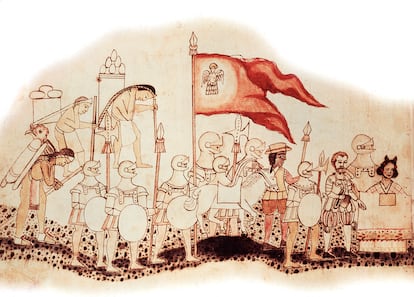
In this complex panorama, it is also necessary to give greater context to the figure of La Malinche. “She was an Indigenous slave given to Cortés, who realized that she knew Mexica and used her as an interpreter. He had a son with her and gave her every privilege,” says Tenorio. Malintzin, her name in Nahuatl, or Doña Marina, the name given to her by the colonists, has sometimes been viewed as a traitor. For Tenorio, she was more of a “survivor.”
José Luis Villacañas agrees that “it is important that we not forget that the conquests of Mexico and the Inca empire were legally illegitimate, carried out by adventurers on their own initiative, and that the Spanish monarchy accepted the fait accompli of a conquest that it had not authorized.” Tenorio adds that after an initial phase that lasted almost two centuries, in which Emperor Charles V granted the encomienda system to the colonists, “the king became the ruler, not the conquerors. Of course, this included the arrival of the Inquisition, but also the opening of a dynastic line for the Moctezumas, and privileges like the fueros, similar to those that the Basques had, for the Tlaxcaltecs. Or the thesis, which was already present in the mid-16th century, that the Indigenous people could not be enslaved unless they resisted. The spiritual conquest was no small matter; the Franciscans protected the Indigenous people in order to Christianize and better exploit them.
This backdrop of Catholicism has been strongly emphasized by those who argue that the Spanish Conquest in Mexico was less cruel than that of the Protestant Anglos elsewhere. One of the view’s most recent exponents is Elvira Roca Barea. Her resounding bestseller Imperiofobia y leyenda negra (Imperialophobia and the Black Legend; Siruela, 2016) aims to dismantle the “Hispanophobia” that in her opinion, has permeated historical tradition through the influence, or outright conspiracy, of propaganda from the Dutch and English, who were adversaries of the Spanish empire at the time.
Villacañas, who authored a book in response to Barea’s, Imperiofilia y el populismo nacional-católico (Imperialphilia and national-Catholic populism; Lengua de Trapo, 2019), argues that the criticism expressed in Mexican territory by the Spanish friars Fray Bartolomé de las Casas or Fray Servando Teresa de Mier “have been dismissed among us as mere black legend, but it was not generated by European ‘enemies’, but rather by the Spanish themselves, and by the best-educated Creoles.” Spanish ENAH historian Pérez Vejo agrees in part, though he does offer a reminder that the first publication outside of Spain of the work of De las Casas, Brevísima relación de la destrucción de las Indias (Very Brief Tale of the Destruction of the Indies), was in Holland. “It’s true that there was a propaganda campaign on the part of the Protestant countries. At any rate, the atrocities of the Spaniards were no less severe than those of the English and the Dutch — but the Spanish liberal elite internalized some of the criticism.”
Pérez Vejo highlights another contrast with, for example, the United States. “One of the Spanish Crown’s justifications for not enslaving people was the conversion of the Indigenous population. That is why the comparison with the United States does not work, as only the descendants of settlers were considered citizens there. In New Spain, everyone who lived in its territory was considered a citizen.”
The apology
López Obrador’s polemic letter can be understood in the context of the tradition of Mexican liberals. The former president was an avowed follower of Benito Juárez, the great Mexican liberal statesman, as well as a deeply nostalgic and nationalistic politician. All the academics who were consulted underscored the partisan aspects of AMLO’s letter. But at the same time, they value the importance of its so-called processes of recognition, memory and reparation. “Spain lacked some sensitivity, and the lack of response was interpreted as an affront,” notes Ríos Saloma. The UNAM researcher, who promoted various academic events during the recent anniversary of the Conquest, emphasizes that the famous letter did have valuable aspects. “It proposed the creation of a joint commission made up of historians from both countries to reflect on their common past and help build a shared narrative.”
And similar events have taken place in the past. In the 1990s, during the 500th anniversary of 1492, the Mexican delegate to UNESCO, Miguel León-Portilla, the great historian of the world of the Nahuatls, the people who inhabit the modern-day Valley of Mexico, proposed to his Spanish colleagues that the phrase “discovery of America” be substituted by “the meeting of two worlds”. The proposal caused some unrest in the Spanish delegation, whose response lagged, though they did eventually make the change.
Among the academics consulted for this article, there is a unanimous conviction that the recent gesture by the Spanish foreign minister was the right thing to do. It was seen as a compromise to break the deadlock, taking advantage of an exhibition on Indigenous art at the Cervantes Institute in Madrid, as well as the Princess of Asturias Awards to the National Museum of Anthropology and Mexican photographer Graciela Iturbide.
For Spanish professor Enrique Moradiellos, it is understandable that part of the current Mexican population feels like the heir to the pre-Columbian peoples, but he considers it “ridiculous” to demand an apology for events that took place five centuries ago. “It is a phenomenon that cannot be judged by present-day moral standards because it puts us in an absurd anachronism,” he argues. “It was the pattern of behavior known and practiced by humanity since we have written records.”
Going a step further, UNAM expert Federico Navarrete argues that, in any case, the apology should not be directed at the Mexican state, but Indigenous peoples. The academic points out that during forums with Indigenous intellectuals on the issue, their demands focused on “the colonial policies of the Mexican state, such as the imposition of Spanish, the dispossession of lands, and even the sterilization of Indigenous women.” It is yet another twist in the thousand facets of this historical conflict, which, as one of the historians says, has become “shadow theater for political gain.”
Sign up for our weekly newsletter to get more English-language news coverage from EL PAÍS USA Edition
