
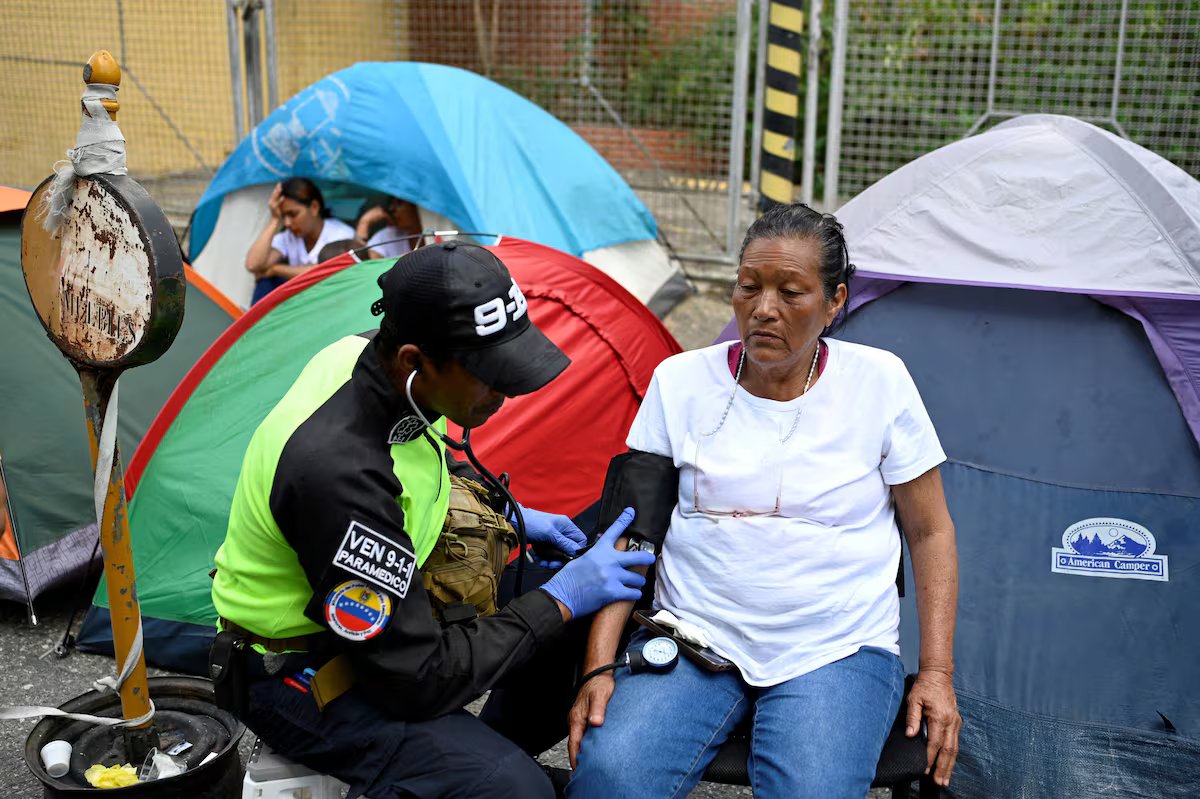
Yarelis Salas, 39, the mother of political prisoner Kevin Orozco, died a few days ago of a heart attack outside Tocorón prison, an hour and a half from Caracas, after taking part in one of the several vigils organized at the facility by relatives demanding an amnesty for all political prisoners in Venezuela. Journalist Ramón Centeno, another recently released detainee, left prison in a wheelchair, suffering from the harsh conditions of detention and from several untreated ailments developed while incarcerated. His mother, Omaira Navas, has also just died, after suffering a stroke. She had spent four years trying to find out her son’s whereabouts. Carmen Dávila, 90, has also died. She was the mother of physician Jorge Yéspica, 66, who was jailed in late 2024 amid one of the Venezuelan government’s repeated legal crackdowns on the opposition in recent months.
The recent release of political prisoners has unleashed pent‑up indignation that had long been bottled up on Venezuela’s streets. It has started to gain momentum to the extent that the government of Delcy Rodríguez — now seeking to ease tensions — has allowed it to do so. Students and civil society activists have taken the first steps to reclaim the constitutional right to protest, which had all but vanished from the streets in recent months. At the Central University of Venezuela, students directly challenged Chavista rule with protest banners and briefly blocked traffic to express their discontent.
Protests aimed at drawing attention to the fate of thousands of political prisoners who have been detained in recent months are gaining some space. Official announcements of releases, which are being carried out at an extremely slow pace, have brought no relief; instead, they have caused intense anxiety for family members and loved ones. They have also sparked frustration due to the unexplained discrepancies in the numbers: the Chavista government claims 600 political prisoners have been released, while organizations linked to the victims — such as Justicia, Encuentro y Perdón, or Foro Penal — have documented 276.
As political prisoners return to the streets, new reports are emerging about the dire conditions in Chavista prisons. These stories are circulating among families and friends, compounding the anguish. Many mothers and wives of political prisoners have spent weeks or months without knowing where their loved ones were being held. Many families are gripped with the fear of dying before seeing their imprisoned children freed — as happened to these mothers.
Evelis Cano, 49, the mother of political prisoner Jack Tantak, 31, says she is “desperate” and has decided to chain herself to one of the bars at the so‑called Zone 7, which houses cells of the Bolivarian National Police, to plead for her son’s release. “I am willing to die,” she cries. “Take away those hearts of stone,” she shouts at the police overseeing the families’ protest. “There is no response, only silence. You have no mercy. We demand justice. Everyone here is innocent; none of them is a criminal.”
Opposition leader Edmundo González Urrutia — who claims he won the disputed 2024 presidential election and has the official voting records that prove it — says that the deaths of these women, who were mothers of political prisoners, “are irreversible harm that we will not normalize.” “We know of fathers, mothers, and children who wait outside prisons and detention centers for hours and days to learn about their loved ones, without answers, without information,” he adds. “This anguish has consequences. Political persecution extends to families, consumes lives, and leaves wounds that time cannot heal.”
The situation of political prisoners in Venezuela has been largely absent from the country’s mainstream news and commentary. The issue is kept alive primarily as a persistent demand on social media from relatives, some political parties, and human rights groups. Occasionally an opposition leader calls for the release of political prisoners or underscores the importance of an amnesty law as part of national reconciliation. But the terrible prison conditions, the anguish of families, the deaths of relatives, and the sheer number of people jailed in recent months have been largely excluded from local daily news coverage.
This contributes to the fact that many Venezuelans who support Chavismo — or ordinary people who are not constant news consumers — are noticeably disconnected from this reality.
Despite the mass prisoner releases announced by the government of Delcy Rodríguez, tens, and, by some estimates, hundreds of political prisoners remain behind bars. According to Foro Penal and other local human rights organizations, while some releases have occurred, many detainees remain in custody, and opposition figures say the process is opaque and incomplete. Numbers vary by source, and critics argue official tallies do not reflect the actual scope of releases.
Sign up for our weekly newsletter to get more English-language news coverage from EL PAÍS USA Edition
