
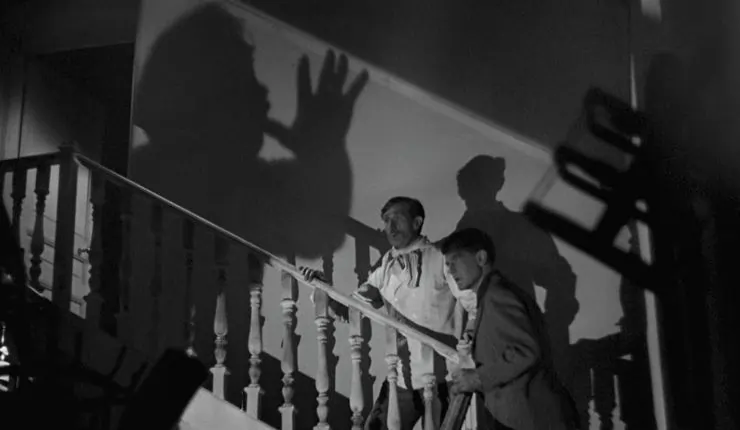
Directed by Maurice Tourneur in 1943, The Devil’s Hand (La Main du diable) was produced under German occupation at the height of the Second World War. Adapted from a short story by Gérard de Nerval, the film carries with it an air of fatalism that feels inseparable from its historical context. Now receiving its first UK Blu-ray release courtesy of Eureka Entertainment on 16th March, this new remastered edition allows the film’s visual sophistication to shine in a way it perhaps never has before. Having seen this restoration, I can confidently say it looks exquisite, the textures, shadows and fine details are rendered with remarkable clarity.
There’s something immediately transportive about The Devil’s Hand. From its opening moments, the film feels steeped in classical tradition, yet remarkably crisp, accompanied by a score that is as beautiful as it is faintly menacing. A group of travellers, stranded in a snowbound hotel after an avalanche, find their uneasy isolation disrupted by the arrival of Roland Brissot – a man missing a hand and carrying a small, ominous box. It’s an entrance loaded with portent, and Tourneur stages it with deliberate theatricality, allowing tension to seep gradually into the confined setting.
Though I’m not deeply versed in classical French cinema, this film feels like a striking gateway. Pierre Fresnay is superb as Roland. Introduced as abrasive and mysterious, he gradually reveals himself to be something far more tragic: a man ensnared by a Faustian bargain. Having purchased a severed hand that promised him love, wealth and fame, Roland has enjoyed a year of prosperity, until the devil returns to claim his due. Fresnay brings a compelling vulnerability to the role, balancing arrogance with palpable fear. Many critics over the years have praised the performance for precisely this duality, his ability to shift from cynical opportunism to existential dread gives the film its emotional backbone.
Visually, the film leans into shadow with exquisite control. The cinematography carries a muted chiaroscuro quality that recalls the brooding fatalism of Double Indemnity, directed by Billy Wilder. Even the simplest details- a dripping tap, a corridor swallowed in darkness- feel charged with unease. Some modern commentators have noted how closely the film edges toward what would later be termed film noir, blending poetic realism with supernatural horror. The oppressive interiors and moral ambiguity certainly anticipate that tradition.
The performances are undeniably heightened, bordering on melodrama, yet this theatricality is part of the film’s charm. Characters occasionally verge on caricature, none more so than the chef Mélisse, played with flamboyant desperation by Noël Roquevert. His portrayal of a sleazy, scheming opportunist- eager to rid himself of the cursed “gift” – is overdone in the best possible way, adding texture and dark humour. Some reviewers have even singled out Roquevert’s performance as a sly injection of satire, suggesting the film toys with the absurdity of greed as much as it condemns it.
By contrast, Josseline Gaël brings warmth and grace as Irène. She provides a much-needed lightness within the film’s shadowy world. One image in particular lingers: Roland grasping her face, her profile illuminated with delicate precision. It’s a moment of startling beauty amidst the moral decay, and in this new restoration the fine gradations of light and texture in that shot are particularly striking. The improved picture quality truly foregrounds Tourneur’s painterly compositions.
The score by Roger Dumas weaves seamlessly through it all, romantic yet haunting, perfectly attuned to the story’s fatalism. The music never overwhelms; instead, it subtly reinforces the sense that Roland’s fate was sealed long before we met him.
Narratively, the premise is simple, and perhaps I found myself wishing for greater layers of mystery or suspense. Yet many critics have argued that its simplicity is precisely its strength – the film plays like a dark moral fable, almost folkloric in structure. What it lacks in narrative complexity, it more than compensates for in atmosphere, performance and visual elegance. The framing device, with its gathering of strangers recounting tales of the cursed hand’s previous owners, adds a cyclical inevitability that deepens its allegorical weight.
It is also fascinating to see the stylistic lineage at work. The narrative tropes and directional talent Maurice Tourneur passed down to his son Jacques Tourneur are evident, particularly when considering Jacques’ later classics such as Cat People and Out of the Past. The shared sensitivity to shadow, suggestion and psychological dread feels unmistakable.
Ultimately, The Devil’s Hand stands as a haunting, elegantly crafted work – a supernatural tale shaped by the anxieties of its time, yet timeless in its moral resonance. This Blu-ray release is not only a treat for collectors but an essential rediscovery for anyone interested in the crossroads between poetic realism, early noir and gothic horror. It’s a dark fable that lingers long after the final frame, and in this restoration, it has never looked more devilishly beautiful.
★★★1/2
On Blu-ray from March 16th / Pierre Fresnay, Josseline Gaël, Noël Roquevert/ Dir: Maurice Tourneur/Eureka Entertainment/ PG / Buy
Related
Discover more from
Subscribe to get the latest posts sent to your email.
