
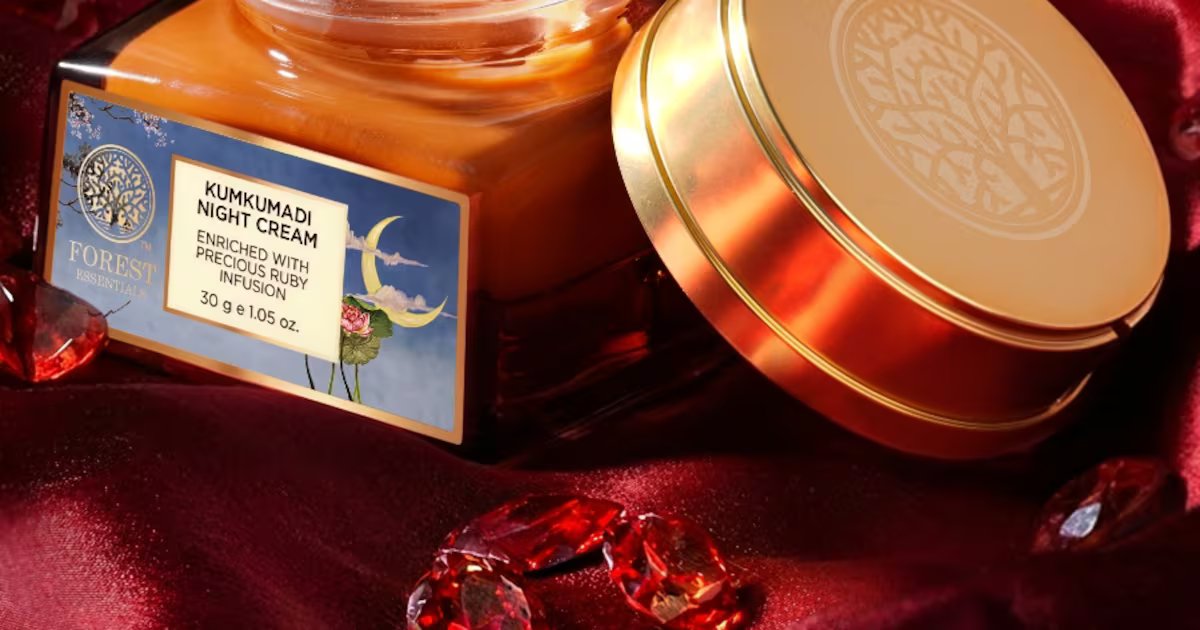
The Estée Lauder Companies has agreed to acquire Ayurvedic beauty line Forest Essentials. The move marks the first purchase by the conglomerate led by chief executive Stéphane de La Faverie.
Founded in 2000 by Mira Kulkarni, Forest Essentials is known for its science-meets-luxury approach to Ayurvedic skincare, along with its distinctive Indian heritage. The brand, which has roughly 200 freestanding stores and a significant hospitality business, mostly in India, will continue to operate in New Delhi and be led by Kulkarni. In 2025, revenue reached 5.8 billion rupees (around $63 million); earnings before taxes, interest, taxes, depreciation and amortisation reached 2.8 billion rupees (around $30 million) according to India’s Ministry of Corporate Affairs.
Lauder first took a minority stake in Forest Essentials in 2008, before upping its investment in 2020 to 49 percent. Kulkarni met with then-chairman of the board Leonard Lauder early in the label’s lifecycle and when asked what the future of the brand resembled, she said she saw the young label in the same places you would find Estée Lauder.
The phased purchase approach follows the same progressive acquisition strategy the company took with skincare label Deciem, in which it took a stake in 2017 before taking a majority position in 2021 and fully integrating it into the company three years later.
“We will be able to reinforce and strengthen the positioning of Forest Essentials in India, but at the same time use the commercial and operational scale of this historical company to bring Ayurveda to the global stage,” said de La Faverie.
The acquisition also gives Lauder a definitive foothold in one of beauty’s fastest growing markets, India, a country where it has recently stepped up its investment. It sells 14 brands there, including MAC and Clinique, and it developed the Beauty & You discovery program for young Indian founders in 2022.
“Somebody may say, ‘Why would you have a partnership like this?’ And it’s because I think what we can do in India, nobody else can do. But [what] we want to [do] is take [Forest Essentials] to the world,” Kulkarni said. Beyond India, Forest Essentials has slowly expanded to the UK and Middle East.
A Win for Lauder
While the company has had a hit-or-miss track record with integrating brands it acquired in the 2010s, namely Smashbox, Becca and Too Faced, its more recent deals with founder-led lines Le Labo and Deciem have been more successful. In its latest earnings release, the two brands were called out for their outsize performance.
Since his appointment as president and chief executive last year, de La Faverie has paid special attention to both lines. Deciem and Le Labo and their leaders report directly to him versus the standard Estée Lauder clusters led by category heads; Forest Essentials and Kulkarni will follow the same model. And there are synergies that already exist with the brands as Le Labo continues to operate as a largely direct business that relies on stores.
De La Faverie has made no secret of his intention to pursue M&A activity, as part of the company’s broader turnaround strategy, which has been underway for the better part of a year. But many expected divestitures to happen first.
The purchase of Forest Essentials follows the company’s strong start to the year, where it saw China sales rebound as well as growth in skincare and fragrance. Its stock price is up over 50 percent year-on-year. It recently invested in Xinú, another founder-led business in Mexico.
“We will always be a part of the M&A conversation,” said de La Faverie.
From New Delhi to The World
It’s no secret that India and much of the global south is where conglomerates and brands are looking for expansion. According to the The State of Fashion: Beauty Report — Solving the Growth Puzzle, 78 percent of global executives see India as the most promising region for growth. India’s beauty market is $10 billion, with skincare accounting more than 40 percent, according to McKinsey & Co. The Gen-Z consumer, in particular, and the size of India’s Tier 1 and 2 hubs have made it especially attractive.
Lauder’s commitment to Forest Essentials is as much of a commitment to India, de La Faverie said, calling it one of the “most important beauty players in the [market.]”
But Forest Essentials’ anchor of Ayurvedic beauty is not one that has been translated well globally because of its complexity. Kulkarni described the brands pre-Forest Essentials as “medicinal” and “uncomfortable to use.” Ayurvedic skincare like Ayurveda is based on the centuries-old practice of treating the body and mind holistically. ”I thought I would use it if it was packaged differently, it was presented differently and I would enjoy using it,” she said of the line’s early origins.
But for Estée Lauder Companies to succeed with Forest Essentials, the brand needs to stay true to its roots. Challengers from Kama Ayureda, backed by Puig, and indies like Unilever Venture’s SkinInspired and Secret Alchemist are vying to be India’s breakthrough brand. For now, Forest Essentials remains ahead as the top skincare brand in the country. And de La Faverie and Kulkarni remain confident.
“This is a brand that spans across ages, generations and is anchored in India, in the culture,” said de La Faverie. “There’s no reason why this business model would not translate.”
Sign up to The Business of Beauty newsletter, your complimentary, must-read source for the day’s most important beauty and wellness news and analysis.
