
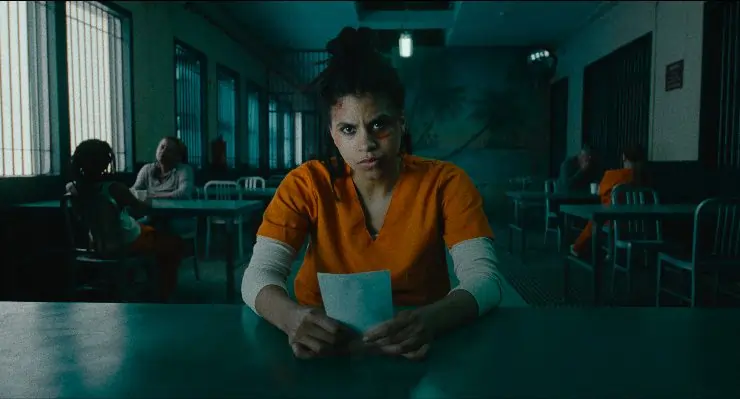
Horror has always had a complicated relationship with women. For a genre built around them, it hasn’t always known what to do with them besides putting them in danger. However, recently something seems to have shifted, and the upcoming release of They Will Kill You on March 27 reiterates horror’s renaissance of sharp, self-aware, and more interesting women, not just as victims, but as fully realised, powerful characters. In They Will Kill You, Asia Reaves takes a housekeeping job in an upscale New York City high-rise, expecting routine work in a prestigious setting. Instead, she uncovers a disturbing pattern: residents have been disappearing without explanation for decades. As rumors of a possible cult circulate among the building’s shadows, what begins as a straightforward job quickly takes on a far more ominous edge.
To see how far we’ve come, it’s worth revisiting early horror pictures such as Alfred Hitchcock’s Psycho. Within Psycho, Marion Crane serves as a central, but mostly expendable character, with her body remaining the main spectacle. The iconic shower scene is a stand out moment in cinema, but it also captures the early voyeuristic lens on women at the time.
By the time Halloween arrived in 1978, this lens was being questioned, and the foundations of a woman’s role in horror shifted to create the “final girl” trope that would define horror for decades. Laurie Strode wasn’t just a victim at the hands of men, she was cautious and resilient. What set her apart wasn’t just that she survived Michael Myers, but that she did it through instinct and intelligence. She wasn’t written as naïve, but a strong protagonist against Myers. Halloween established a version of the final girl who felt grounded, human, and, for the first time, central to the story rather than incidental. Horror that began to look at itself in the mirror. This then progressed into a series of headstrong “final girls” evolving through the decades from Sidney Prescott to Ellen Ripley, and onto modern iterations such as Asia Reaves in They Will Kill You.
Fast forward to more recent years, and this reflection on horror has turned inward. For example, 2019’s Midsommar lingers less on jump scares and more on emotional depth. Dani, its central character, doesn’t feel like a typical horror protagonist, and that’s the point. Her grief is consuming, her relationships fragile, and her sense of self deteriorating. The horror isn’t just what happens around her, but what’s happening within her. And by the end, her iconic smile is both freeing and unsettling. Is she really free? A complex departure from the final girl and characterless victim.
Moving onto 2019’s Us. Lupita Nyong’o’s performance does something rare in horror, asking the audience to empathise with both sides of the story. The film plays with the idea of doubles. The self you present versus the self you suppress, and it’s through its female lead that those ideas hit hardest. She isn’t just reacting to the horror, she is a part of it. It’s a development of the ideals of women in horror and how audiences are less interested in clean and direct characters, but more interested in the grey areas.
And then there’s 2022’s Pearl, which feels like a character study disguised as a horror film. Pearl isn’t running from anything, she’s chasing something. Escape. The tragedy is that none of those things are available to her in the way she wants them to be. What follows is unsettling not just because of what she does, but because of how understandable her frustration feels. This presentation of female rage doesn’t ask for sympathy, but demands attention and understanding.
Few genres can tackle body image and ageing as viscerally as horror, and 2024’s The Substance leans all the way in. It takes the constant expectations placed on women to stay desirable, and turns them into something grotesque and impossible to ignore. It’s uncomfortable in a way that lingers, because it doesn’t feel entirely removed from reality. If anything, it feels like an exaggeration of something already there.
What ties all of these films together is a sense that women in horror are no longer just surviving the story, but shaping it. They’re allowed to be unlikeable, complicated, even frightening in their own right. The “final girl” still exists, but has evolved. She doesn’t just make it to the end but changes what the end means. And that is exactly what They Will Kill You, in cinemas March 27 explores.
Related
Discover more from
Subscribe to get the latest posts sent to your email.
