
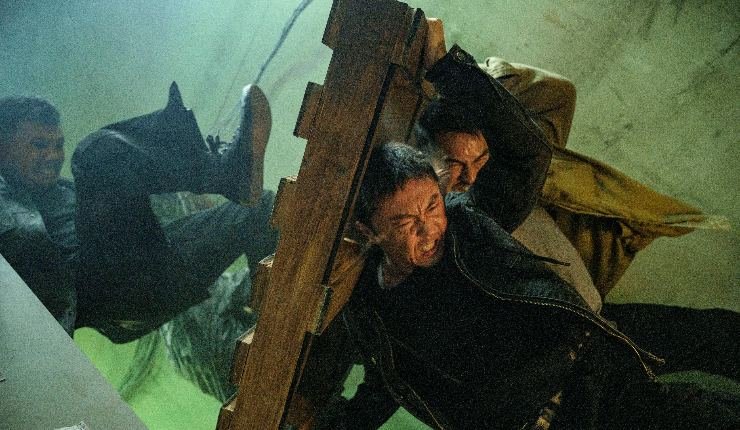
The Furious is directed by one of the most influential figures in contemporary action cinema, Kenji Tanigaki. Although his name might not immediately ring alarm bells, his work has created ripples across the globe. Enlisting the services of master action choreographer Kensuke Sonomura, this collaboration is a match made by the action gods themselves. Bringing together two of the most inventive minds in the genre should yield outstanding results, and while “stellar” is accurate, that description feels like an understatement. In fact, this is nothing short of revolutionary.
An intertitle boldly proclaims that we are somewhere in Southeast Asia. We follow a mute Chinese father (played remarkably by Xie Miao), whose daughter Rainy is returning to China to live with her grandmother, despite her objections. However, after an argument with his daughter, Rainy (Yang Enyou) is abducted. Driven by fury, and after the police fail to act, he embarks on a relentless mission to find his daughter at any cost. During his quest, he crosses paths with Navin (Joe Taslim), who has been searching for his missing wife.
Narratively, The Furious doesn’t reinvent the wheel or overhaul the genre’s formula. Many films feature similar plots, but what this film does better than most is cut much of the filler. Once the key players are established and Rainy is kidnapped, we are straight into the action, transitioning seamlessly from one sequence to the next with minimal dialogue, which mainly serves to push the plot forward. It may be a blessing that there is little dialogue, as some performances come across as quite wooden or dubbed in post-production, especially with some of the police officers featured throughout the film.
However, this raises an interesting question about why we watch a film like this: is it for the narrative or the action? This film has challenged me with this idea, as its narrative is neither new nor complex, and the acting can be inconsistent, which should make it difficult to invest in the action. However, the simplicity of the film’s story is a strength and is carried by the outstanding main performances from Miao, Taslim, and Enyou. It allows viewers to become immersed in the action and experience the narrative unfolding with each punch and the emotion in every scene. We want the father to reconnect with his daughter and Navin to reunite with his wife. I wouldn’t feel this way if the story weren’t compelling.
Even after multiple viewings, the film reveals nuanced and compelling storytelling. Every character is driven by fury—whether from institutional failures, a kidnapped daughter, or an abducted wife—and even the villains share this rage. The story shows how anger can lead to impulsive violence, but also how compassion can be just as powerful.
All these elements enable the action to thrive, and Tanigaki and Sonomura deliver an action masterclass in here. Action scenes, much like musical numbers, propel the story and reveal characters’ intentions and motivations. A single punch communicates as much to the story as any spoken line ever could. I have never seen a martial arts action film that left me so dazzled by its choreography, despite it being an evolution of the last 25 years of East Asian action cinema. Many fights throughout the film could serve as the finale in other movies.
The final 30 minutes will go down in history as one of the most visceral final set pieces ever. It begins with gun-fu using a bow and arrow, which transitions into a rip-roaring one-on-one fight that showcases judo facing off against dance-inspired kicks and Wushu blending with Pencak Silat — all set to an electronic version of Caprice No. 24. This then develops into a two-on-two fight featuring otherworldly tracking shots, which unexpectedly escalates into a five-way battle with breathtaking choreography and seamless exchanges as all five fighters engage and shift between opponents, leading to a split screen, a third of the way through the fight, that will be remembered as one of the most badass moments in cinema history.
The choreography melds multiple martial arts, including Wushu, Judo, and Pencak Silat, making the film a genuine love letter to martial arts. This affection is reflected in its international cast from China, Indonesia, the USA, and Japan. In addition, the entire film operates as a homage to the genre, whether it be Ho, a character with a steel skull reminiscent of those seen in films like Drunken Master and exudes vibes of Sammo Hung, being a larger man with the agility of someone a quarter of his size. The start echoes Hong Kong films from the 80s, where characters are severely bruised. As the film nears its conclusion, the blood begins to pour and feels pulled straight out of Indonesian films like The Night Comes for Us.
Tanigaki, Sonomura, and the rest of the cast and crew have delivered a truly exceptional film. It is no exaggeration to declare this the greatest action film released in my lifetime. A breathtaking masterpiece — with immaculate choreography that leaves the audience breathless — The Furious offers a pulse-pounding thriller that is a genuine magnum opus of the genre. The film will undoubtedly be remembered as one of the greatest action films ever and a defining piece for years to come.
★★★★★
In US cinemas on June 12th, UK Cinemas on June 26th / Xie Miao, Joe Taslim, Jija Yanin, Joey Iwanaga, Yang Enyou / Dir: Kenji Tanigaki / Lionsgate / 18
Discover more from
Subscribe to get the latest posts sent to your email.
