

For the dedicated ornithologist, there are a few types of holy grail sightings that would crown any bird-watcher’s career, and one of these is waiting to be found here in Mexico: the imperial woodpecker, or Campephilus imperialis, which we will get to in a moment.
These three types of sightings would get any ornithologist into the history books:

- Sighting a species previously unknown to science. Even in our modern world, there might still be small, isolated populations of a never-before documented bird species in some thick mountain forest or on a remote island. A good example is the Banda Myzomela (Myzomela boiei), a small, beautiful bird with a bright-red head found across Indonesia’s Banda Islands, discovered in 2025 to consist of three separate species.
- Finding the fossil of a previously undiscovered bird species. The existence, for example, of the Baminornis zhenghensis — a pigeon-sized bird from the Jurassic Period — was discovered only this year. It might change our whole understanding of bird evolution.
- Bringing a bird back from the dead. This means spotting a bird previously thought by science to be extinct. This does very occasionally happen: The night parrot, a brilliantly colored nocturnal bird once common in Australia, was until recently believed extinct — a victim of humans and the feral, predatory animals that hitched a ride with them. The bird’s existence was confirmed, however, in 2013 — after 23 years without a sighting — when a ranger discovered a night parrot egg.
A sighting of Mexico’s imperial woodpecker — which hasn’t been provably documented since 1956 — would fall into this third category.
The imperial woodpecker: A tragic tale of human-driven extinction?
The imperial was — and hopefully still is — a remarkable bird, bright-red and black, and the biggest of all the 241 species of woodpeckers found worldwide.
It is officially listed as “critically endangered (possibly extinct)” by both the IUCN and BirdLife International because there has not been a confirmed sighting of the imperial woodpecker since 1956, and the weight of evidence edges towards extinction. The story of this bird’s discovery — and its demise — is both a fascinating and tragic tale.
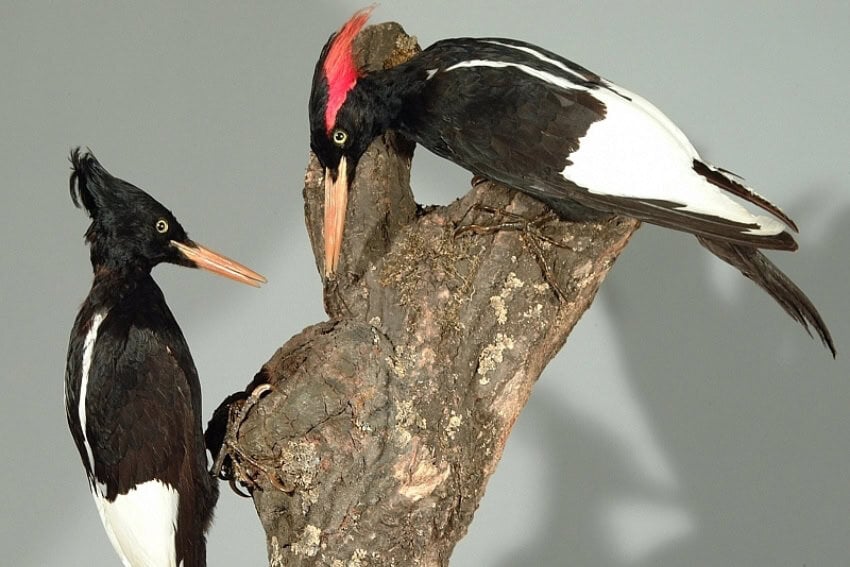
The imperial woodpecker was once widespread throughout the Sierra Madre Occidental, that mountain range that runs through much of northern and central Mexico. It fed on the forest region’s insect larvae, which it found under the bark of dead pine trees.
A healthy forest has only a few dead and rotting trees at any one time, so specialist eaters such as the woodpeckers require a large area to search for food. As a result, the imperial woodpecker population was never numerous, and, even in happier times, its mountain home probably only supported a few thousand individuals.
The imperial woodpecker’s discovery
Although obviously known to locals, the bird didn’t come to academic attention until 1832, when John Gould presented some dead specimens to the Zoological Society of London. He had not collected these himself and was vague about where they originated, believing them to come from somewhere near Southern California, and details about the woodpecker species would remain a mystery for several more decades. It was 1892 before Edward Nelson and his young assistant, Edward Goldman, became the first outsiders to see living examples.
Unusually for woodpeckers, the imperial species was often reported flying in small flocks — most likely because they tended to gather on the same dead trees to feed. This fact made them vulnerable to hunters, as the Edwards showed by dropping several out of the sky with a single shotgun blast. Adding to their vulnerability was the fact that — despite being hunted for their plumage, for medical properties and sometimes just because their loud noise upset people — the birds weren’t scared of humans.
In the first half of the 20th century, as loggers opened more paths in the region, more guns arrived in the villages, and the imperial woodpecker’s numbers declined. When ornithologist Arthur Allen and his wife hiked through these forests in 1946, they only found a solitary female. William Rhein, a dentist by trade and a bird-watcher by passion, made three expeditions into the region in the 1950s and saw only a few. The region was still a wild and at times dangerous area, and foreign visitors remained rare. When James Tanner and his son came to Durango in 1964, they sought a bird not spotted by an outsider for a decade.
Tanner was a woodpecker expert who earned his PhD studying the ivory woodpecker in the United States. He interviewed locals — who knew of the bird by its Mexican name, pitoreal — but even they had not seen one for four or five years. Villagers, however, did know of a remote area they said might still be untouched.
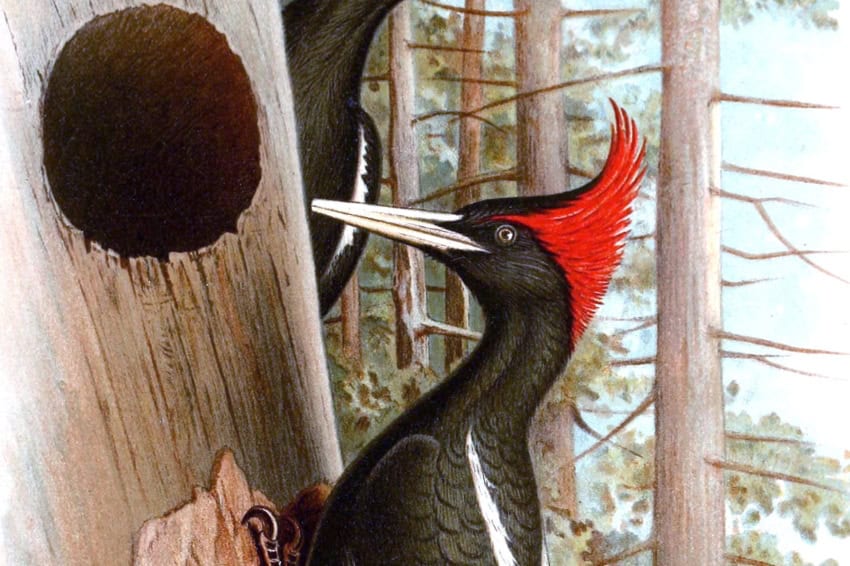
Despite warnings that bandits made the area dangerous, the Tanners employed a local guide and headed there, but there was no sign of the elusive bird. Tanner did collect new information about the species, however, noting that the young nestlings were considered a local delicacy — probably another reason for their dwindling numbers.
While the ivory woodpecker had suffered primarily from the loss of habitat in the U.S, Tanner noted that, by contrast, forests of the Sierra Madre had not yet been stripped bare. He believed that hunting had taken a higher toll on the imperial woodpecker than had habitat loss.
A renewed search
A handful of unconfirmed sightings continued between 1965 and 1995, but nothing definitive enough to convince scientists that the imperial woodpecker was still alive. Then, in 1995, Dutch woodpecker expert Maurits Lammertink was in Cornell University’s archives going through old letters exchanged between Tanner and Rhein. In these letters, he found reference to filmed footage of the bird.
Lammertink visited Rhein in Pennsylvania and viewed the footage shot by Rhein in 1956. A few seconds of the grainy film included distant but clear views of the imperial woodpecker, presenting new information on the bird’s flight pattern: It had, for example, a fast wing flap rate compared to other woodpeckers. Lammertink also documented information on the bird’s favorite perches.
The footage inspired Lammertink to enter Sierra Madre Occidental in 2010 with wildlife photographer and author Tim Gallagher. Gallagher had become a birding legend in 2004 by documenting an ivory-billed woodpecker in Arkansas — a living example of the species had not been seen in the U.S. since 1944. Lammertink and Gallagher retraced Rhein’s route through the Sierra Madre Occidental, heading for the area where Rhein had shot his footage.
Back in the 1950s, this region still consisted of old-growth forest with abundant large and dead trees. Since then, the area had been regularly logged, and locals told the pair that logging firms in the 1950s had encouraged rampant poisoning of woodpeckers. Despite Lammertink and Gallagher’s best efforts — which included trying to attract birds with a small device that mimicked the characteristic double-knock drum of many woodpeckers — no imperials were spotted, and the interviews of locals suggested that the bird had become extinct around 1960.
Could the imperial woodpecker still be alive?
It seems unlikely — but it’s not impossible — that this bird still survives in the mountains of the Sierra Madre Occidental. While it hasn’t been provably sighted since 1956, the area today is a center of the criminal drug trade, so scientists and ornithologists seldom venture there. As Gallagher wrote, “Why would anyone go looking in such a terrifyingly dangerous place for a bird that might not even exist?”
While logging in Mexico continues to take its toll on the region’s forests, it is possible that enough patches of old forest survive today to form a last refuge for the imperial — or that the birds have been able to adapt to life in a secondary growth habitat. But while rediscovering an extinct bird might bring headlines, it doesn’t guarantee a happy ending: When a bird is spotted after such a long gap, it generally means that too few have survived to maintain a breeding population.
Even if a living example is found one day, it is probably too late at this point to save the imperial woodpecker. But Mexico has nearly 100 other endemic birds considered endangered. Perhaps there is still time to learn from the imperial woodpecker’s story — and to spare other Mexican species from a similar fate.
Bob Pateman is a Mexico-based historian, librarian and a life-term hasher. He is editor of On On Magazine, the international history magazine of hashing.
