
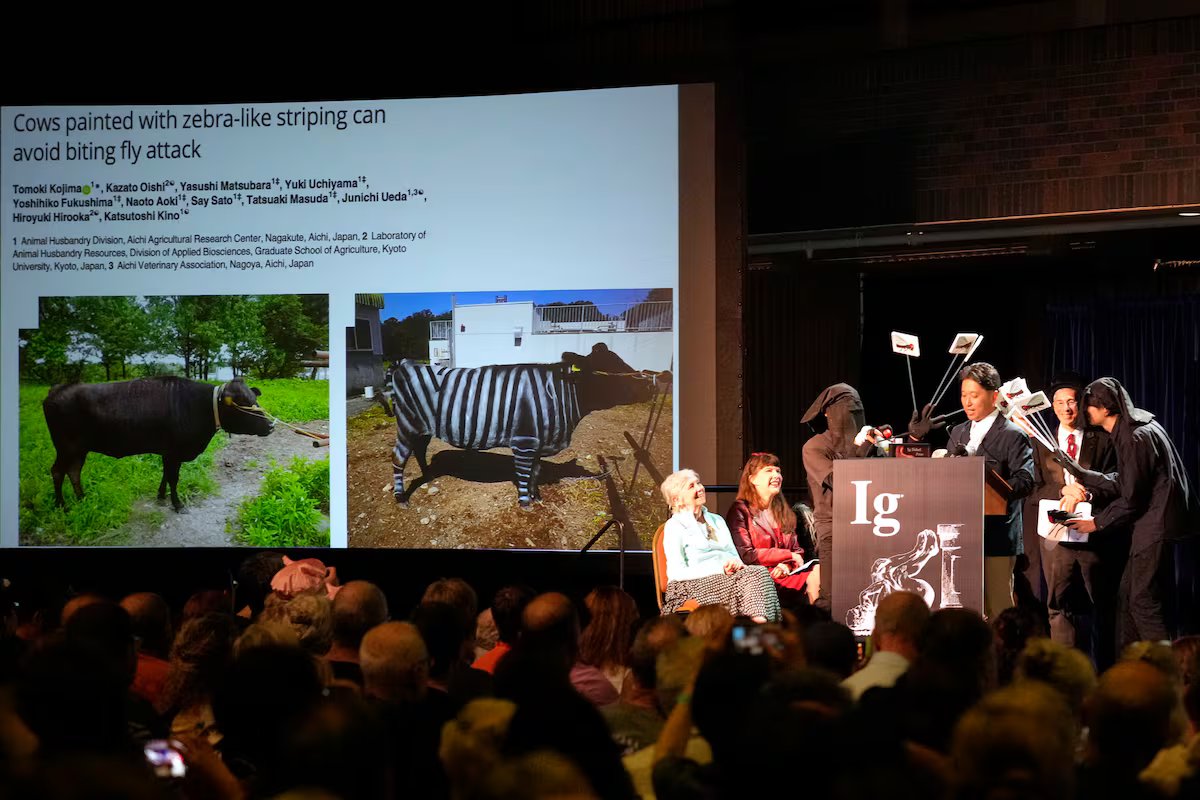
These awards, according to their founder, make you laugh and then think. The Ig Nobels have been held in Massachusetts since 1991; first at Harvard University, then at MIT, and later at Boston University. But their organizers have just announced that they are leaving the United States for the first time. The 36th edition of the awards will take place on September 3 in Zurich, Switzerland. In a press release, Marc Abrahams, founder and master of ceremonies of the event, explains: “During the past year, it has become unsafe for our guests to visit the country. We cannot in good conscience ask the new winners, or the international journalists who cover the event, to travel to the U.S. this year.”
The Ig Nobel Prizes, organized by the journal Annals of Improbable Research, recognize unusual scientific research with a clear mission: to spark curiosity about science through humor. Each year, 10 new winners receive their awards from real Nobel laureates amidst a shower of paper airplanes launched by the audience. Among the 2025 winners were the fly-repelling effect of cows disguised as zebras, the fondness of certain lizards for four-cheese pizza, and the fact that alcohol helps with speaking languages. The prizes celebrate “improbable science” because it is also part of science; according to the prestigious journal Nature, “the Ig Nobel Prizes are undoubtedly the highlight of the scientific calendar.”
Starting in September 2026, the ceremony will be held in collaboration with several Swiss institutions, including the University of Zurich, whose epidemiologist Milo Puhan was awarded the prize in 2017 for demonstrating that playing the didgeridoo (an Aboriginal wind instrument from northern Australia) reduces snoring and sleep apnea. “Switzerland has nurtured many unexpected good things — Albert Einstein’s physics, the world economy, and the cuckoo clock leap to mind — and is again helping the world appreciate improbable people and ideas,” says Abrahams.
The long-term plan envisions alternating the venue between Zurich—every two years—and various European cities in the intervening years, “a little bit like Eurovision,” according to Abrahams. The ceremony will be streamed live online, as it has been since 1995. U.S. researchers won’t be left out of the celebration: there will be an event in Boston on September 24, featuring past winners. “We are merely ensuring that the winners can travel and meet. Despite the current strange winds, science and scientists and the public’s love of science are very much alive and kicking in the U.S.,” the statement reads.
Abrahams’ decision is not a symbolic gesture: it reflects a real crisis in U.S. science. Since Donald Trump began his second term, the U.S. administration has canceled more than 2,400 projects at the National Institutes of Health (NIH), the world’s largest biomedical research organization, and has proposed cutting its budget by 40%, from $47 billion to $27 billion. The National Science Foundation has also eliminated nearly $1.4 billion in funding. The result is a brain drain unprecedented in decades: a survey by the journal Nature, published in March 2025, revealed that three out of four American scientists were considering leaving the country.
This is compounded by an offensive against foreign researchers: last year, the Trump Administration revoked the visas of more than 600 students, professors, and researchers from 90 universities. Cases like that of Kseniia Petrova, a Russian researcher at Harvard detained at Boston airport and sent to a detention center in Louisiana, have filled international scientists who want (or need) to travel to the U.S. with hesitation.
Sign up for our weekly newsletter to get more English-language news coverage from EL PAÍS USA Edition
