

The trial in the United States against the Jensen family is beginning to reveal the criminal structure that allegedly helped them illegally smuggle thousands of shipments of crude oil stolen from Pemex, the Mexican state-owned oil company, into the U.S. EL PAÍS has followed the trail of the intermediary who connects the family of oil magnate James Jensen to the leadership of the Jalisco New Generation Cartel (CJNG), which is in charge of huachicol: the fuel theft business.
Documents included in the trial now reveal the companies on both sides of the border involved in this lucrative business: from the importer in the United States to the transporters operating from Mexico. An investigation by this newspaper reveals a network of shell companies sanctioned by Mexican tax authorities that have smuggled astronomical quantities of petroleum products into Texas through customs, primarily from Tamaulipas. On Thursday, Mexican President Claudia Sheinbaum confirmed that her government has requested Washington extradite the Jensens for their involvement in the smuggling of fuel stolen from Pemex.
The court documents refer to intelligence reports prepared by U.S. security agencies, with the Drug Enforcement Administration (DEA) in the lead. These reports record conversations between agents and a businessman who became an operative for the CJNG cartel and is now cooperating as an informant. This individual, whose identity is being withheld, described having a close relationship with Iván Cazarín Molina, aka “El Tanque,” and César Morfín Morfín, aka “Primito,” leaders of the Jalisco-based criminal organization dedicated to the theft and smuggling of Pemex oil. The informant, now an integral part of the CJNG’s criminal structure, described his role in collecting extortion payments on behalf of the cartel, money which he then used to bribe federal and local officials. According to the DEA, this individual “described a scheme in which Mexican customs agents falsified documents to export certain crude oil products to the United States.”
This is the heart of the case against the Jensens — the patriarch, James Lael; his wife, Kelly Anne; and their two children — who are accused by Washington of having trafficked more than 4,000 shipments of crude oil between 2018 and 2025, falsely declaring them as “‘waste of lube oils’ and ‘petroleum distillates’” in order to avoid paying the corresponding taxes at customs. It is, in every sense, fuel tax evasion, but in reverse: the Jensens are accused of smuggling oil from Mexico into the United States. And there is an aggravating factor: the raw material was allegedly stolen from Pemex.
According to documents from another trial, the Mexican oil company has been reporting the theft of its products — especially gas condensate — and their illegal sale in the United States to the U.S. Justice Department since 2010. James Jensen was already named as one of the accused at that time.
A DEA intelligence report dated November 2024, which is part of the new trial against the Jensens, directly links the firm Luxemborg Trading LLC to the CJNG intermediary (indicating that the company is part of “its businesses”). The DEA also points to money transfers between the informant and Zachary Jensen, one of James Jensen’s two sons, who are also accused of complicity. The Jensens’ defense team has requested that U.S. authorities hand over bank records and a list of Luxemborg Trading LLC’s clients to verify the DEA’s claims. This newspaper contacted the Texas-based company via email to obtain its position on the allegations made in the trial, but the firm did not respond to the request for comment.
The Jensens’ lawyers’ main objective is to prove that their clients were unaware they were dealing with the bloodthirsty CJNG — led by Nemesio “El Mencho” Oseguera — and thus avoid the serious charge of financing an international terrorist organization. What is beyond doubt is the link between the intermediary and the CJNG, and between that same intermediary and the Jensens.
U.S. authorities state that $300-million worth of good were smuggled from Mexico into Texas. According to the DEA informant’s testimony, $2,000 had to be paid to “the cartels” for each shipment. This implies that, of what the Jensens smuggled over seven years, at least $8 million reached El Mencho’s cartel as piso, the term used for extortion payments.
The Mexico connection
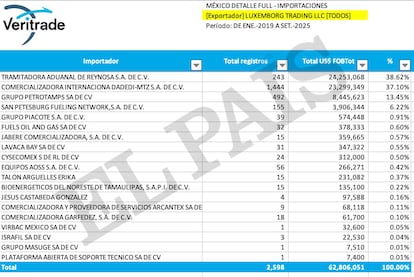
Luxemborg Trading LLC was incorporated in 2010 in Hidalgo County, Texas. It appears to be an ordinary trucking company for moving goods between Mexico and the United States. However, a review of its foreign trade operations reveals it is connected to a network of companies flagged by Mexican tax authorities as shell companies. According to Veritrade records, Luxemborg Trading LLC imported nearly 2,600 shipments of petroleum products from Mexico between 2019 and 2025, valued at $62.8 million. This operation was carried out with the assistance of four firms based in the border city of Reynosa, Tamaulipas, with which it coordinated 90% of its operations.
In 2025, the Mexican tax authority (SAT) classified two of these firms — Tramitadora Aduanal de Reynosa, S.A. de C.V. and Grupo Petrotamps, S.A. de C.V. — as shell companies that simulate transactions to evade taxes or launder money, commonly known as factureras or fraudulent invoicing companies. Luxemborg Trading LLC registered 243 transactions with Tramitadora Aduanal de Reynosa valued at $24.2 million, making it the largest service provider for the Texas importer. Grupo Petrotamps made 492 shipments to it, valued at $8.4 million. A third company, San Petesburg Fueling Network, S.A. de C.V., sent 155 shipments worth $3.9 million.
Of all Luxemborg Trading LLC’s Mexican transporters, one stands out by far: the mysterious firm Comercializadora Internacional Dadedi‑Mtz, S.A. de C.V., which handled 1,444 shipments and billed $23.3 million, making it the company’s second‑largest supplier. Very little can be learned about this firm from public sources. Founded in January 2019, it lists its tax address at a small storefront whose modest appearance contrasts sharply with the millions it has received. In 2021, the SAT placed it on the list of suspended importers and exporters for regulatory violations. Despite that, in the following years — and up until 2024 — Dadedi‑Mtz continued carrying out operations for Luxemborg Trading LLC, according to Veritrade records.
The Texas importer has a subsidiary on the southern side of the border called Luxemborg Mexico Fuel Group, S.A. de C.V. This company, along with Grupo Petrotamps and San Petesburg Fueling Network, shares both an address and the shareholder Néstor García Luna, according to business documents from Mexico’s Ministry of Economy. In turn, Adalberto Pérez Rocha, legal representative of both San Petesburg and Luxemborg Mexico, is listed as the accountant for Dadedi-Mtz, according to the latter company’s website.
Veritrade records indicate that 85% of shipments from Mexico to Luxemborg Trading LLC in Texas crossed the border by truck through the Reynosa customs office. Thirteen percent arrived by rail through the Matamoros and Nuevo Laredo customs offices, which is also in Tamaulipas. The remainder, a smaller portion, was shipped by sea from the ports of Coatzacoalcos and Tuxpan, Veracruz.
The records reveal what Luxemborg Trading LLC declared it was importing into the United States from Mexico. The vast majority of shipments (89%) were registered under a tariff classification that does not correspond to crude oil — its official designation is “crude petroleum oils.” Instead, Luxemborg Trading LLC registered the shipments as oils, lubricants, additives, diesel, and gasoline. These records support Washington’s theory that the crude oil trafficked by the Jensens and the CJNG is registered under different tariff classifications to evade paying duties.
But the shipping records alone do not capture the scale of what was trafficked or the operating methods. The company Comercializadora Internacional Dadedi-Mtz alone registered shipments of 113 million liters of product classified as oils and additives between 2021 and 2024. It often crossed material on the same day simultaneously through several border customs posts, by both road and rail.
Tramitadora Aduanal de Reynosa brought in 58 million liters of material registered as “diesel oil (gasoil)” and high‑octane gasoline in 2019 and 2020; the vast majority of that product (88%) was shipped by vessel from Tuxpan, Veracruz, packed in barrels between March and May 2020.
Grupo Petrotamps operated exclusively through the Reynosa customs post, where it transported nearly 21 million liters of product — reported as biodiesel, gasoil, or gasoline — between 2019 and 2021.
San Petesburg Fueling Network operated only in 2021, during which it transported 19 million liters of material registered mainly as “lubricating oils,” “oxidation inhibitors,” or “light oils.”
An investigation by TV program N+ links the constellation of Luxemborg‑related companies in Mexico to Luis Ariel Rivera Rodríguez, an individual who was arrested in the United States more than 15 years ago for fuel smuggling and money laundering. Rivera, who later became a protected witness, described at the time the scheme to steal gas condensate from Pemex and smuggle it into the United States. The state‑owned oil company reported losses of $300 million to U.S. courts and accused several U.S. companies of profiting from the theft. At the time, Pemex said the Gulf Cartel and Los Zetas controlled the fuel theft business. After regaining his freedom, the N+ report says, Rivera returned to the Pemex‑theft scheme, this time collaborating with the CJNG and the Jensen family.
Sign up for our weekly newsletter to get more English-language news coverage from EL PAÍS USA Edition
