
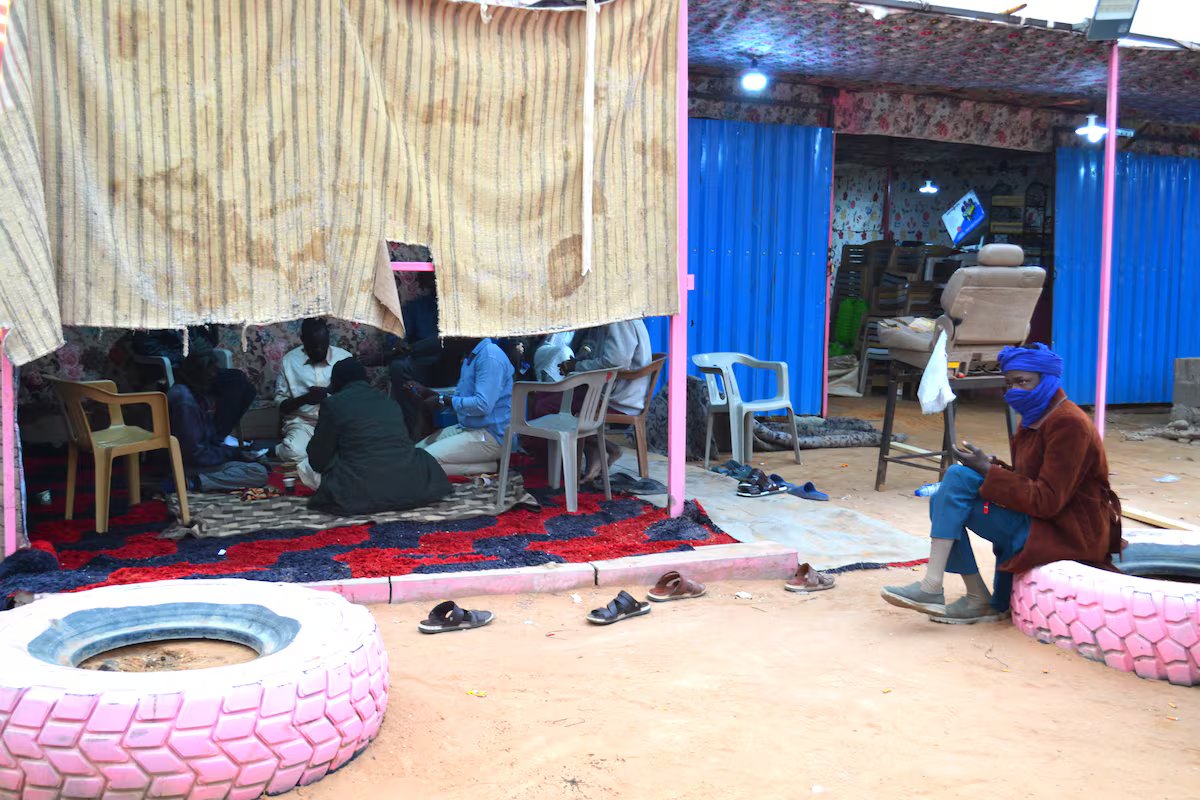
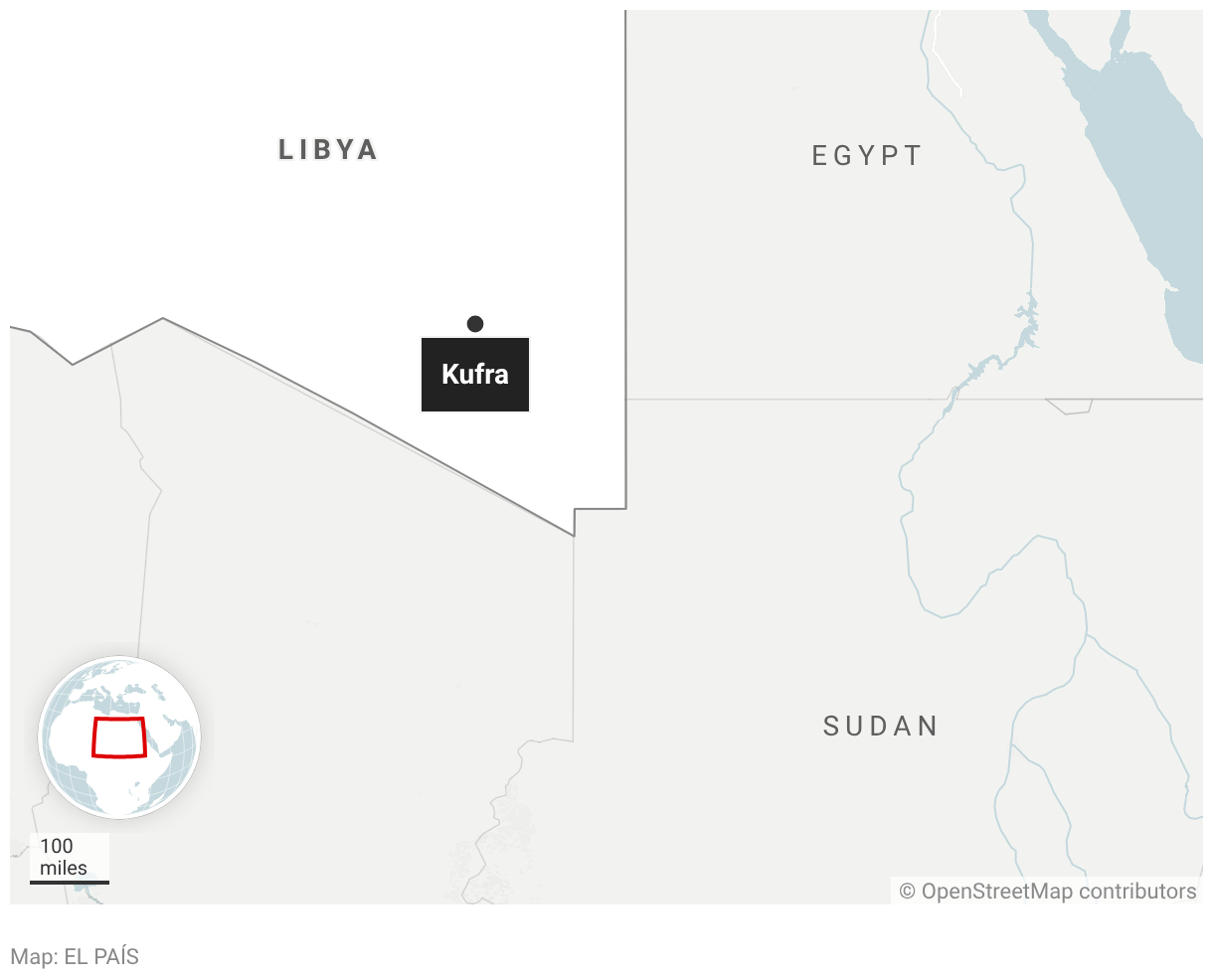
It’s just like being in Sudan, or almost. In her café, framed by colorful fabrics and with a clay floor, Nafissa Boubaker prepares coffee the way they do back home, with spices. However, this 39-year-old mother is far from her homeland: it took her a month and 20,000 Sudanese pounds (around $32), a “fortune” for her, to reach Kufra, the first Libyan city accessible from the southern borders of Egypt, Sudan, and Chad.
For the past four months, Nafissa has worked at this café nestled between two farms — the name given to uncultivated agricultural lands that have housed Sudanese people in makeshift camps since the start of the war in April 2023. There are eight of these farms in the city of Kufra. “My husband is sick and can’t work,” Nafissa explains. “I earn between 100 and 120 Libyan dinars a day, which allows us to more or less feed ourselves.” A veritable commercial hub has sprung up around her café, which is also owned by a Sudanese man. Shops, constructed from tree branches, fabric, tarpaulins, sheet metal, or bricks, line the streets: fruit and vegetable vendors, grocery stores, clothing and shoe shops, places to charge phones, smoke shisha, play cards, or even pool. Trucks arrive regularly to unload goods. It’s a place that seems quite organized and designed to last.
According to the United Nations High Commissioner for Refugees (UNHCR), the Sudanese civil war, which has pitted the regular army against the Rapid Support Forces militia since April 2023, has forced nearly 12 million Sudanese to flee their homes. Of these, more than three million have left the country, with 550,000 arriving in Libya, which has become the second most popular destination after Chad. Between 40,000 (according to the UN agency) and 60,000 (according to the municipality) Sudanese are currently estimated to be in Kufra, almost as many people as its usual population. These figures are difficult to verify due to the movement of people towards coastal cities and the vastness of the borders (1,585 miles across the desert).
The residents of Kufra have long known the Sudanese, accustomed to trading with these neighbors. They also share the same religion. The same cannot be said for other migrants. They often end up in detention centers and are invisible on the streets of Kufra. So much so that Mohammed Halafi, an English teacher at a Libyan school, acknowledges: “When a Sudanese person loses their papers, we organize a meeting where we question them to make sure they are one of us. Often there are Chadians trying to pass themselves off as Sudanese.”
When a Sudanese person loses their papers, we organize a meeting where we question them to make sure they are one of us. Often there are Chadians trying to pass themselves off as Sudanese
Mohammed Halafi, English teacher
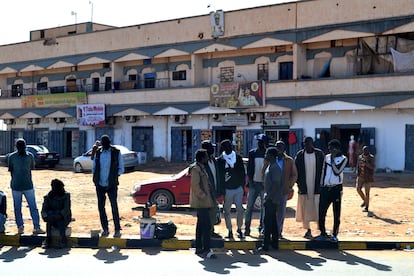
In Kufra, Sudanese people are everywhere. Porters, receptionists, waiters, teachers, laborers. They sit in groups at the roundabouts, waiting for someone to hire them for a day. This is the case for Morsin, 35. He fled El Fasher, where the Rapid Support Forces have committed “hallmarks of genocide,” according to a UN report published on February 19, along with his parents, his wife, his two children, and his sister. “Here, Libyans treat us like brothers,” explains this former shopkeeper, who is doing relatively well. He earns between 1,000 and 1,200 Libyan dinars (between $154 and $185) a month, which has allowed him to rent an apartment in the city. His sister, Thara, works as a doctor in a Kufra hospital. The city, geographically isolated and historically marginalized, has suffered from a shortage of healthcare workers for years. According to the municipality, over 70% of Kufra’s medical staff are Sudanese. “I can’t complain,” Thara admits. “But it’s not easy every day: we still need doctors. And we haven’t been paid for eight months.”
Refugee ‘farms’
Other Sudanese live in far more precarious conditions. Eight camps have sprung up in Kufra. The inhabitants refer to them as “farms,” because they are abandoned agricultural plots. At the Krik farm, Khaled Fadel Allah has become the leader. At 53, this former trader was one of the first to settle here. “In October 2023, we ran out of gas in the Libyan desert, 40 miles from Kufra. The owner of the farm found us and brought us here.” Krik was initially a particularly important transit point. It has gradually emptied out as people move to the city center and to other Libyan cities in the north.
My sister and her husband died from a shell. I have no other goal for my future than to escape the war
Khadija, Sudanese refugee
The closure of the border with Sudan in July 2025 reduced the number of arrivals: since then, Sudanese refugees have had to pass through Chad. Only those who could pay around $60 per person could continue on to Libya. On February 23, Chad also announced the closure of its border with Sudan, further complicating the passage for refugees. Today, Khaled Fadel Allah reports that 380 families have settled permanently in Krik.
This is the case of Khadija. At 29, she already has a lifetime of exile behind her: she fled South Sudan, her homeland, to escape the conflict, settling first in El Bahri, near Khartoum, before fleeing again. “My sister and her husband died from a shell. I have no other goal for my future than to escape the war.” A mother of four, she survives on donations. These sometimes arrive directly at the camp from Libyan families. Aid from international organizations is more regulated: to receive it, one must have a refugee card issued by the Libyan authorities. To obtain this, one must undergo a blood test to detect possible communicable diseases, have a Libyan “sponsor,” and possess valid identity documents. It costs 500 Libyan dinars ($77). Therefore, it is not within reach of those most in need.
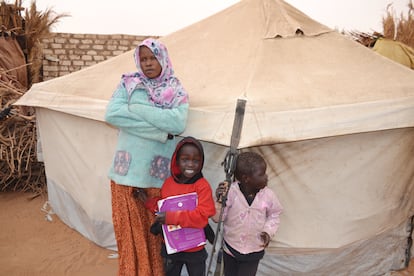
At the camp, shelters made of branches, palm fronds, and fabric line the walls that define the property. In the center, the landowner has installed a water tank. In one corner, UNICEF’s mobile toilets emit a nauseating odor. On the opposite side, two Sudanese men, paid by the NGO Première Urgence Internationale (PUI), are building a drinking water filtration station. This is the French NGO’s last project in Kufra: it left Libya at the end of January as a result of funding cuts imposed by the Trump administration.
Khaled Fadel Allah opens the doors of his “office,” a brick building that was meant to serve as a warehouse. On the wall, he proudly displays a photo of the 100 dromedaries offered during the last Eid by Khalifa Haftar, a high-ranking commander of the self-proclaimed Libyan Arab National Army, which controls the east and south of the country.
That day, the US-based NGO International Medical Corps (IMC) sets up in the office to offer gynecological consultations. Outside, a dozen women, wrapped in colorful fabrics, wait. Dr. Salima Mohamed Akanshi’s work mainly consists of treating women suffering from vaginal infections due to poor hygiene and monitoring pregnancies. The Libyan doctor has assisted in a dozen births since January. These take place in public hospitals and are free of charge. “Some women seek to become pregnant. I think it’s a form of psychological support for a mother who has lost a child during the war, a way of trying to fill a void,” reflects Akanshi.
Psychologists are in short supply, while the refugees have experienced particularly traumatic events. The issue of medical care is even more critical because IMC doesn’t know what will happen beyond April. “Libya has been underfunded in recent years because it is considered stable, despite the humanitarian needs,” explains Talal Burnaz, head of mission in Libya.
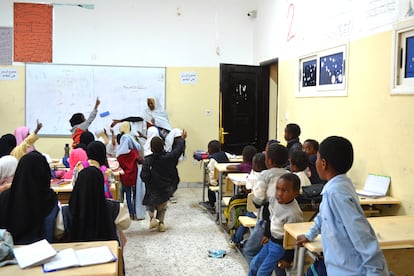
A short distance away, at the Martyrs of Al Ajhar School, the atmosphere is joyful. This Libyan public school welcomes 900 Sudanese children between the ages of six and 17 every afternoon — Libyan children only attend classes in the morning. These children live in camps or in housing in the city, as do their 30 teachers, who follow the Sudanese curriculum. Most are volunteers, although the school administrators are considering asking for contributions from parents who can afford them.
“The teachers are also refugees; they need to eat. On the other hand, it’s very important that the children return to school. Some haven’t set foot in one for three years,” explains Halafi, an English teacher at a Libyan private school and volunteer director of the Sudanese school, who is appealing to international organizations: “We need books, notebooks, pens, transportation from the farms to the school…”
The Kufra municipality has made three schools available. In his office, dominated by a huge portrait of Khalifa Haftar, the new mayor, Mohammed Abdulrahim Boumriz, repeats: “The refugees are our guests. We have received orders from the High Commander to take care of our guests. They are our brothers.”
Sign up for our weekly newsletter to get more English-language news coverage from EL PAÍS USA Edition
