
“Sooner or later, everyone needs a haircut”
Described by Joel Coen as the story of “a barber who wants to be a dry cleaner,” The Man Who Wasn’t There doesn’t sound all that enticing on paper, but this being a Coen brothers film, there’s a lot more to it. The result is one of the brothers’ most quietly ambitious films, where the mundanity of the premise belies the James M. Cain-inspired fatalism and the heavy noir atmosphere that infuses every frame.
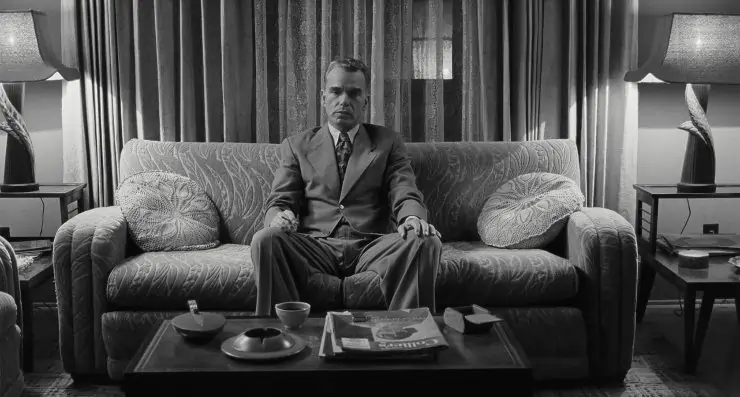
Set in 1949 Santa Rosa (in what feels like a nod to Hitchcock’s Shadow of a Doubt), the film follows Ed Crane (Billy Bob Thornton), a taciturn barber working for his more loquacious brother-in-law (Michael Badaluccio). Ed drifts through life with an impassive stare and a permanent cigarette dangling from his lips, barely registering the world around him. His wife Doris (Frances McDormand) works at a department store owned by the blustering Big Dave (James Gandolfini), and it doesn’t take long for Ed to suspect their relationship is more than professional. When a flamboyant businessman (Jon Polito) pitches Ed on investing in a new dry-cleaning venture, Ed’s actions set in motion a series of events that quickly spiral out of control, involving blackmail, adultery, murder, and even UFO sightings. It’s a plot that sounds absurd, but is played completely straight, unfolding with the grim inevitability of classic noir.
The Coens had flirted with noir before – Blood Simple remains one of the great neo-noirs, and Miller’s Crossing channels Dashiell Hammett in a gangster setting – but The Man Who Wasn’t There is their most overt step into the genre. Beautifully shot in luminous monochrome by Roger Deakins, the film is drenched in shadow, smoke and hard-edged light, emulating the high-contrast chiaroscuro of cinematographer John Alton.
The timing of this release from Criterion is interesting, coming so soon after the release of Guillermo Del Toro’s Nightmare Alley. They are an interesting double feature, both steeped in film noir; one a remake, the other an original story. I’m a big apologist of Del Toro’s film, but there’s no comparison between the two. Where Nightmare Alley had all the plot beats and trappings of film noir, it plays almost like a heightened, melodramatic pastiche of noir. The Coens’ film is superficially atypical of noir – there aren’t any gangsters, there isn’t a femme fatale or a heist or anything like that. However, it feels so much more authentically a love letter to the genre. There are visual nods to The Night of the Hunter, and The Lady from Shanghai, but what separates the film from lesser homages is its specificity.
Rather than checking off noir tropes as they go along, the Coens clearly base the film around the moral fluidity and grim irony of James M Cain. The petty greed, the sordid nature of the affair, and the idea of ordinary people wreaking devastation through small choices, and the final irony of Ed being tried for the one crime he didn’t commit, all feels reminiscent of the plots of Double Indemnity, The Postman Always Rings Twice and Mildred Pierce. Similarly, the characters are less archetypes than they are based on specific roles from noir. Doris isn’t a femme fatale – she has a lot more in common with the world weary characters played by Marie Windsor. Jon Polito’s sweaty salesman is based in part on Marc Laurence’s fink from The Asphalt Jungle, and the defence attorney Freddy Riedenschneider feels like a direct reference to Hume Cronyn’s cocksure lawyer in The Postman Always Rings Twice. Even Ed’s relationship with young ingenue Birdy (Scarlett Johansen) feels like a nod to similar relationships in Double Indemnity and Shadow Of A Doubt.
At the centre of it all is Ed Crane, and Billy Bob Thornton’s performance is a masterclass in conveying a lot while seemingly doing nothing. Ed’s stoicism make him seem the typical laconic noir protagonist, but the truth is that Ed just isnt that bright. As the title suggests, he’s just not there. In many ways he feels cut from the same cloth as Meursault from Camus’ The Stranger, someone who is completely disconnected from society, observing from an outsider’s perspective, as demonstrated in his increasingly disturbing ruminations on hair (“it just keeps growing”) and the ever present subject of his own masculinity. Several characters ask him “what kind of man are you?” and each time he doesn’t have an answer. Ed isn’t a hard-boiled antihero undone by fate; he is a man who drifts into disaster because he cannot fully engage with his own life.
The Coens have been accused of misanthropy before, in mocking their characters and delighting in their downfall, and while there is an element of that here, the final stretch is so poignant it’s difficult to really accept this point of view. In fact, the characterisation of Ed seems to be a deep condemnation of the pitfalls of what happens when you detach from family, from society, from life itself.
McDormand is superb as Doris, especially in her devastating reaction when Ed lays out exactly what happened, only for his confession to be brushed aside immediately. It’s a beautifully observed, subtle, heartbreaking non-verbal moment. Meanwhile, Riedenschneider is just about the perfect side character; he comes in, steals the film with his dynamism, then leaves before we get tired of him. His speech about the uncertainty principle is quite possibly the highlight of the film – it’s a thoughtful, almost hypnotic scene that draws you in so much you almost miss how absurd it is. It helps that it’s beautifully shot, as he walks between beams of light and the shadows of the prison bars. The Coens wrote the part for Shalhoub, and he’s perfect, a flipside of his neurotic producer from Barton Fink. Gandolfini is also great, showing so much versatility in only three scenes, deftly changing from jocular bonhomie to genuine menace. Richard Jenkins takes what is on paper a throwaway role, and makes it one of the most memorable in the film, doing some of the best drunk acting on film.
An enthralling, dryly comic, melancholy film, The Man Who Wasn’t There is at once atypical and entirely in keeping with the Coen brothers’ style. While more subdued than some of their more flashy, crowd-pleasing works, it’s one of their most existential, thought-provoking and moving films, as well as being a heartfelt tribute to noir, and up there with their very best. Not bad for a film about cutting hair!
Special Features
The big draw here is the 4K restoration which looks absolutely stunning. Aside from this, there aren’t many extras which weren’t already available on the previous DVD release, including a commentary with the Coens and Thornton, an interview with Roger Deakins and a Making Of documentary. The only new feature is a neat conversation between the Coens and author Megan Abbott about the film, where they discuss their influences, and the film’s production.
★★★★★
Released on 2nd March / Billy Bob Thornton, Frances McDormand, James Gandolfini, Tony Shalhoub / Dir: Joel & Ethan Coen / The Criterion Collection / 15
Related
Discover more from
Subscribe to get the latest posts sent to your email.
