
The Middle East is holding its breath after the United States and Israel launched a “major combat operation” against Iran on Saturday — a move which could drag the region into a war of attrition marked by attacks and reprisals. Unlike the last attack in June 2025, U.S. President Donald Trump has not only threatened to destroy Iran’s nuclear program, but has also spoken of regime change, prompting Tehran to adopt survival mode.
In the face of U.S. military power, Tehran is weighing options such as attacking U.S. bases and troops in the Middle East — where between 40,000 and 50,000 personnel are deployed — launching an offensive against Israel, or against the U.S.-allied monarchies in the Persian Gulf. It could also disrupt oil and goods trade through the Strait of Hormuz.
Presencia permanente de EE.UU.
Bases de apoyo
Barcos de EE.UU.
Portaaviones
Países donde Irán puede activar milicias aliadas
“The Gulf countries are very nervous because they know it is they who will be left to clean up the damage and to bear the consequences, both in their markets and in domestic public opinion,” says Negah Angha, a visiting researcher at King’s College London and a former political adviser at the United States National Security Council during the presidency of Joe Biden, in a telephone interview from London. Twenty percent of the world’s oil production passes every day through the Strait of Hormuz, within range of attacks by the Houthis in Yemen, or by Iran itself.
In December 2024, the fall of Bashar al-Assad and the rise of Ahmed al-Sharaa, a former commander of the local branch of Al-Qaeda, to the presidency in Syria broke the Shiite axis that linked the country with Iran. Al-Shara, who leads a national army made up of Salafist Sunni militias, has reshaped Syrian politics, aligning it with the United States and detaching it from the so-called pro-Iranian “axis of resistance.”
The withdrawal of U.S. troops — around 1,000 remain on Syrian soil — and the weakening of the pro-Assad Alawite insurgency in Syria have reduced the likelihood of attacks within and from the country. At the same time, the shift in Damascus’s foreign policy has closed off Iran’s ability to project influence across a continuous land route linking Iran to Lebanon through Iraq and Syria.
The aggressive war waged by Israel in the region since the Hamas attacks in October 2023 — with air strikes in Lebanon, Syria, Iraq, Iran, Qatar and Yemen, as well as in Gaza Strip — has clearly weakened Iran’s ability to respond through its network of allies in the region, though it has not eliminated it entirely. These are the main groups aligned with Tehran.
The Houthis in Yemen: The only group capable of carrying out attacks at sea
The Houthis are militants who follow a form of Islam distantly related to the Shiite branch and have been fighting the government of Yemen for nearly two decades. In 2015, they seized control of the country’s northwest and its capital, Sana’a. According to data from the United Nations, their armed wing, Ansar Allah, has between 200,000 and 300,000 fighters. Following the weakening of the Lebanese militia Hezbollah, the Houthis have become Iran’s strongest asset in the region.
“The Houthis’ capabilities should not be underestimated — they are greater than those of any other pro-Iranian group, and they are seeking greater visibility. They are the only militia able to strike maritime targets, whether with drones, missiles, or fast boats,” explains expert Laura Silvia Battaglia, the author of the book Los partisanos de Alá (The Partisans of Allah) on Iran’s allies, in a phone interview from Milan.

Since 2016, the Houthi militia Ansar Allah has demonstrated its ability to carry out attacks in the Red Sea against warships — such as the U.S. destroyer USS Mason or the Emirati vessel HSV-2 Swift — Saudi oil tankers in the strategic Bab el‑Mandeb Strait, as well as ships carrying commercial goods or weapons bound for Israel.
“The market is nervous, and insurers of merchant vessels are nervous even before an attack actually takes place,” notes the researcher Angha.
Hezbollah, decapitated but still capable of causing damage
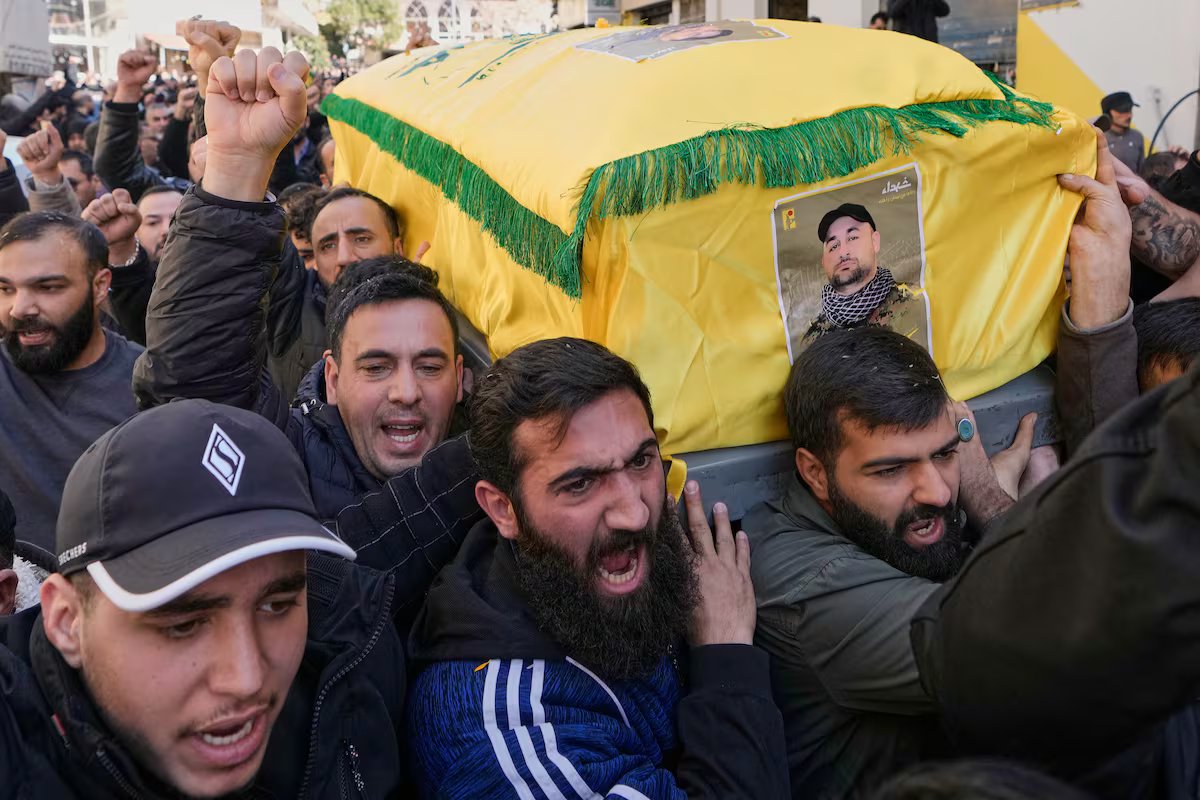
The fact that the United States announced on Monday the evacuation of non-essential staff from its embassy in Beirut — the second-largest U.S. diplomatic mission after the one in Baghdad — shows that the Shiite militia-party Hezbollah still has the capacity to attack U.S. targets in Lebanon. It also retains a stockpile of rockets and drones capable of striking military targets throughout Israeli territory.
Israel has already warned the Lebanese government through indirect channels that it has drawn up a list of 1,200 targets in Lebanon in the event that Hezbollah responds to an attack against Iran. The Lebanese government, which has adopted a damage-control policy, is working to exclude civilian targets and Beirut airport — the country’s only air gateway for citizens— from that list.
Founded in 1982 as a resistance movement against the Israeli occupation of southern Lebanon, Iranian sponsorship turned Hezbollah into a state within the Lebanese state and into the most powerful militia in the region, with an army of 30,000 fighters according to the United Nations. But Israel has managed over the past 28 months to decapitate its military leadership after killing its leader, Sheikh Hasan Nasrallah, and eliminating more than 5,000 fighters. It has also succeeded in neutralizing its communications system and destroying 70% of its military arsenal.
Nasrallah, a strategist and adviser to Tehran, has been replaced as secretary-general by Naim Qassem, who is considered subordinate to Tehran’s directives. In a televised speech, he said that the party’s “right to defense and to resistance is legitimate.”
The ceasefire with Israel in November 2024 entails, on the part of the Lebanese government, a commitment to disarm Hezbollah and to deploy the regular army south of the Litani River, along the Israeli border and in the Shiite group’s stronghold.
Iraqi militias: The closest to US bases
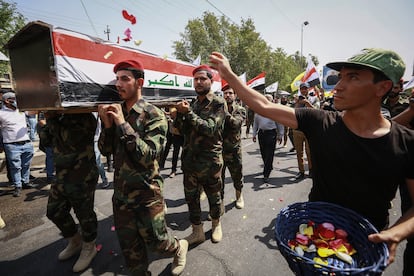
The Popular Mobilization Forces (PMF), better known as Hashd al-Shaabi, have become a powerful network of pro-Iranian militias on Iraqi soil, with between 100,000 and 150,000 fighters in their ranks, according to estimates from the U.S. Department of Defense. Created in 2014 to fight the Islamic State (ISIS), they gained extensive combat experience during the three-year anti-terror campaign. Today, these militias are part of Iraq’s state security apparatus.
Washington still maintains around 2,500 Marines in Iraq, who have been repeatedly targeted with drones and rockets by the PMF. The PMF is made up of several armed groups, many of which now have representatives in the Iraqi Parliament, making them more vulnerable to U.S. pressure, as the U.S. conditions economic aid to Iraq on the disarmament of these militias.
Although they stayed on the sidelines during the 12-day war fought last year between Iran and Israel, one of these militias, Kataib Hezbollah, with several thousand members, has already announced that it is prepared for “total war” in case of an attack on Iran. The PMF “could attack bases in Gulf countries: Qatar, the most important in the region; Bahrain, for its role in naval support; and Abu Dhabi, which houses F-16 fighter jets,” says Battaglia.
Sign up for our weekly newsletter to get more English-language news coverage from EL PAÍS USA Edition
