

15,800 years ago, on a volcanic plateau in central Anatolia (Turkey), a dog gave birth to a litter of puppies. They died very young, at perhaps just a few months old. The humans who lived at the Pınarbaşı site deliberately buried them in the same area where they laid their own dead to rest. They fed them fish, the same fish they ate. And one of those puppies is now the oldest genetically identified domestic dog, and its story — reconstructed from bone fragments the size of coffee beans — has just been published in the journal Nature, in two simultaneous studies that rewrite the history of how that puppy became humankind’s best friend.
Until now, the earliest genetic evidence of domestic dogs dated back approximately 10,900 years, found at a Mesolithic site in Karelia, Russia. New research, authored by scientists from 17 international institutions, pushes that date back more than 5,000 years, to the late Upper Paleolithic, when all humans were still hunter-gatherers and no other domesticated animals existed. “We are talking about 6,000 years before humans began to live alongside cows, goats, or pigs, and more than 10,000 years before horses,” said researcher Lachie Scarsbrook of the University of Munich, co-author of the lead study, during a press conference held to present the research.
The first study, led by William Marsh of the Natural History Museum in London and Scarsbrook, analyzes canid remains from two sites: Pınarbaşı, on the Central Anatolian Plateau, and Gough’s Cave, in Somerset, UK. The fragments from Pınarbaşı are extraordinarily small — “like freeze-dried coffee,” Scarsbrook described — but the team still managed to extract enough nuclear DNA to confirm that they were domestic dogs and not wolves, and to date the oldest specimen to 15,800 years ago.
The second study, authored by Anders Bergström and Pontus Skoglund of the Francis Crick Institute in London, analyzed more than 200 European canid remains dating from 14,000 to 1,000 years ago. Among them, it confirmed the status of a long-debated specimen found in Kesslerloch, Switzerland, and dated to 14,200 years ago: it had already been proposed as a domestic dog based on its morphology, but that status remained under debate. “We can now confirm that it was indeed a dog,” Bergström noted.
The most striking finding for researchers is that the dog from Pınarbaşı and the one from Gough’s Cave, separated by almost 2,500 miles, were genetically almost identical. Their common ancestors lived around 16,900 years ago, just a few centuries before the animals themselves. This implies that a highly homogeneous dog population had spread with extraordinary speed across Western Eurasia before the end of the last Ice Age.
Dogs are the same, humans are different
The paradox is that the humans who lived alongside these dogs were very different from one another. Gough’s Cave was inhabited by Magdalenian hunters, adapted to the extreme cold of northern Europe. Pınarbaşı was inhabited by Anatolian hunter-gatherers who also exploited aquatic resources. “Before this study, we didn’t know that these two communities had any form of interaction,” Marsh noted. “And it turns out they shared dogs.” The discovery forces us to revise our understanding of Paleolithic cultural exchanges: dogs circulated between genetically distinct human groups, possibly as valuable goods or hunting tools.
Bone analysis confirmed that the dogs at both sites ate the same food as their owners. At Pınarbaşı, the remains point to a diet with an aquatic component, consistent with the freshwater fish remains found in the human layers of the site: the humans likely fed them the same fish they consumed. At Gough’s Cave, the diets of the dogs and humans were virtually indistinguishable.
The symbolic relationship was also very intense in both cases. At Pınarbaşı, the puppies were buried alongside the humans, with the same funerary rituals. At Gough’s Cave, where humans practiced ritual cannibalism — the skulls of their dead were transformed into cups and the bones showed human tooth marks — the dog’s jawbone had a deliberate perforation identical to the type of postmortem modification made to human remains. This means that, 2,500 miles apart, two radically different cultures treated their dogs in ways analogous to how they treated their dead. “Even 16,000 years ago, these animals seemed to have symbolic importance for these humans,” Marsh said.
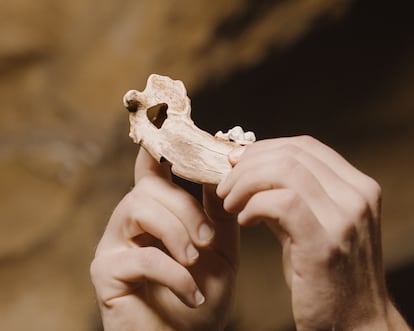
The second study yielded another surprise: when farmers arrived in Europe from southwest Asia around 8,000 years ago, they genetically replaced between 80% and 90% of the continent’s human population. But the hunter-gatherer dogs didn’t disappear: they contributed roughly half of the ancestry of the new farmers’ dogs. “Hunter-gatherer humans were almost genetically erased. Their dogs weren’t,” Bergström noted. That lineage persists to this day: modern European dogs, from the German Shepherd to the Saint Bernard, carry the imprint of these Pleistocene animals in their genome.
Two crucial questions remain unanswered. The first is exactly where and when domestication occurred. No one has yet identified the gray wolf population from which all domestic dogs descend. Both studies point to western Eurasia as the most likely area of origin, but the mystery persists. Researchers believe that genetic diversification in dogs from 16,000 years ago suggests that domestication occurred several thousand years earlier. The second question is what role these early dogs played in Paleolithic societies. “We can’t know for sure, but they must have served some specific purpose; perhaps as alarm systems or in hunting, because they were expensive to feed,” Frantz reflected. “And yet, children probably played with the puppies.”
Sign up for our weekly newsletter to get more English-language news coverage from EL PAÍS USA Edition
