
Malick, a graduate of Harvard’s philosophy department, featured similarly philosophical conventions and naturalistic cinematography in his earlier works like Badlands and Days of Heaven. But The Tree of Life manifests these devices in a more experiential capacity by infiltrating the senses of the viewer. Lubezki’s camera takes an almost POV angle to its surroundings, and places just as much importance on leaves or curtains blowing into the home or the sun webbing through the treetops as it does to its human subjects. The film simulates memory, forgoing narrative structure and instead jolting between various associative images. The Tree of Life has been described as kaleidoscopic, a ‘tone poem’, and a work of neo-expressionism that defies categorization altogether. Even the New Yorker’s David Denby, who called the film “insufferable” in his review, admitted that, years after its release, “the movie will be remembered as a freshening, even a reinvention, of film language.”
The Tree of Life was so singular in its vision that it established a legacy which is infinitely repeatable, yet impossible to exact. Even Malick himself has struggled to recreate its glory. The film has such an essence that, once you move past the alleged solipsism and surrender to its majesty, you experience a brush with the sublime. Even so, its once-innovative style, so choppy and expressionistic, can be easily divorced from the sublimity it wishes to evoke.
Recently, I pushed Kevan on his claim about the film’s stranglehold over commercials. Surely he was exaggerating. To my surprise, however, he tells me that in his own extensive experience with directing commercials, the influence is very literal. Commercials are a limited medium – they’re restricted by the needs of corporate clients, time constraints, and minimal dialogue. It’s thus, by necessity, a heavily visual medium. So commercial directors often work with visualists, people who pull images from all over the place and create visual decks from which to build upon, often on softwares like Shot Deck and Frame Set. And Kevan laments that, “Especially within the decade after the movie, it got to a point where you’d actually have to tell [these visualists] ‘I don’t want anything from Tree of Life.”
It’s commonplace in the making of dramatic commercials, Kevan tells me, for clients to ask for a style known as “elevated documentary.” This gives the commercials a look of cinematic prestige while still being able to shoot with real people, which is why The Tree of Life, with its associative imagery and natural lighting, appears frequently in the decks. As a consequence of these limitations, its visual language becomes an easy shorthand for profundity.
This visual language can be seen in a vast range of advertising: a Barossa Valley tourism campaign, a four-minute film to promote Volvo’s “Made in Sweden” campaign, a star-studded ad for Gucci Bloom, or even an uncharacteristically sentimental Walmart commercial. Jump to any dramatic commercial made in the past decade or so, and it’s likely you will find The Tree of Life in there, from whispers to direct imitation. Kevan himself has directed some of his own.
Kevan’s view of the commercial advertising industry is a rather cynical one: “Commercial advertising doesn’t push culture forward. It follows it.” Aided by advances in digital technology, it’s easier than ever for directors to mimic profundity without clocking in the years it took Malick to make his masterpiece. The utter volume of the style alone has proven that it’s a rather profitable venture.
Commercial advertising is not the only medium to be smitten with The Tree of Life. Its influence appears in narrative filmmaking as well. Before Train Dreams, there was Beasts of the Southern Wild, The Assassination of Jesse James by the Coward Robert Ford, Waves, Nickel Boys, and most recently Hamnet among others – all of which speak Malick’s language, to varying extent and effect.
Like The Tree of Life, Train Dreams is a similar meditation on grief that is both minute and grand in scale. Grainer is an introverted railworker who is briefly taken from his solitude when he starts a family with his freespirited wife, Gladys (Felicity Jones), but is quickly shoved back into the dark when she and their young daughter Kate are killed in a wildfire. His devastation keeps him chained, for better or worse, to a life of hermitude at a time where societal change was moving at an unprecedented pace.
Train Dreams is a sweet film. You come to genuinely like Grainer, you want to help him, maybe reach through the screen and hug him. But watching it I was struck by two things. First, by its palpable reverence for The Tree of Life. Second, for the rather dispassionate response it evoked in me, when compared to my experience watching Malick’s film. There are techniques shared by both films that once left Robert De Niro’s Cannes jury so dumbfounded they awarded The Tree of Life the Palme d’Or for the simple fact that it “ultimately fit the bill.” But I was not at a loss for words watching Train Dreams, and instead felt that the film’s meditative and expressionistic cinematography actually kept me at a distance from the psyche of this already opaque character.
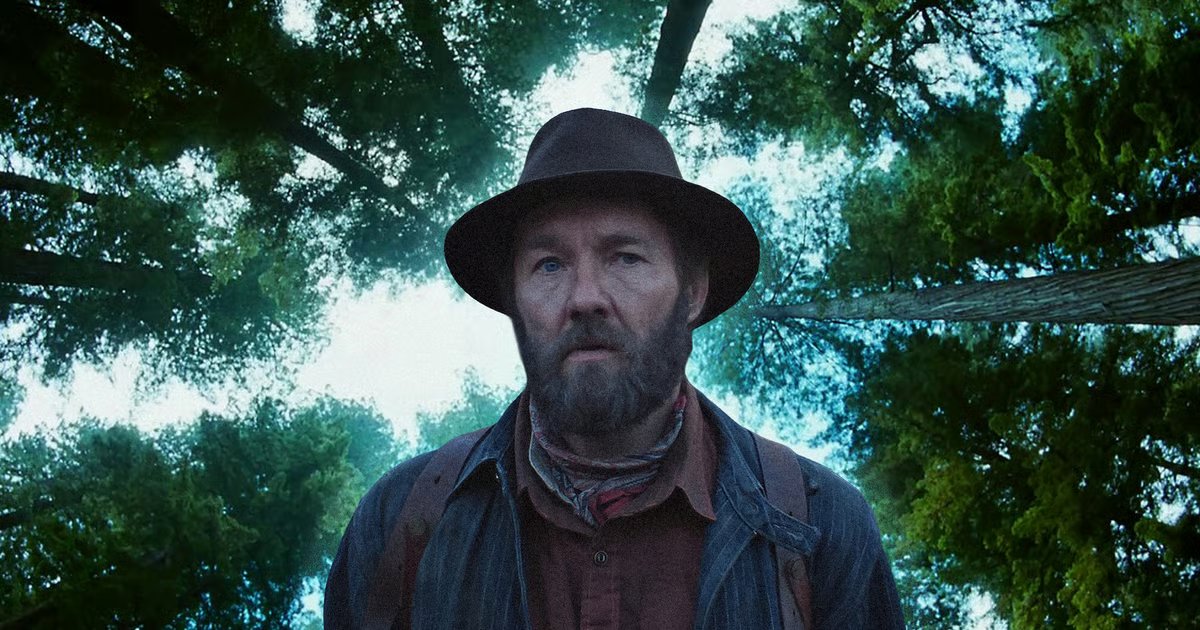
The Tree of Life comes through not only in Train Dreams’ ruminations on a little life, but also, as mentioned, its cinematography. It opens with that classic Malickian tracking shot. It’s filmed predominantly amidst nature, following behind characters as they move through the bush or lingering on tall grass being prodded by the wind. The POV shots are there too, fisheyeing onto a falling tree; on a woman sitting with her back to us at the front of a wagon. Almost everything is touched only by natural light. Associative imagery appears mostly in sequences where (like Jack) Grainer is grieving. The disembodied voice of his wife (like Jack’s mother) echoing around him as we cut to non-diegetic glimpses of their time together, sutured together like memory. Veloso confirmed in a chat with the American Society of Cinematographers that this was all in service of a documentary-esque, naturalistic feel. But the effect is detached.
