
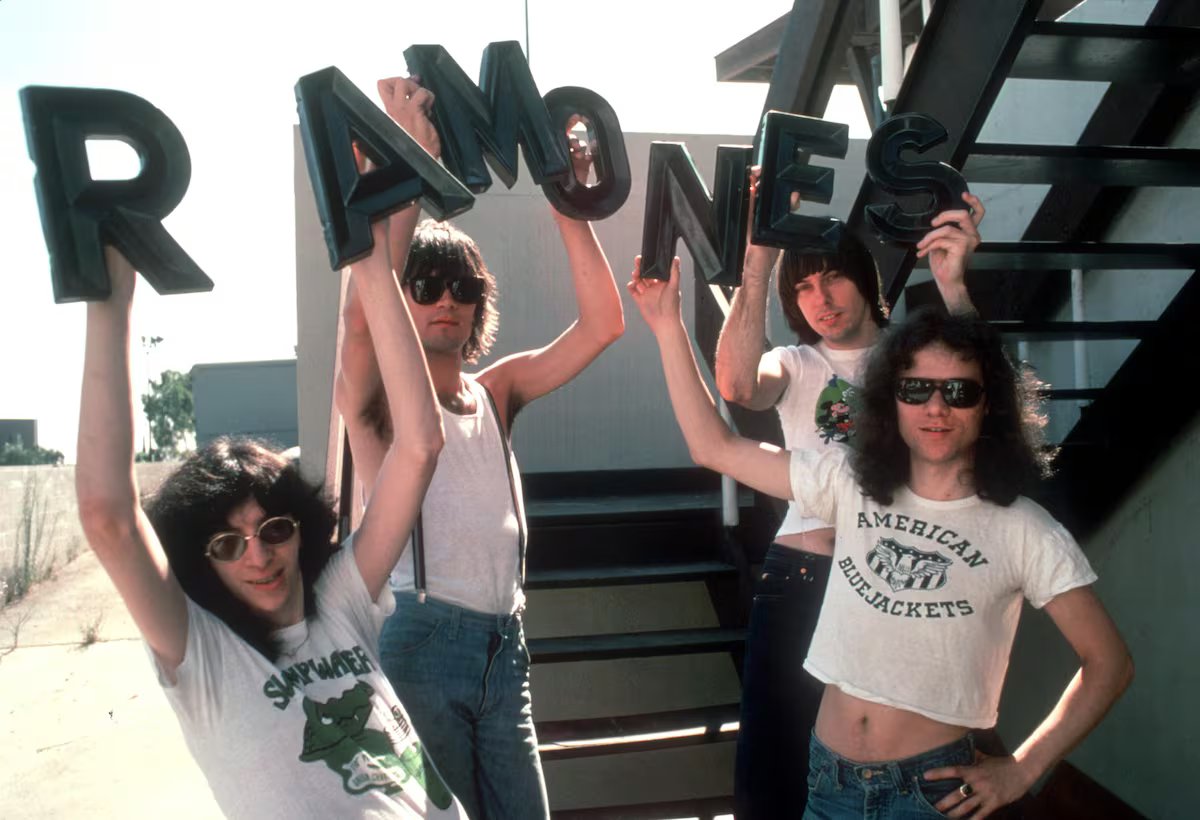
On April 23, 1976, the Ramones’ first, self‑titled album was released. It was recorded over seven days on the eighth floor of New York’s Radio City Music Hall and cost $6,400 at the time — an almost laughably small amount compared with the big budgets common in the record industry then. Their label, Sire, decided to release two singles, Blitzkrieg Bop and I Wanna Be Your Boyfriend, but neither made it onto the sales charts, nor did the LP itself. Even so, it is considered one of the most influential albums in the history of popular music. The cultural weight attributed to it far exceeds the 29 minutes and four seconds it takes to listen to what is widely regarded as the album that invented punk.
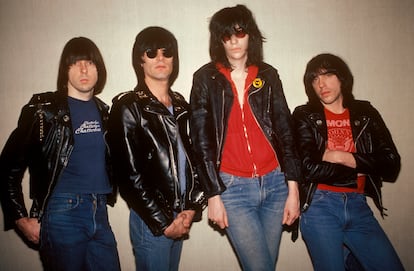
Jeffrey Hyman, John Cummings, Douglas Colvin, and Tom Erdelyi were between 24 and 25 years old at the time. They had met at Forest Hills High School, a middle-class neighborhood in New York City, where they felt like outcasts, out of place. For them, the band was a way to forge a new identity, something they did quite literally. They adopted the surname Ramone, as if they were all brothers, and the first names Joey, Johnny, Dee Dee, and Tommy, respectively. They also adopted a uniform, like superheroes of the underclass: shaggy hair, black leather jackets over worn-out T-shirts that were too small, ripped blue jeans, and sneakers.
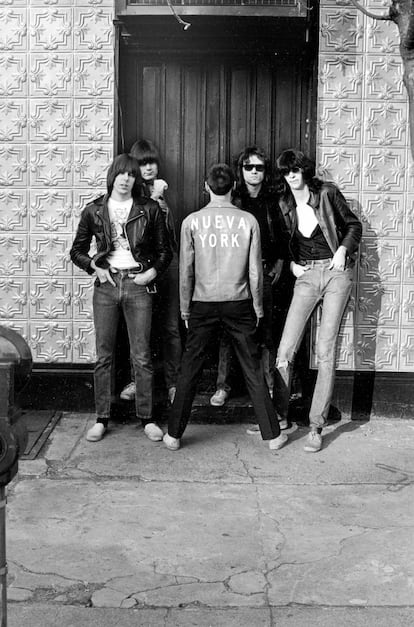
They posed against a wall, unknowingly creating one of the most iconic images in rock history. Today, that portrait — which appeared on the album cover and was shot by Roberta Bayley, a photographer for Punk magazine, in an alley in the Bowery — hangs in New York’s Museum of Modern Art (MoMA).
The Ramones wore the perfect street uniform for unleashing loud, dirty, fast, infectiously melodic, and silly songs that never reached the three‑minute mark. At the time, it was a revolution — one that marked a before and after in the history of rock. As sociologist Donna Gaines wrote in the text accompanying their induction into the Rock and Roll Hall of Fame, “The Ramones democratized rock and roll — you didn’t need a fat contract, great looks, expensive clothes or the skills of Clapton. You just had to follow Joey’s credo: ‘Do it from the heart and follow your instincts.’”
In reality, it was more of a revolt than a revolution, as the quartet sought to recapture the spirit of the most primitive rock of the 1950s and 1960s. A world that, according to them, had been lost, buried beneath the virtuosity and pretentiousness of symphonic rock. “We decided to start our own group because we were bored with everything we heard,” Johnny Ramone once declared. “Everything was tenth-generation Elton John, or overproduced, or just junk. Everything was long jams, long guitar solos… We missed music like it used to be.”
The band’s songs celebrated trash culture: television, hamburgers and pizzas, World War II movies or B-movies, comic books, surfing, vending machines, baseball… But they also reflected a street culture more associated with crime and social deviance. This was especially evident in Dee Dee’s lyrics. For example, the song 53rd & 3rd was based on the bassist’s own experience as a hustler on the Manhattan street corner where the song is set, and ended with the protagonist murdering a client. Now I Wanna Sniff Some Glue was about his habit of sniffing glue, and Beat on the Brat was rumored to have come to Joey after seeing a mother chasing an obnoxious child with a baseball bat.
The Ramones could be highly controversial when they used Nazi iconography in Blitzkrieg Bop and Today Your Love, Tomorrow the World, but it came more from cluelessness than from provocation: both Joey and Tommy were Jewish, and Tommy’s parents had barely survived the Holocaust in their native Hungary.
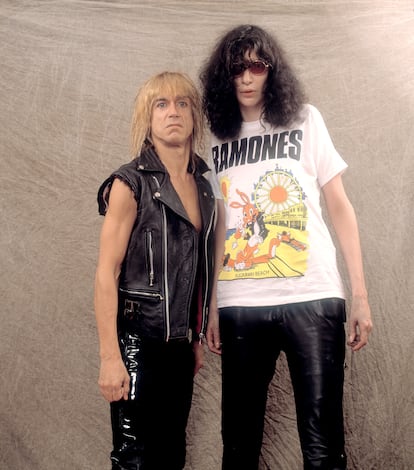
When their debut album was released, the Ramones had barely ventured beyond a few streets in their hometown. They began playing live in 1974 and became fixtures at CBGB, performing 74 times in their first year. Their average set lasted 17 minutes, and it was there that they built their initial fanbase. A key figure in this was music journalist Lisa Robinson, who convinced Danny Fields (former manager of Iggy Pop and The Stooges) to become their manager and, ultimately, persuaded Seymour Stein of Sire Records to offer them the first record deal ever signed by a punk band.
In a feature in The Guardian, Richard Hell —another pioneer of that New York scene — remembered them like this: “They were really ramshackle. They only had five or six songs and were so broke they had to carry their guitars in laundry bags, and they’d get mixed up about what they were doing and start yelling at each other.”
He continued: “They were like The Three Stooges: always getting angry with each other, but in a funny way. They’d toss their guitars away in frustration or forget what song they were supposed to be playing. You had to love them. They were completely uncompromising. The songs were irresistible, even if they were about sniffing glue. It was all calculated, but at the same time they were total clowns.”
More than the fifth Ramone
But there’s another parallel story here that doesn’t usually receive the same attention. Arturo Vega was popularly known as “the fifth Ramone,” but in reality, he should be considered the third. Of the 2,263 concerts the band played in his lifetime, he only missed two (one, he said, because he was in jail; the reason for the other is unknown).
Only Joey and Johnny — the only Ramones who were there from beginning to end — played more shows than he did. He used to travel with the band as a lighting technician and set up the merchandise stand. If you ever bought a T‑shirt at a Ramones concert, chances are you bought it — without knowing it — from the very person who designed it: Vega himself.
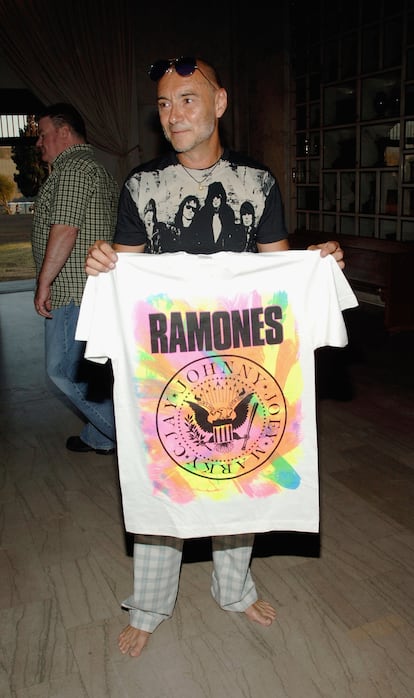
Vega had moved from Mexico to New York to pursue a career in show business. He even auditioned for the Broadway musical Hair, but found greater success as a graphic artist. He met the Ramones on the corner of CBGB (the New York club considered the birthplace of punk) and, from that moment on, they became inseparable. So much so that his Manhattan loft became the band’s base of operations and an occasional home for Joey and Dee Dee.
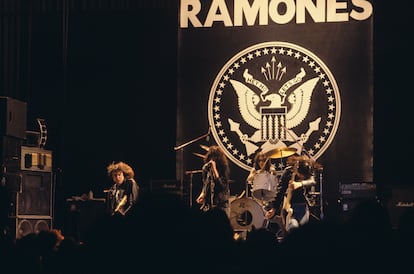
Quite by chance, Vega also became their art director. He first came up with the idea for the logo that became immortalized on the back cover of that album. This is how he explained how the idea came to him: “To me, they reflected the American character in general, an almost childish innocent aggression. I thought, ‘The great seal of the president of the United States’ would be perfect for the Ramones, with the eagle holding arrows to symbolize strength and the aggression that would be used against whomever dares to attack us, and an olive branch, offered to those who want to be friendly.”
“But we decided to change it a little bit,” he continued. “Instead of the olive branch, we had an apple tree branch, since the Ramones were American as apple pie. And since Johnny was such a baseball fanatic, we had the eagle hold a baseball bat instead of the arrows.”
In a 2016 interview, Marc Miller, curator at the Queens Museum in New York, praised Arturo Ramones’ work by comparing it to the Rolling Stones’ iconic tongue logo, designed by John Pasche in 1971. While Pasche’s logo reinforced the Rolling Stones’ bad-boy image during a specific period in the history of the world’s most famous rock band, “Arturo’s challenge was different since he was working with an unknown group.”
He explained: “His logo based on the presidential seal sought to confer stature and authority and has become inseparable from the Ramones. This can be attributed to the strength of the design and to the fact that stature and authority are always desirable attributes. Its success is also rooted in the inspired way Arturo has been able to exploit the design’s flexibility, adjusting it to reflect Ramones personnel changes as well as the group’s new projects.”
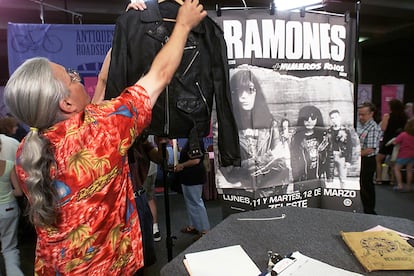
Vega used that logo and the band’s name font to print T-shirts in his own loft, and he did it out of sheer necessity. When the group went on tour to California in August 1976, he wanted to go with them, but the record label refused to cover his expenses. To pay for the trip, he decided to bring some T‑shirts to sell — much to the band’s amusement, who told him no one in their right mind would want to buy a shirt with the name of an unknown band on it. It was an eccentric idea, because, as Vega himself admitted in an interview, he had been to concerts by Led Zeppelin, the Rolling Stones, and Alice Cooper, and what those artists sold were tour programs with photos. No one had thought of selling T‑shirts as merchandise. At the first Ramones show, at the Roxy Theatre in West Hollywood, he sold every single one he had brought.
In those early years, promoters often complained that they were losing money with the Ramones. Not enough people came to see them. However, the T-shirts always sold, becoming the band’s most stable source of income, as well as a highly successful promotional tool. During the 1980s and 1990s, demand grew so much that Vega began outsourcing production to other companies worldwide, producing all sorts of merchandise: socks, pants, jackets, wallets, skateboards, bibs and children’s T-shirts, stickers, hats, mugs, and just about anything else you can imagine.
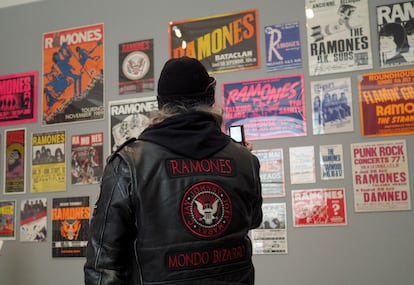
“They sold more T-shirts than records and probably they sold more T-shirts than tickets,” Danny Fields said, according to The New York Times. Although the numbers are impossible to calculate precisely, due to the enormous number of unofficial merchandise items printed daily around the world, it is highly likely that the Ramones T-shirt is the best-selling T-shirt of all time.
Over time, it lost its status as a symbol of belonging — the kind typically associated with band T-shirts — and transcended the Ramones themselves, eventually being worn by all sorts of people who had never even heard of them. There’s nothing about it that sets true fans apart from those who aren’t. And in that sense, it has become more inclusive than the band itself ever was.
Many guardians of rock authenticity still complain that today there are plenty of people who buy a Ramones T‑shirt — maybe at some big multinational chain — who wouldn’t be able to recognize even one of the band’s songs. But the truth is that neither the Ramones themselves nor their heirs ever cared about that. In that sense, Arturo Vega’s work was just as important — if not more so — than the band’s first album.
Sign up for our weekly newsletter to get more English-language news coverage from EL PAÍS USA Edition
