
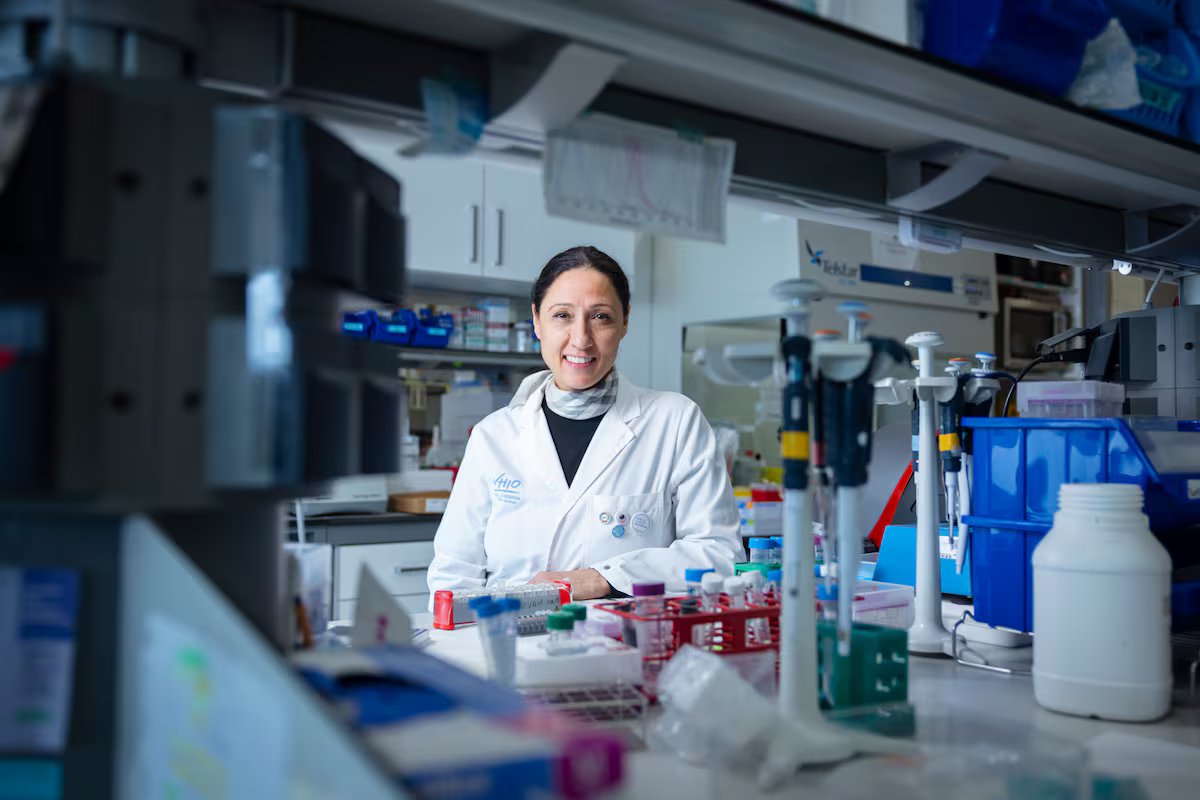
The biologist Laura Soucek eliminated lung cancer in mice nearly two decades ago. On February 8, after learning that pancreatic cancer patients worldwide were requesting an experimental rodent treatment announced on television by the Spanish biochemist Mariano Barbacid, Soucek reacted on social media. “I have deep respect for Dr. Mariano Barbacid. Precisely for this reason, honest information that doesn’t generate false expectations is crucial. From mouse to drug, there are years of work and no guarantee of success. It is a moral obligation to explain this and defend the research,” she stated.
Barbacid presented his promising results — 45 mice cured with a cocktail of three experimental drugs from other laboratories — on some of Spain’s most-watched television programs, such as El Hormiguero, Y ahora Sonsoles and El programa de Ana Rosa. On the first show, the host, Pablo Motos, declared: “It’s a miracle, it’s a miracle,” after which Barbacid underscored: “At least in experimental tumors. It must be made very clear that, to reach patients, we still have at least two or three years to go.”
That message of a possible imminent cure for pancreatic cancer prompted the European Society for Medical Oncology itself to clarify on February 3 the numerous obstacles ahead, after a multitude of oncologists around the world, even in Tucson, Arizona, received visits from patients asking for the non-existent Barbacid therapy, from the National Cancer Research Center in Madrid.
Laura Soucek directs the Experimental Therapeutics Program at the Vall d’Hebron Institute of Oncology (VHIO), a leading public center in Barcelona. The biologist’s journey illustrates the extremely long, and in most cases insurmountable, gap between a cancer cure in mice and an effective and safe drug for humans. Soucek, born in the Italian town of Velletri 52 years ago, made a groundbreaking discovery when she was 22.
In her doctoral thesis, the twenty-something confronted the “master of all cancers”: Myc, a protein that coordinates the proper division of a cell. Soucek uses a musical analogy. “It’s like an orchestra conductor, who decides which instruments are played during a concert. Myc activates the genes necessary for a cell to divide,” she explains. “In normal cells, Myc is activated for 20 minutes, conducts the orchestra, and then disappears. In cancer cells, it remains active all the time,” she warns. Soucek, then at the University of Rome La Sapienza, designed a mini-protein in 1996 capable of binding to Myc, blocking its function, and preventing the uncontrolled multiplication of mouse cells in her laboratory. Hopeful, the biologist named it Omomyc.
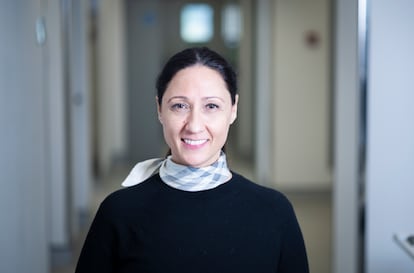
Soucek already had a promising drug candidate three decades ago. In 2008, while working at the University of California, San Francisco, she demonstrated that Omomyc was capable of eliminating lung cancer in mice, with only mild adverse effects. Her achievement was published in the journal Nature, one of the world’s leading scientific publications. This is the same journal that rejected Barbacid’s study, which was ultimately published via an expedited process, with slightly less rigorous peer review, in the journal PNAS of the U.S. National Academy of Sciences, thanks to the fact that he is a member of the Academy.
The so-called “triple therapy” developed by Barbacid’s group consists of three experimental drugs: daraxonrasib, from the U.S. company Revolution Medicines; afatinib, from the German company Boehringer Ingelheim; and SD-36, developed at the University of Michigan. This combination could be toxic in humans, so Barbacid and other partners founded a company, Vega Oncotargets, in April 2024 to try to find their own alternatives and patent them. The cancer research group CRIS Contra el Cáncer, a private foundation, has launched a successful fundraising campaign, which has already raised €3.5 million ($4.12 million) from nearly 80,000 donors, to finance the development of these new molecules.
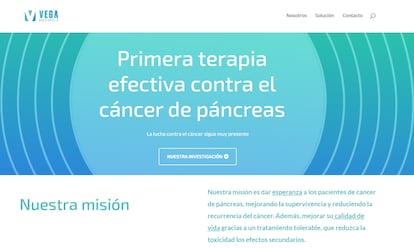
Mention of Barbacid’s company was omitted from the conflict of interest statement of its study published in PNAS, and the firm does not yet have any drug candidate, yet its website advertised until February 6 “the first effective therapy against pancreatic cancer.”
Soucek moved from San Francisco to Barcelona in 2011 and continued her experiments with mice. In 2013, she showed that Omomyc also eradicated the most aggressive lung tumors in rodents. In 2014, she founded Peptomyc, a spin-off from the Vall d’Hebron Institute of Oncology, to develop her experimental drug. After testing her mini-protein in two other species — rats and monkeys — to avoid toxicity issues, the team took the leap to human trials. One day in May 2021, a person received the first dose of Omomyc at Vall d’Hebron Hospital. A quarter of a century had passed since the biologist designed her drug candidate. Soucek recalls watching the scene from afar and, overcome with emotion, beginning to cry.
That first trial recruited 22 patients with different types of cancer to analyze the safety of the experimental drug. Only mild side effects, such as chills and nausea, were detected. In one of the participants, with pancreatic cancer, the volume of his metastases was reduced by half. The results were published in February 2024 in the journal Nature Medicine. Two months later, the European Research Council awarded Soucek a grant of €2.5 million ($2.9 million) to continue the development of Omomyc.
Peptomyc’s headquarters are located within the Vall d’Hebron Institute of Oncology. Soucek is the company’s scientific director, but until last year she was its executive director. In a decade, she secured €31 million ($36.5 million) in private capital and another €11 million ($13 million) in public funding, according to her figures. She aims to partner with a major pharmaceutical company to accelerate clinical trials, which to date have yielded “promising” but still unpublished results in approximately 60 patients.
Soucek, after three decades of work with her Omomyc, insists that false expectations shouldn’t be created. “I’m Italian, and I’ve heard reports of patients in Italy requesting this cocktail [the one used by Barbacid in mice]. My father is Czech, and he’s heard similar reports from Prague. That’s the part that hurts me the most. It needs to be explained that this cocktail doesn’t exist for humans. It just doesn’t exist,” she underscores.
The Pancreatic Cancer Association sent a statement to its members on February 12 urging caution following the announcement by Barbacid’s team. “No one can currently establish specific timelines for this treatment to reach patients, as it depends on numerous scientific, regulatory, and safety factors,” warns the Spanish organization, created by patients to promote research. “We know that many people have felt hopeful upon hearing the news, but also uncertain or confused. Therefore, we want to be clear: the Pancreatic Cancer Association does not participate in media campaigns nor does it endorse messages that could generate unrealistic expectations,” the statement concludes.
Biologist Laura Soucek says her 30-year journey has been “particularly difficult.” The German pharmaceutical company Boehringer Ingelheim, with annual sales of nearly €27 billion ($31.8 billion), follows a standard timeline of about 15 years to develop a drug: four or five years to compare thousands of compounds in the laboratory, another year to test hundreds of the most promising molecules in animals, and between five and seven years to study a dozen candidates in humans. If any of them prove effective and safe, obtaining regulatory approval can take another couple of years.
Barbacid’s group has received nearly €11 million in public funding, both national and European, since 2018, according to its center. Around 66% of its funding is public. The CRIS Cancer Foundation, which has already contributed €3.6 million ($4.2 million) to Barbacid’s laboratory, spearheaded the campaign to communicate the results of the mouse experiment and raise an additional €3.5 million ($4.1 million).
“I believe CRIS Cancer Foundation’s intention was to showcase an example of research funded by donations that is yielding very promising results. That kind of message is very valuable. The intention was absolutely good, but mistakes have been made,” says Soucek. Hundreds of people with cancer have written to Barbacid’s center in recent days, believing that an experimental treatment already exists or that it could at least be available within two years, as the biochemist stated on the TV show El Hormiguero. Some desperate patients have even gone in person to the center’s doorstep, and one French couple drove 11 hours from Marseille to Madrid to try to speak with the scientist.
Sign up for our weekly newsletter to get more English-language news coverage from EL PAÍS USA Edition
