Close Menu

    Subscribe to Updates

    Get the latest creative news from FooBar about art, design and business.

    What's Hot

    Riders sign American defensive back Jerry Jacobs

    February 26, 2026

    Rogers, Telus, Bell offer basically the same network performance: Opensignal

    February 26, 2026

    Shia LaBeouf Running From Courthouse, on Video, After Appearing Before Judge

    February 26, 2026
    Facebook X (Twitter) Instagram
    Select Language
    Facebook X (Twitter) Instagram
    NEWS ON CLICK
    Subscribe
    Thursday, February 26
    • Home
      • United States
      • Canada
      • Spain
      • Mexico
    • Top Countries
      • Canada
      • Mexico
      • Spain
      • United States
    • Politics
    • Business
    • Entertainment
    • Fashion
    • Health
    • Science
    • Sports
    • Travel
    NEWS ON CLICK
    Home»Top Countries»Spain»‘The weird house’: How Frank Gehry revolutionized a neighborhood with his own home | Culture
    Spain

    ‘The weird house’: How Frank Gehry revolutionized a neighborhood with his own home | Culture

    News DeskBy News DeskDecember 11, 2025No Comments5 Mins Read
    Share Facebook Twitter Pinterest Copy Link LinkedIn Tumblr Email VKontakte Telegram
    ‘The weird house’: How Frank Gehry revolutionized a neighborhood with his own home | Culture
    Share
    Facebook Twitter Pinterest Email Copy Link

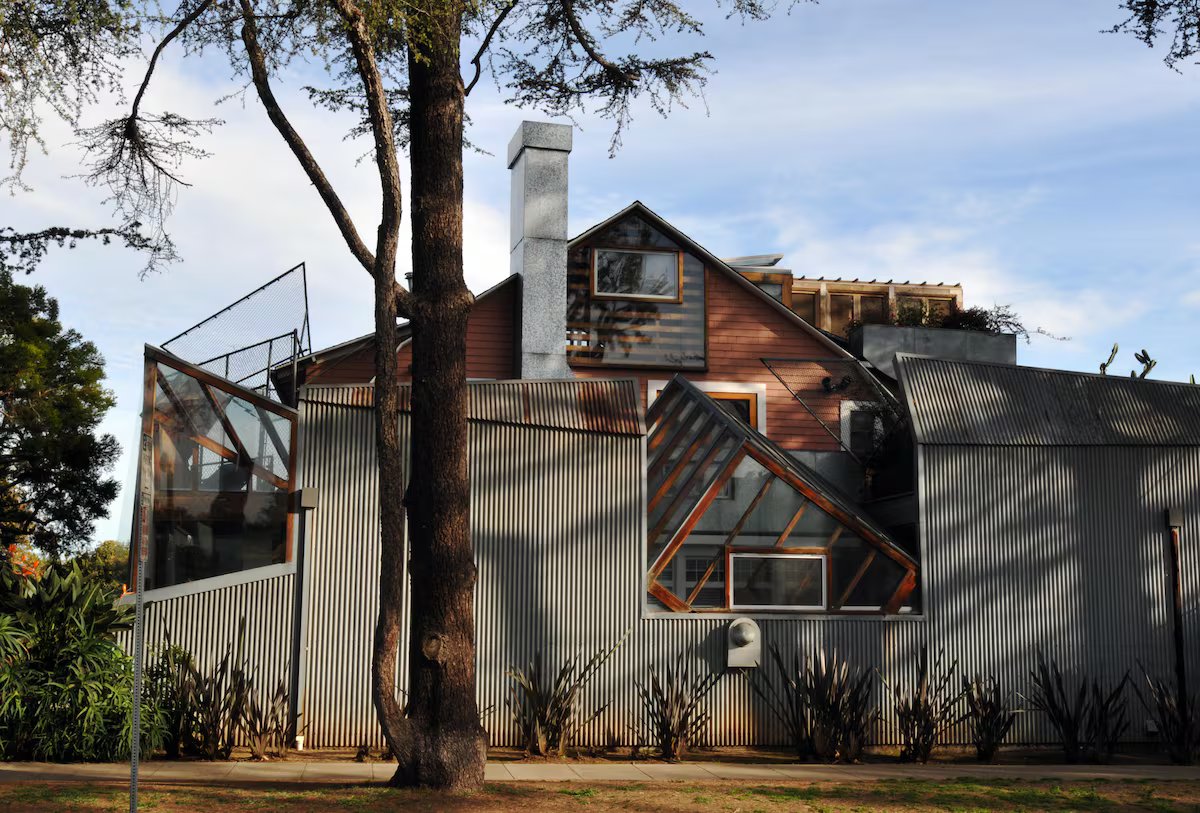
    On December 5, Frank Gehry, one of the most influential — and most joyfully undisciplined — architects of our time, passed away. And while collective imagination will remember him for oceanic museums, titanium auditoriums, and cultural centers that resemble migratory birds mid-evolution, the truth is that it all began, like so many architectural genealogies we love because they seem humble (and later turn out not to be) with a house. His house. A modest, unassuming home that, in less time than it takes a neighbor to utter “demolition order,” became the first recognizable heartbeat of the Gehry who would later emerge.

    Frank Gehry, with his son Alejandro, leaving his home in Santa Monica in 1980.Susan Wood (Getty Images)

    In the late 1970s, Gehry bought a perfectly ordinary bungalow in Santa Monica, built in the 1920s, one of those that line a neighborhood where the most daring aesthetic statement is usually a hydrangea of questionable color. And Gehry, instead of remodeling it with the restraint recommended by any mortgage survival manual, decided to subject it to an intervention so unusual that even today it’s difficult to describe without it sounding like performance art.

    What’s truly fascinating — the master stroke that sets him apart from the rest of us mortals who think that renovating is just moving a partition wall and praying it’s not structural — is that he didn’t rebuild the house, but rather wrapped it. Literally. As if the traditional bungalow — a small Dutch-American house with a pleasing geometry — had grown, almost parasitically, a shell made of corrugated metal, construction mesh, plywood, and glass positioned in a way that defied any academic textbook.

    Instead of concealing the old house, he embraced it. Gehry enveloped it in another architectural structure, creating a double object that functioned like a kind of contemporary matryoshka doll, where the outer shell is slightly chaotic, but the inner original house still works as a normal home. Between these two layers emerged recesses that belonged neither entirely inside nor outside, architectural chambers where the air circulated with that whimsical freedom usually reserved for improvised courtyards and Sunday afternoon science experiments. There, the light entered according to rules seemingly established by a committee of sunbeams with their own sense of humor.
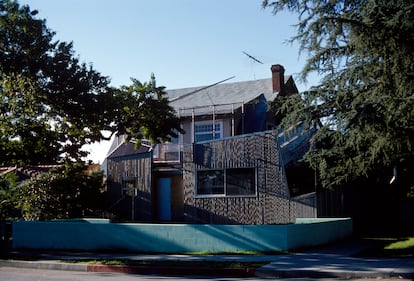
    Exterior view of architect Frank Gehry's self-designed home, Santa Monica, California, January 1980.
    Exterior of the bungalow that Frank Gehry renovated and lived in in Santa Monica.Susan Wood (Getty Images)

    And it worked. It functioned as a house. In its own way, of course, but it worked. Gehry lived there, amidst gaps and irregularities, exposed beams, rooms that opened onto ambiguous spaces, and terraces that seemed invented by a sculptor in the throes of therapeutic frenzy. To inhabit the place was to coexist with a mutating organism that offered microclimates, alternative routes to the bathroom, and a kitchen that acquired symbolic importance. A spatial remnant and, at the same time, a constructed, profoundly conscious remnant, breathing within that dual domestic anatomy.

    The neighbors, for their part, reacted to the transformation like someone discovering that a meteorite, now paying property taxes, has settled on their quiet street of houses. They called the complex “the weird house,” with a mixture of suspicion and fascination that should be included in any sociological study on the limits of aesthetic tolerance in the American suburbs. Because suddenly, in that row of canonical houses, a three-dimensional collage emerged that seemed improvised, although in reality it possessed the precision of a goldsmith. There were criticisms, rumors, comments like “what is this?”, a few minor squabbles with regulations, but nothing that impeded the process. The 1970s, after all, were a different era. More experimental, less obsessed with the homogenous color scheme of the neighborhood.
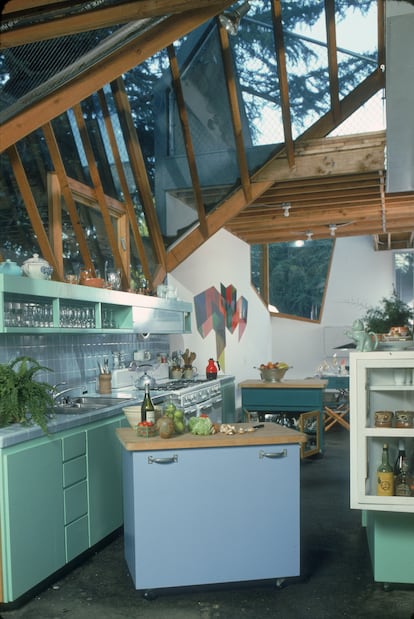
    Interior of Canadian-American modern architect Frank Gehry's house showing the kitchen, Santa Monica, California, January 1980.
    Living in this house was like living with a mutant organism that offered microclimates and a kitchen that acquired symbolic importance.Susan Wood/Getty Images (Getty Images)

    In that project were already all of Gehry’s future obsessions: controlled fragmentation, forms with musical energy, material disobedience, the deliberate erasure of the boundary between inside and outside and, above all, the idea that a house can cease to be an object and become a conversation between layers.
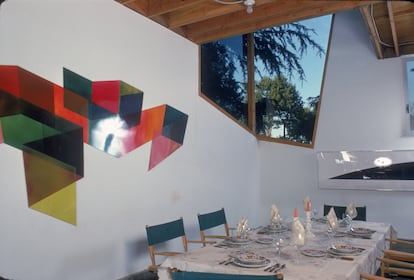
    Interior of American modern architect Frank Gehry's house showing the dining area just off the kitchen, Santa Monica, California, January 1980.
    Dining room of the house designed by Frank Gehry.Susan Wood (Getty Images)

    This house was not his first work, but it is his first personal, risky project. A foundational building where his embryonic style — later called deconstructivism — appears unapologetically for the first time. Because Gehry was experimenting with something radical: architecture not as demolition, but as an envelope, as a gentle contradiction to the pre-existing, like that gesture of sketching something crooked on a napkin and then subjecting it to an almost surgical engineering process. The seed of the Gehry method is there, in that house, which he himself considered his laboratory. It wasn’t a game or a gratuitous provocation, but a serious experiment that allowed him to understand what he could do and, above all, what he was willing to do with architecture.

    If you think about it, it’s colossal. That a domestic gesture — half crazy, half brave, yes, but domestic nonetheless — was the dress rehearsal for everything that would come after. The Guggenheim Museum in Bilbao. Walt Disney Concert Hall. The Fondation Louis Vuitton. Gigantic projects with astronomical budgets and complex conceptual frameworks, yet which come from this seed: a wrapped bungalow, a metal shell surrounding a small Dutch house, a fierce intuition that decided that architecture should tell a different story without erasing the previous one.
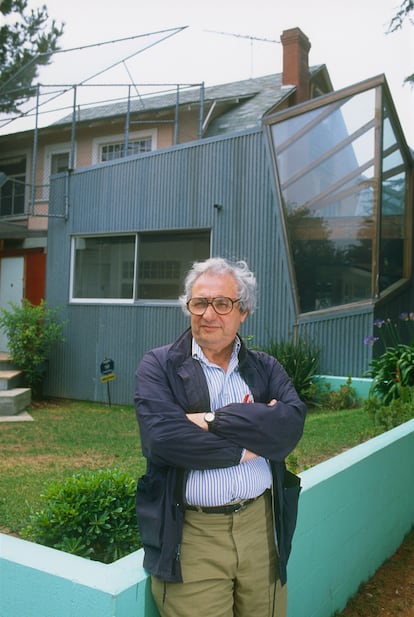
    World renowned architect Frank Gehry poses for a 1988 portrait in front of his Santa Monica, California home
    Frank Gehry posing in front of his house in 1988.George Rose (Getty Images)

    Because Gehry’s architecture doesn’t begin with the facade, institutional programs, or monumental iconography. It begins with an intimate decision: to envelop what already exists and force it to reveal something new. Gehry did this with his own house. And from that strange, checkered, luminous, and stubbornly original dwelling, emerged one of the most unclassifiable voices in contemporary architecture.

    Sign up for our weekly newsletter to get more English-language news coverage from EL PAÍS USA Edition

    Frank Gehry
    Share. Facebook Twitter Pinterest LinkedIn Tumblr Email Telegram Copy Link
    News Desk
    • Website

    News Desk is the dedicated editorial force behind News On Click. Comprised of experienced journalists, writers, and editors, our team is united by a shared passion for delivering high-quality, credible news to a global audience.

    Related Posts

    Spain

    Cómo una serie cambió la animación en televisión y marcó el nacimiento de un canal icónico de dibujos animados

    February 26, 2026
    Spain

    ICE will not be at polling places during the November midterms, says DHS | U.S.

    February 26, 2026
    Spain

    Gustavo Dudamel receives $1 million award from musician Herb Alpert: ‘We can change the world, but it starts with educating young people’ | Culture

    February 26, 2026
    Spain

    La Comisión Europea rechaza crear un fondo para que las mujeres puedan abortar con seguridad en la UE

    February 26, 2026
    Spain

    Do you need travel insurance for the EU if you live in Spain?

    February 26, 2026
    Spain

    Police begin patrols on electric scooters in Spain’s Valencia

    February 26, 2026
    Add A Comment
    Leave A Reply Cancel Reply

    Don't Miss

    Riders sign American defensive back Jerry Jacobs

    News DeskFebruary 26, 20260

    REGINA — The Saskatchewan Roughriders have signed American defensive back Jerry Jacobs, the team announced…

    Rogers, Telus, Bell offer basically the same network performance: Opensignal

    February 26, 2026

    Shia LaBeouf Running From Courthouse, on Video, After Appearing Before Judge

    February 26, 2026

    Report: Dolphins first, Steelers last in NFLPA report cards

    February 26, 2026
    Tech news by Newsonclick.com
    Top Posts

    Kylian Mbappe against surgery on knee but without clear solutions

    February 26, 2026

    The Roads Not Taken – Movie Reviews. TV Coverage. Trailers. Film Festivals.

    September 12, 2025

    Huey Lewis & The News, Heart And Soul

    September 12, 2025

    FNE Oscar Watch 2026: Croatia Selects Fiume o morte! as Oscar Bid

    September 12, 2025
    Stay In Touch
    • Facebook
    • Twitter
    • Pinterest
    • Instagram
    • YouTube
    • Vimeo

    Subscribe to Updates

    Get the latest creative news from SmartMag about art & design.

    Editors Picks

    Riders sign American defensive back Jerry Jacobs

    February 26, 2026

    Rogers, Telus, Bell offer basically the same network performance: Opensignal

    February 26, 2026

    Shia LaBeouf Running From Courthouse, on Video, After Appearing Before Judge

    February 26, 2026

    Report: Dolphins first, Steelers last in NFLPA report cards

    February 26, 2026
    About Us

    NewsOnClick.com is your reliable source for timely and accurate news. We are committed to delivering unbiased reporting across politics, sports, entertainment, technology, and more. Our mission is to keep you informed with credible, fact-checked content you can trust.

    We're social. Connect with us:

    Facebook X (Twitter) Instagram Pinterest YouTube
    Latest Posts

    Riders sign American defensive back Jerry Jacobs

    February 26, 2026

    Rogers, Telus, Bell offer basically the same network performance: Opensignal

    February 26, 2026

    Shia LaBeouf Running From Courthouse, on Video, After Appearing Before Judge

    February 26, 2026

    Subscribe to Updates

    Get the latest creative news from FooBar about art, design and business.

    Facebook X (Twitter) Instagram Pinterest
    • About Us
    • Editorial Policy
    • Privacy Policy
    • Terms and Conditions
    • Disclaimer
    • Advertise
    • Contact Us
    © 2026 Newsonclick.com || Designed & Powered by ❤️ Trustmomentum.com.

    Type above and press Enter to search. Press Esc to cancel.