
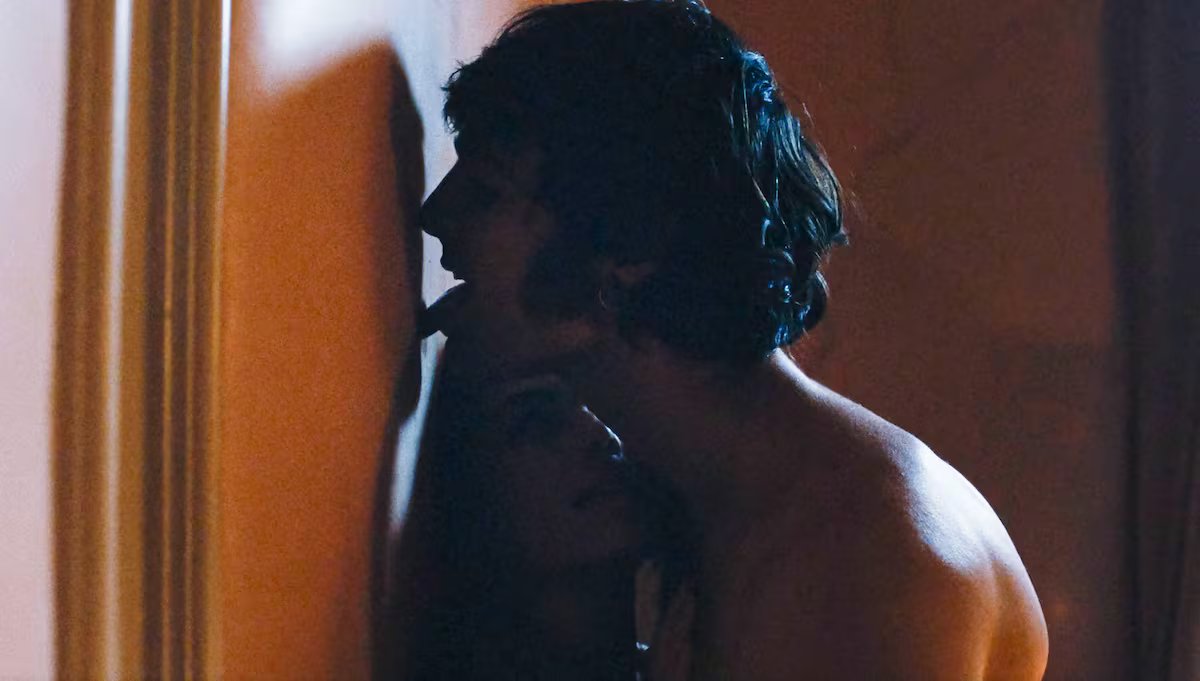
Emerald Fennell put the title of her film in quotation marks — “Wuthering Heights,” not Wuthering Heights — and she’s right. The film is a reflection of what Fennell felt reading the novel at 14: her private memory. Fennell thus protects herself, in advance, against accusations of infidelity. But in doing so, she says something more unsettling: that the original text is not accessible as a shared experience, that each reader has their own version, and that none is truer than another. Fennell’s problem isn’t that she’s unfaithful to the book. Every great adaptation is. The problem is the direction of her infidelity: she doesn’t take the novel further, she makes it more comfortable. Because even before you enter the theater, the cultural industry has already decided for you what Wuthering Heights is.
The Valentine’s Day premiere tells us this is a love story, not about the violence of attachment, nor about hatred, nor about what the social order does to a woman who doesn’t fit into it. The $80 million Warner Bros. budgeted for the film also speaks volumes. It suggests this is a spectacle that must be quickly recouped, not a difficult text that has resisted interpretation for 180 years. Margot Robbie and Jacob Elordi, drenched by the rain, suggest that the intensity between these two characters is sexual, and beautiful, but not that nameless thing Brontë describes, that fusion prior to sex and greater than it, projected in Catherine’s monstrous declaration, when she states, “I am Heathcliff.” Catherine’s “I am you” is the dissolution of the boundary between two beings, not a love story. And perhaps that’s why there’s something worth knowing before entering the theater: in Wuthering Heights, there is no sex. Not even a bedroom scene between Catherine and Heathcliff. The most violently intense novel in English literature does not contain a single erotic moment.
Emily Brontë, who died at 30, probably without having known sex, knew something that Fennell dismisses: that imagination is more powerful than experience
As children, Catherine and Heathcliff are one and the same. They run across the moors without anyone telling them who is who. There is no hierarchy. No gender. But she is going to grow up, and growing up as a woman means entering a house, bearing a surname, belonging to someone. When she says “I am Heathcliff,” she is not speaking of love. She is speaking of everything she will have to leave behind to become a wife. He is her freedom, and freedom has no place in marriage. Heathcliff is the part of her that can exist without submission. The rage, the energy, the freedom that will be confiscated from her as a woman. Heathcliff is not a handsome man. He is a being without origin or surname, taken in from the street. Nelly doesn’t know whether to call him “he” or “it.” As Sandra Gilbert and Susan Gubar laid out in The Madwoman in the Attic, Heathcliff’s position in the social order is close to that of women: illegitimate, without inheritance, without a voice. What’s unsettling about Heathcliff isn’t his attractiveness, but his anomaly. His excess. And that’s precisely what a soaked Jacob Elordi in the rain can’t embody.
In the film, Catherine leaves Wuthering Heights and goes to Thrushcross Grange of her own free will: she falls from a fence and Edgar finds her. In the novel, it’s the other way around: the Grange captures her. A bulldog bites her foot, wounding her and causing her to bleed, leaving her unable to walk. They take her in for five weeks to nurse her back to health and return a young lady, already bearing the scar of that wound, to the place where a wild child had entered. The two places are two incompatible worlds. Catherine enters one as a child. She leaves as a woman. And these two things, in Brontë’s work, cannot inhabit the same body. Wuthering Heights is chaos, energy, freedom, a world where man and woman still mean nothing, everything that society considers wild or dangerous. The Grange is order, beauty, hierarchy, refinement, the place where one learns to be a woman, everything that society deems desirable. But Brontë reverses the terms: the “wild” place is where Catherine is alive and whole, the “civilized” place is where they fragment her, domesticate her, and ultimately kill her. Becoming a lady is a form of mutilation. They wash her feet, comb her hair, dress her in clothes that barely allow her to move. She entered barefoot and free; she leaves shod, combed, and lame. What appears to be care is actually domestication. And the worst part is not what they put on her — the manners, the dress, the decorum — but what they take away from her inside: she learns to be two people at once, the one she is and the one they pretend she is.
That is what the 19th century termed “becoming a lady.” That is why Catherine doesn’t really choose freely between Heathcliff and Edgar, because the society in which she lives has already decided for her which option is acceptable. Fennell tells this story as if it were a romantic dilemma between two men. But Brontë wrote the opposite: a system that closes the trap and then blames the woman for falling into it.
That’s why sexualizing the relationship between Catherine and Heathcliff, as Fennell does, is not an act of transgression but of domestication: it is doing to the novel exactly what the Grange did to Catherine.
Catherine writes all the versions of her name on the window ledge — Earnshaw, Heathcliff, Linton — like someone who no longer knows who she is. The more names she has, the emptier she becomes. She is a woman who multiplies herself because she is losing herself. And it is another character, Lockwood, who finds those names on the window ledge much later. Fennell also eliminates Lockwood, the novel’s external narrator, the civilized man through whose gaze, and Nelly’s, the entire story reaches us. In Brontë’s novel, the passion of Catherine and Heathcliff is never shown directly: it is always seen from the outside, through layers of narration, as if the story could not approach the center without being burned. Fennell removes those layers, places the camera on top of them, and in doing so destroys what made the novel unbearably powerful: that the most intense element was precisely what could not be looked at directly.
Wuthering Heights is not a novel about how desire is negotiated within the social order; for that, there’s Jane Austen, for that, there’s Charlotte Brontë. It’s a novel about what civilization cannot contain. Emily Brontë is the writer of what cannot be contained. She writes from outside of everything, without precedent, without a line you can draw back. Cinema has translated that intensity into the language of sex. And in that translation, the intensity is lost. Because Emily Brontë, who died at 30, probably without having known sex, knew something that Fennell dismisses: that imagination is more powerful than experience, that the most disturbing ferocity is the one that doesn’t pass through the body. If she had lived 20 years longer, the history of the European novel would be different. No blockbuster can capture her, and Fennell’s quotation marks, at least, have the honesty to admit it.
Sign up for our weekly newsletter to get more English-language news coverage from EL PAÍS USA Edition
