
– From equity in co-productions and sustainability practices to XR development and filmmaker safety, Agora foregrounds collaboration, responsibility and structural change across the documentary field
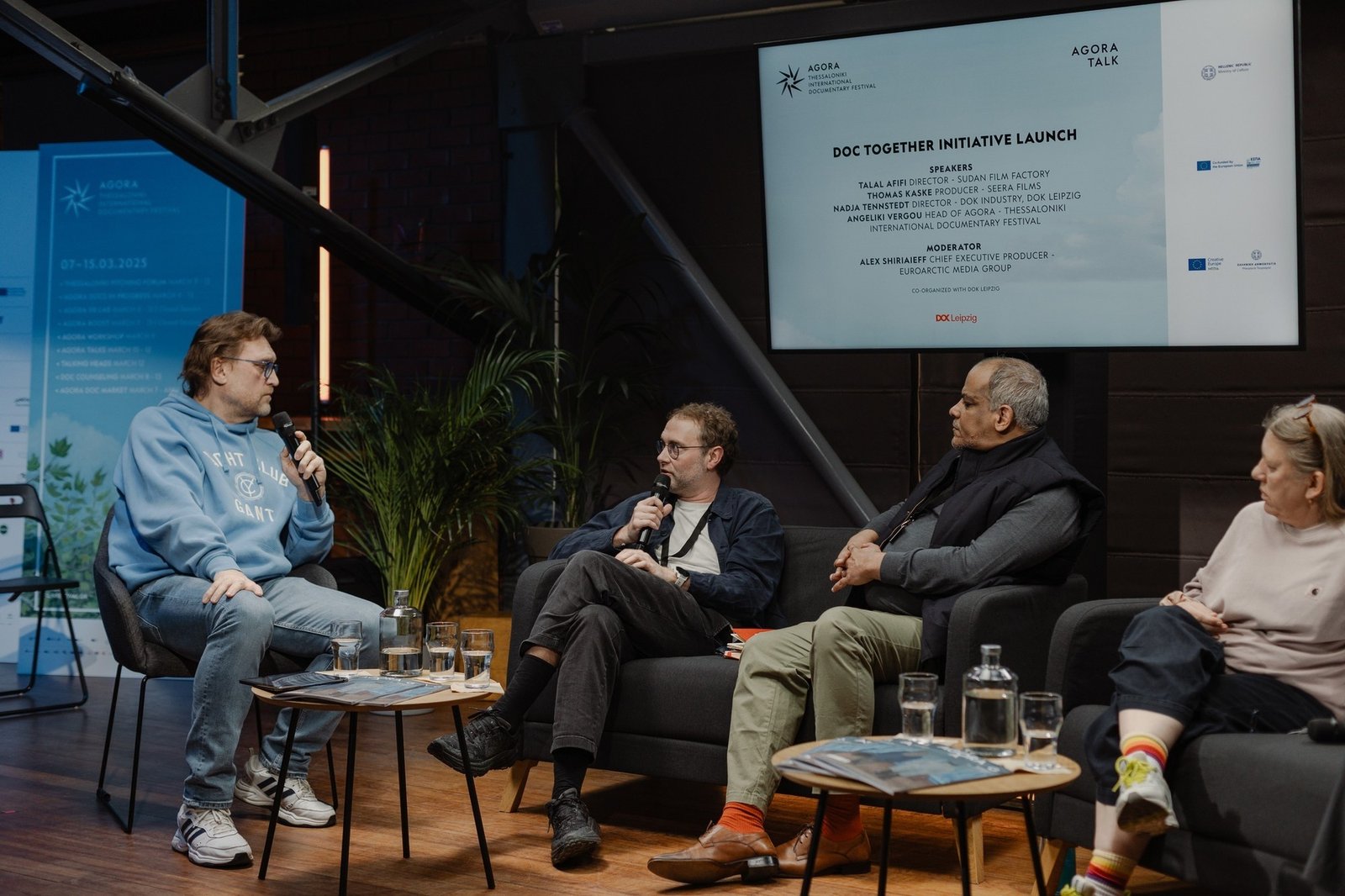
A moment from last year’s Agora Talks
The Agora of the Thessaloniki International Documentary Festival returns for its 28th edition from 8-11 March. At the core of the programme are the Agora Talks (8-11 March), a structured strand of discussions addressing pressing questions in contemporary documentary practice, from co-production equity and misinformation to sustainability, XR development and institutional reform. Carrying forward an emphasis on care, accountability and international exchange, Agora 2026 introduces new cross-border collaborations while deepening its engagement with support mechanisms for filmmakers at risk.
The programme opens with the presentation of the Doc Together Think Tank Report, an initiative launched at the previous edition of the festival in collaboration with DOK Leipzig. Conceived as a long-term, cross-sector coalition supporting filmmakers affected by censorship, displacement or crisis, Doc Together convened 60 industry professionals in Leipzig in October 2025 to assess current challenges and propose structural responses. The session in Thessaloniki will outline the key findings of the report, introduced by representatives from DOK Leipzig and Agora, alongside the International Coalition for Filmmakers at Risk.
This focus on advocacy and freedom of expression continues with a featured talk by Dominic Asmall Willsdon, executive director of the International Documentary Association, who will present the organisation’s new emergency assistance programme for filmmakers at risk, and address broader concerns around media consolidation and independent documentary sustainability. Equity within international partnerships takes centre stage in the panel “It’s Only Fair”, featuring Selin Murat (IDFA Bertha Fund), Leonard Cortana (EURODOC) and producer Malin Hüber (Her Film). The discussion examines structural imbalances affecting filmmakers from lower-capacity production environments, focusing on transparency, rights allocation and pathways towards more balanced co-production frameworks.
On 9 March, Agora launches Agora Cross-Border, a new initiative aimed at strengthening ties between regional producer delegations and international industry guests. The inaugural focus turns to the Basque Country, in partnership with BASQUE.AUDIOVISUAL (operated by Zineuskadi). Four producers – Nagore Eceiza (El Santo Films), Zuri Goikoetxea (Doxa Producciones), Marta Gómez Calderón (Al Borde Films) and Gentzane Martinez De Osaba (Marmoka Films, Bide Guztiak AIE) – will present their projects and engage with festival professionals, fostering exchange and potential co-production synergies. The session will be moderated by Greek producer and consultant Hermione Efstratiadou (Films Out There), with French producer Victor Ede (Cinéphage) serving as tutor.
Questions of documentary responsibility and public discourse underpin the discussion “Keeping It Real”, bringing together filmmaker András Földes (80 Angry Journalists), producer Antoine Goldet (Amok Films) and journalist-director Marianna Kakaounaki. Moderated by Brigid O’Shea, of the Documentary Association of Europe, the session reflects on the role of independent documentary cinema in countering misinformation, amid declining press freedom across Europe.
Sustainability enters the spotlight through the session “From Vision to Reality: Unleashing the Sustainability Superpower in Film Production”, organised within the framework of the European Green SCAP project. Green SCAP (Green Skills for Cinema and Audiovisual Production – Erasmus+) is implemented by Veneto Film Commission, Film Office–Central Macedonia, the Hellenic Film and Audiovisual Center/Hellenic Film Commission and the Mediterranean Creative Hub of Mallorca, under the supervision of Green Film. Sustainability consultant Júlia Tordai (Green Eyes Production) and producer Serena Alfieri will explore practical intersections between environmental responsibility and day-to-day production realities, in a discussion moderated by Linnea Merzagora (Trentino Film Commission).
XR and immersive practices shape Wednesday’s programme with “Empowering the XR Ecosystem”, powered by Onassis ONX. Speakers include Anastasia Mavrogianni (Onassis Foundation/Onassis ONX), Avinash Changa (WeMakeVR, IMPRES) and Achilleas Tsoutsis (Hellenic Film and Audiovisual Center). Moderated by Lazaros Boudakidis, head of Immersive at the Thessaloniki Film Festival, the session addresses storytelling innovation, infrastructure development, funding tools and the legal frameworks necessary to sustain immersive documentary production.
Agora 2026 is also hosting a closed-door Documentary Chapter Think Tank, organised in collaboration with the European Film Academy. This invitation-only session convenes leading European documentary professionals to shape the vision and priorities of the Academy’s forthcoming Documentary Chapter, scheduled to launch in 2027. Participants will outline strategic objectives for 2027-2030 and explore collaborative models with existing documentary organisations, marking a significant institutional step towards strengthening documentary representation within the broader European film landscape.
The programme concludes with “The Future of European Documentary Beyond Greece: Funding, Risk and Responsibility”, co-organised with the Greek Documentary Association (Hellas Doc). The panel brings together Anne-Laure Negrin (ARTE), Magdalena Borowska (Telewizja Polska SA), Montse Armengou Martín (Televisió de Catalunya) and Elisabeth Lehmann (Deutsche Welle), moderated by producer Photini Economopoulou, president of the Greek Documentary Association. The discussion assesses shifting financing structures, editorial decision-making processes and the distribution of risk across the production chain, reflecting on whether the sector faces cyclical contraction or deeper structural transformation.
