
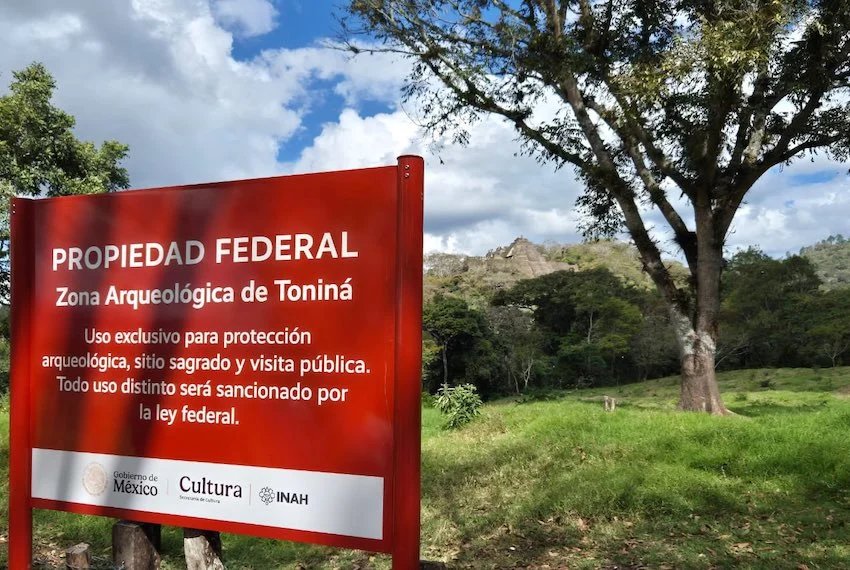
Nearly three years after it was abruptly closed to the public, the Toniná archaeological zone in southern Chiapas has been reclaimed by the federal government.
The national heritage site was shuttered in 2023 after a private landholder of a 9.22-hectare parcel within the complex allegedly refused to allow visitors unless the government agreed to pay monthly rent.
(Cuartoscuro)
On Dec. 18, 2025, President Sheinbaum issued a decree to expropriate the privately owned area. Authorities from the National Institute of Anthropology and History (INAH) on Tuesday took possession of the site, which will now be dedicated to conservation and research.
Toniná was declared an archaeological zone in 1994 and is considered to be one of the most important sites in the Maya region. It comprises an acropolis built upon a 70-meter-high pyramidal base, with seven platforms supporting temples, palaces and ritual sites, connected by 260 staircases.
“Toniná is an essential part of the living history of Chiapas and Mexico,” Culture Minister Claudia Curiel de Icaza said. “This decree [to reclaim the land] is a measure that protects a national asset and contributes to exercising cultural rights through access to knowledge and historical memory.”
Curiel also said that Toniná’s recovery demonstrates Mexico’s capacity to preserve archaeological heritage, ensure its management, and support conservation, restoration and research efforts.
Speaking at the site during an event celebrating the expropriation, Chiapas Governor Eduardo Ramírez Aguilar said he expects the move to promote responsible tourism, which will support economic growth in the valley. “This measure fulfills President Claudia Sheinbaum’s commitment to reopen the doors of this cultural and historical space that belongs to Chiapas, to Mexico, and to the world,” Ramírez Aguilar said.

The Sheinbaum administration plans to work in coordination with local communities to implement socially responsible tourism projects based on the philosophy of “buen vivir” (good living), according to Ramírez Aguilar.
Toniná is set to reopen to the public on March 21.
With reports from Excelsior and La Jornada
