
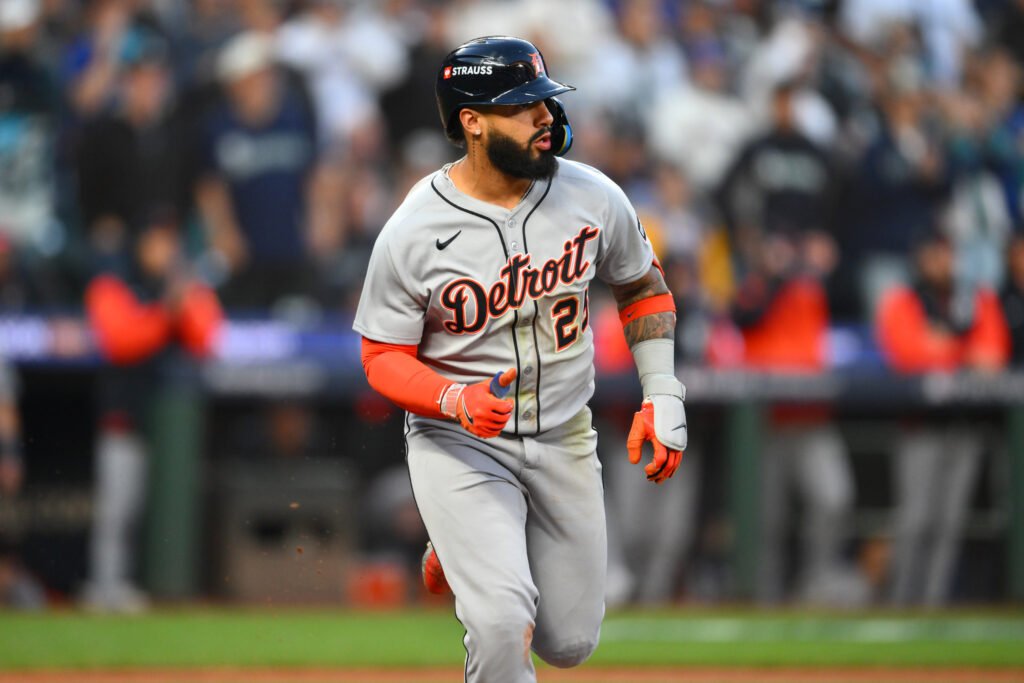
The injury in question was a sports hernia that required surgery at the end of October. Torres said he’d been playing through the pain for most of the season’s second half, which explains his rather stark splits. After hitting .281/.387/.425 in 359 plate appearances prior to the All-Star break, Torres slumped to a .223/.320/.339 slash line in his final 269 regular-season plate appearances, plus he hit only .235/.316/.382 over 38 postseason PA.
The end result was an overall set of numbers (.258/.358/.387 with 16 homers in 628 PA) that weren’t far off Torres’ numbers in his last Yankees season. Since the sports hernia provided a pretty clear reason for Torres’ downturn, the Tigers still felt comfortable making Torres the $22.025MM qualifying offer, and the club is confident that a healthy Torres will look a lot more like the first-half version from 2025. From Torres’ perspective, he still gets a healthy raise over his 2025 salary and returns to a familiar and welcome environment.
For Flaherty, he ended up choosing the Tigers for the third straight offseason. Flaherty inked a one-year, $14MM free agent pact with Detroit in December 2023, and he ended up winning a World Series ring with the Dodgers after the righty was dealt to Los Angeles at the trade deadline. Flaherty then returned to Motown on a two-year, $35MM guarantee, which broke down as a $5MM signing bonus, a $20MM salary in 2025, and then $10MM in 2026. However, Flaherty added an extra $10MM to his 2026 salary in the form of a bonus clause triggered when he made his 15th start of the 2025 season.
Since Flaherty’s previous forays into free agency came after in-season trades, he had never been eligible for a qualifying offer until last fall. Detroit therefore could’ve issued Flaherty a QO if he had opted out, and having draft compensation attached to his services may well have adversely impacted Flaherty’s market. Opting out and seeing if the Tigers floated a QO might’ve landed Flaherty an extra $2.025MM, but the safer move was just to stay in his present contract.
As with Torres’ camp, Flaherty said his reps at Wasserman checked out the market before he had to make his option decision, but ultimately, “not everything is about money. Especially when you are in a place you feel you have a chance to win,” the right-hander told Chris McCosky of the Detroit News.
“This is an unbelievable team in here,” Flaherty said. “It’s an unbelievable group of guys. It’s a group you want to be a part of….I’ve gotten a lot better the last two years being here. Another year working with [the coaching staff] and building those relationships through another offseason, to go back and forth with them, it pays dividends.”
Since Flaherty was only able to land that two-year, $35MM guarantee following a solid 2024 season, he might have found a less welcome market in the wake of a 2025 campaign that saw his numbers go backwards in most major statistical categories. Flaherty posted a 4.64 ERA over 161 innings last year, with an above-average 27.6% strikeout rate but a subpar walk rate (8.7%), hard-hit ball rate (43.8%), and barrel rate (10.3%). Flaherty’s 3.67 SIERA was almost a run superior to his real-world ERA, yet it was far from the kind of ideal platform year that would’ve guaranteed the 30-year-old a significant multi-year contract.
Retaining Torres and Flaherty, re-signing Kyle Finnegan, and signing Kenley Jansen and Drew Anderson stood as the Tigers’ most significant moves for much of the offseason. This relatively quiet winter suddenly sparked earlier this month, when Detroit made a pair of major rotation signings in Framber Valdez and team legend Justin Verlander. These additions bolstered the pitching staff to the point that Flaherty may now be the fifth starter, depending on how the team chooses to line up Flaherty, Verlander, and Casey Mize behind the top two of Tarik Skubal and Valdez.
As for the everyday mix, Torres and Spencer Torkelson are the most prominent right-handed bats within a lineup that still tilts heavily to the left side. Despite multiple rumors linking the Tigers to Alex Bregman and a few other position players, Detroit basically stood pat with its lineup, putting more pressure on Torres and the rest of the hitters to deliver a more consistent performance in 2026.
