
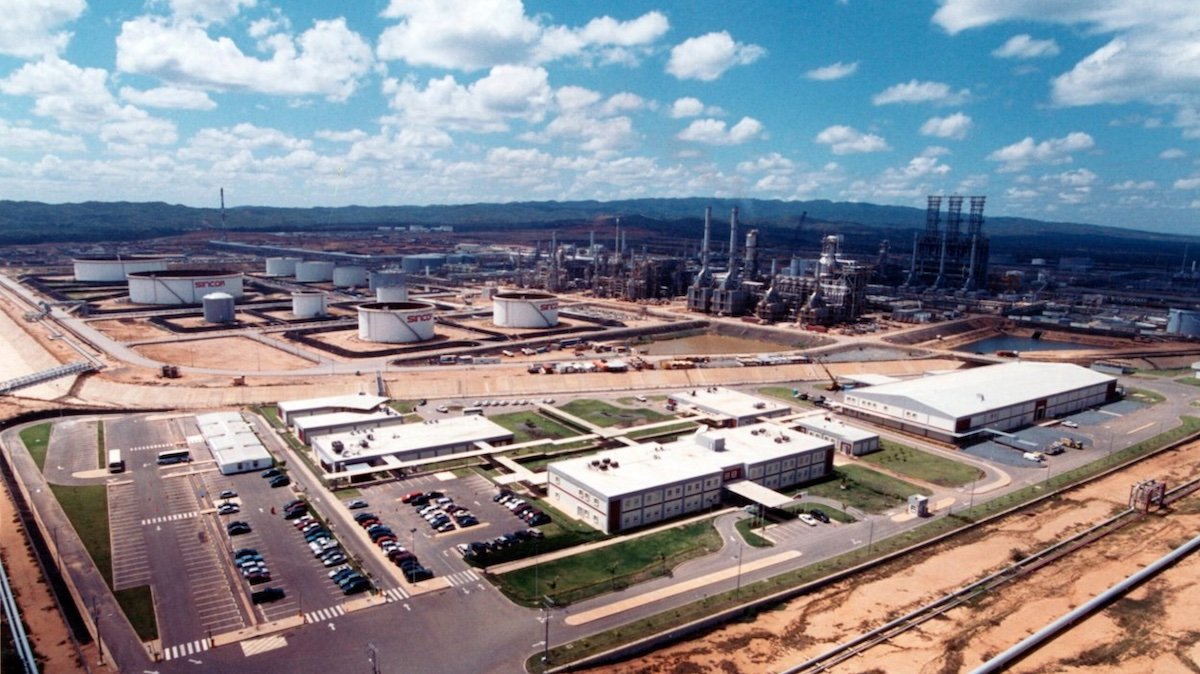
When the dust settles on U.S. President Donald Trump’s effort to take over Venezuela and its massive heavy oil reserves, the outcome is unlikely to be good for Alberta. This is true in both the short and longer terms.
Indeed, if things go well for the United Conservative Party’s favourite national government – that is, the anti-constitutional one on the banks of the Potomac – the result could well quickly turn out here in Wild Rose Country to be double-plus ungood!
In the meantime, while the Trump Administration, U.S. news media, Canadian politicians of all stripes, and scores of idiots on social media are all declaring MISSION ACCOMPLISHED in Venezuela, whether Mr. Trump’s special military operation has accomplished much remains far from clear.
As is well understood, Mr. Trump impulsively rushes into major projects without doing the necessary work to ensure they succeed. So while the U.S. military certainly has the capacity to overwhelm Venezuela’s armed forces, the jury remains out on whether the imperial takeover of Venezuela’s massive oil reserves that the president declared from his private club in Florida is going as smoothly as everyone seemed to think it was yesterday.
In other words, Venezuelan President Nicolás Maduro may have gone quietly with his Delta Force kidnappers, but that doesn’t mean his government will surrender as easily, or that other Venezuelans will knuckle under even if their government does. Students of geopolitics with long memories will recall President Maduro’s predecessor, Hugo Chávez, distributed assault rifles, submachine-guns and grenades the colectivos in the barrios of Venezuela’s cities.
But beyond vague statements about more attacks and boots on the ground, Mr. Trump and his enablers seem to have paid very little attention to who will run Venezuela or its giant Orinoco tarpatch, and who will pay for this imperial resource grab.

There’s no evidence he even talked to the Houston oil executives he hopes to draft to get the oil flowing to its self-declared new owners north of the Gulf of Mexico. The investment could be risky in more ways than one. There may be less investment enthusiasm than Mr. Trump anticipates.
So this could all go swimmingly for the president, or it could turn out like the U.S. invasion of Iraq in 2003, which as we all now understand didn’t work out very well at all considering that U.S. taxpayers spent something in the order of $3 trillion on the project and reaped only disorder in the Middle East and in the homeless encampments of their own cities.
We all laughed when Saddam Hussein, he of the still-undiscovered weapons of mass destruction, promised the Mother of All Battles if Iraq was invaded. The judgment of history, though, seems to be that in the event the remnants of his Republican Guard delivered just that. Even Alberta’s iconic balladeer Corb Lund has a song about it!
Readers will also recall that just like President Trump’s Venezuela attack, president George W. Bush’s Iraq invasion was supposed to pay for itself. “Under every plausible scenario, the negative effect will be quite small relative to the economic benefits,” said the White House economic advisor of Mr. Bush’s Iraq plan. “It’s going to make a lot of money,” promised Mr. Trump of his Venezuela SMO.
Alas, just as then-secretary of state Colin Powell’s famous 2002 Pottery Barn Rule turned out to apply to Iraq, it will likely apply in Venezuela as well. Remember, for invaders, the first day of an invasion is always the best one. Things generally go downhill after that.

Notwithstanding this, Canadian politicians enthusiastically cheered President Maduro being carted off to New York for an imperial show trial. Surely one of the stranger things said by a Canadian politician about Mr. Trump’s undeclared war on Venezuela was our prime minister’s remark, summarized by a Globe and Mail headline writer as “Carney hails ouster of Maduro in Venezuela but calls for respect for international law.”
Alas, you can have one or the other, but you can’t have both, because international law is an actual thing. Better for this kind of argument, methinks, to stick to the “rules based international order,” which apparently means Washington makes up the rules and the rest of us take the orders.
Well, one eternal truth about Canada is that even when the prime minister says something dumb, the Opposition leader can be depended upon to say something dumber. So when Conservative Party Leader Pierre Poilievre weighed in – on social media, naturally – he soon fell to screeching, “Down with socialism. Long live freedom.”

Actually, Alberta Premier Danielle Smith showed more sense than either of them and, at least when this was written, had said nothing at all.
Perhaps she understands that, as I first pointed out here seven years ago, regime change in Venezuela isn’t likely to work out very well for Alberta.
As I wrote in February 2019, Venezuela is conveniently located just across the Caribbean Sea and the Gulf of Mexico from the U.S. refineries of the Gulf Coast of Texas, where much of Alberta’s low-quality bitumen nowadays ends up. “In the simplest terms, one likely effect of this unfolding scenario would be to flood those American refineries with cheap, heavy oil from Venezuela,” I concluded. “After that, it’s just a matter of supply and demand. A big increase in supply, conveniently located for inexpensive ocean transfer, will depress the price fetched by Alberta oil, especially low-quality oilsands bitumen. Given the size of Venezuela’s reserves, the low prices could last for a very long time – possibly until the planet’s transition from a fossil fuel economy is complete.”
That opinion was ignored, then considered eccentric, but in the past few hours seems to have entered the mainstream.

“At least in the short term, the principal impact is likely to be downward pressure on the price Canada heavy crude can command in the U.S. market,” The Globe and Mail intoned Saturday. “Canadian producers with narrow margins would be most exposed. The highest risk would be that U.S. Gulf Coast refineries begin to shift to cheaper Venezuelan crude.”
The Globe added the caveat that “U.S. midwestern refineries are more integrated with Canadian pipeline supplies and have less flexible sourcing making the penetration of Venezuelan crude at scale unlikely.” That is true, for the moment.
“Venezuelan oil could put Canada out of business,” a National Post headline screeched yesterday over a plea for more bitumen pipelines to the West Coast. “Venezuela has the world’s largest proven oil reserves, and its oil – from the Orinoco Belt — is extra heavy crude, similar to that found in Alberta’s oilsands,” the rather calmer author of the op-ed explained.
“U.S. Gulf Coast refineries are calibrated and built to process and crack heavy crudes like those from Venezuela and Canada,” wrote University of British Columbia business lecturer Adam Pankratz. “This is why, during the current trade spat with the U.S., the one product which has always avoided tariffs — despite Trump’s threats — was Alberta oil, for the simple reason that the Gulf refineries couldn’t just switch to lighter, sweeter crudes, like U.S. shale, overnight. However, if there were another reliable source of heavy crude for U.S. refineries, then Canadian crude would not be nearly as valuable …”

And now, it would appear, there soon will be – notwithstanding the current dilapidated state of the Venezuelan oilpatch.
Well, it’s called the iron law of supply and demand for a reason. Short term or long term, the combination of more supply and less significant increases in demand isn’t going to cause the price fetched by Alberta bitumen to rise.
Add to that the facts the number of North American refineries that can process Alberta and Venezuelan heavy crude is limited, with more unlikely to come on stream soon, and that China is moving as fast as it can toward complete electrification, and that in effect puts a cap on demand.
None of this is good news for a province with a one-note economy and a government focused on ideological projects and propping up the fossil fuel industry.
Probably the best hope for Alberta is for Mr. Trump’s gunboat diplomacy to go badly.
