
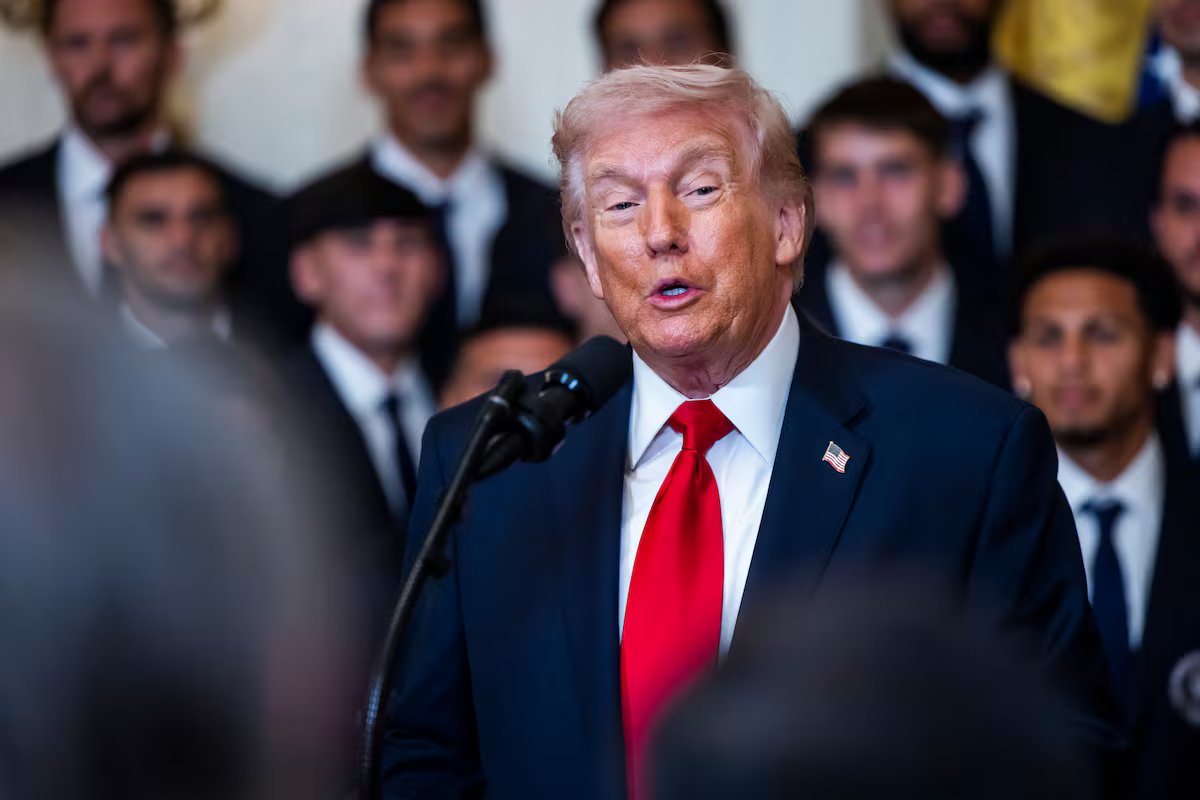
U.S. President Donald Trump woke up on Friday — the seventh day of the war against Iran — gave an interview to CNN, and then turned to his social network, Truth Social. There, as he often does, he abruptly shifted his tone on a conflict that appears increasingly driven by his personal whims.
“There will be no deal with Iran except unconditional surrender,” he posted on Truth Social. Washington — and much of the rest of the world — immediately began analyzing the consequences of that statement.
Trump’s post also served to revive the justification for launching the joint war with Israel that he put forward early last Saturday, shortly after ordering the attack on Iran. Despite later denials, his Friday message suggests he is seeking regime change in Iran.
“After that [unconditional surrender], and the selection of a GREAT & ACCEPTABLE Leader(s), we, and many of our wonderful and very brave allies and partners, will work tirelessly to bring Iran back from the brink of destruction, making it economically bigger, better, and stronger than ever before. IRAN WILL HAVE A GREAT FUTURE. MAKE IRAN GREAT AGAIN (MIGA!),” he wrote in a post, using his trademark all-caps.
Hours later, the White House press secretary, Karoline Leavitt, tried to clarify the idea of “unconditional surrender” in a brief interview on Fox News. The host cautiously pointed out that demanding such a thing could be problematic when dealing with a regime as fierce and deeply entrenched in society — one that has ruled through terror for decades — as the Iranian one.
Leavitt responded: “President Trump means when he says unconditional surrender is when he, as commander in chief of the United States military and the leader of the free world, determines that Iran can no longer pose a threat to the United States of America and to our troops and our personnel in the Middle East.”
Earlier, Leavitt had said that the “overall mission” of the operation was “to ensure that Iran can never again possess a nuclear weapon. That was the real imminent threat that was posed by Iran to the United States.” In reality, Tehran has never had a nuclear weapon, which made Leavitt’s suggestion that Iran must be prevented from having one “again” surprising.
Pending a clearer explanation of what he meant, Trump’s insistence that “unconditional surrender” is a sine qua non condition for ending the war represents a shift from his earlier statements. On Sunday, the U.S. president told a reporter from The Atlantic: “They want to talk, and I have agreed to talk, so I will be talking to them. They should have done it sooner. They should have given what was very practical and easy to do sooner. They waited too long.”
Iranian plot
Since last Saturday, Trump has given fewer of his usual White House press conferences, opting instead for phone interviews with prominent Washington journalists. In those conversations, he has linked the death of Ali Khamenei to a personal vendetta.
In 2024, U.S. authorities foiled an Iranian plot to assassinate him, and Trump suggested that the killing of the Iranian leader may be tied to that episode. He also sent a clear signal that he wants a say in the decision over who will become the new leader of the Iranian regime.
Speaking to the news agency Reuters on Thursday, Trump said it was still too early to replace Ayatollah Khamenei, but that Mojtaba, his son, did not seem like a likely option. “We want to be involved in the process of choosing the person who is going to lead Iran into the future,” he said. “We don’t have to go back every five years and do this again and again […] Somebody that’s going to be great for the people, great for the country.”
The U.S. president has repeatedly pointed to Venezuela as an example of what could happen in Iran. Trump considers the military operation that ended with the capture of Nicolás Maduro a success, as well as the decision to leave the country in the hands of his former vice president, Delcy Rodríguez. According to that logic, what Washington is looking for in Tehran is the “Iranian Delcy.”
With that goal in mind, the chances of Reza Pahlavi — the son of Iran’s last shah, who lives on the outskirts of Washington and has recently regained a prominence he had lost for decades — do not appear especially strong. “Some people like him, and we haven’t been thinking too much about that. It would seem to me that somebody from within maybe would be more appropriate,” Trump told CNN this week. He added that Pahlavi “looks like a very nice person,” but that he is looking for something different: “Somebody that’s there, that’s currently popular if there’s such a person.”
Sign up for our weekly newsletter to get more English-language news coverage from EL PAÍS USA Edition
