
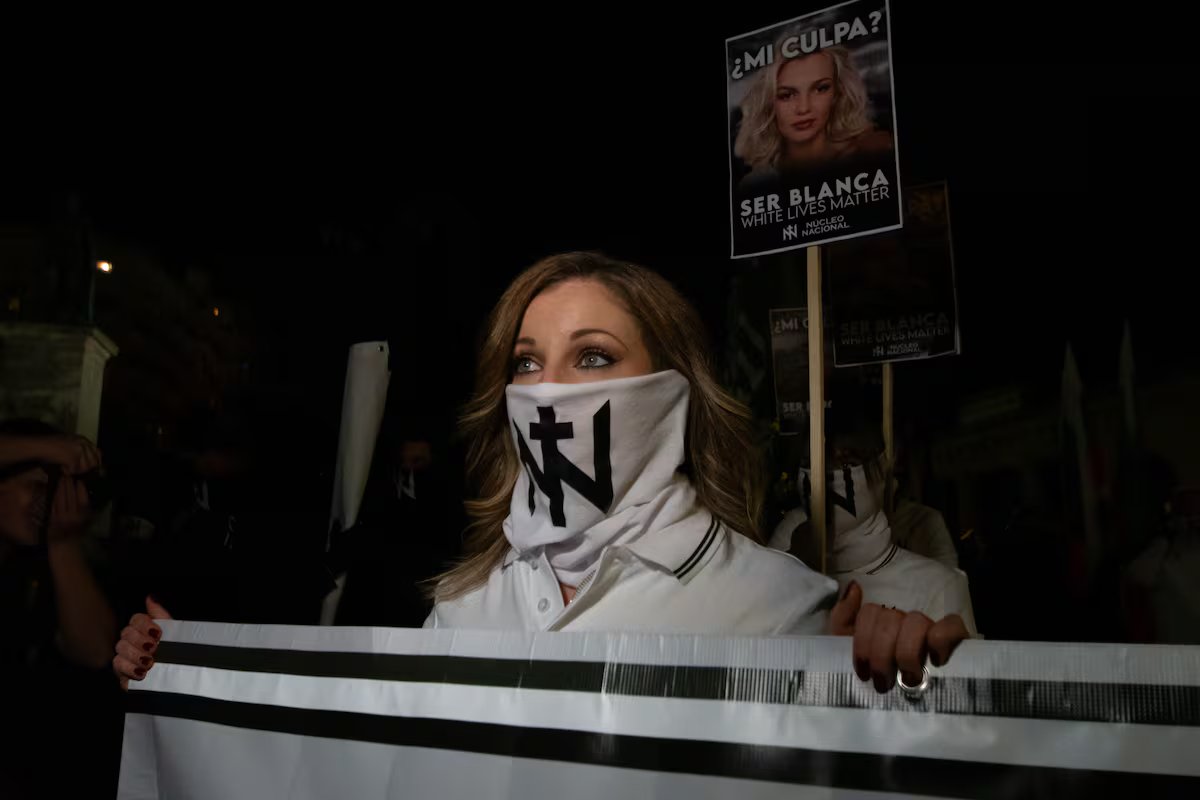
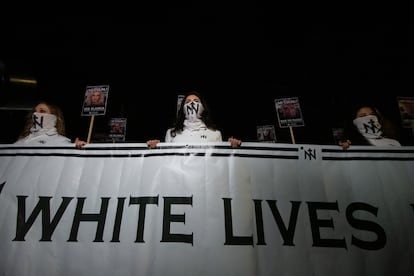
The rise of the global far-right can be seen as an epidemic. It doesn’t erupt suddenly: first, it’s a mild, almost imperceptible fever. Then, it spreads, mutates, becomes contagious. Finally, it settles in, like the climate. It ceases to be alarming, because it has become commonplace. “We’re in the most developed phase of the epidemic,” says Franco Delle Donne, an Argentine researcher and author of Epidemia ultra: Del fascismo europeo a Silicon Valley (translated as Extremist Epidemic: From European Fascism to Silicon Valley), a book published in 2025, in which he argues that democratic forces made a grave error in underestimating the far-right outbreaks until they spread… and now, it’s too late.
Extremist Epidemic is just one of the many works of non-fiction being produced by the publishing industry, which is always attentive to issues dominating public debate (and to those causing seismic civilizational shifts). Recently, essays and books by authors such as Antonella Marty, Mark Fortier, Bruno Cardeñosa, Adriana Hest, Francesc-Marc Álvaro and Luciana Peker (among others) have been released. And, later this year, publications by other academics and journalists working in the Spanish language, including Alicia Valdés, Antonio Maestre and Carlos Fernández Liria, will be released. This publishing epidemic, running parallel to the expansion of the new right, reflects the need to understand what few people anticipated.
Where to pinpoint the origin of this phenomenon? Delle Donne, for one, seeks the root of these movements, which are diverse, yet aligned. He looks at a wide range of events, from the ideological shadows of the early 20th century, to the authoritarian drift of Donald Trump. For this researcher, the fundamental premise is that of the decline of Western civilization, which appeared in the work of German philosopher Oswald Spengler (1880-1936) and fueled the fascist imaginary of the 1930s.
After the discrediting of such ideologies — which were crushed during World War II — the thread was picked up again by the Nouvelle Droite (the “New Right”), led by French philosopher Alain de Benoist, which responded to the explosion of countercultures and the New Left that emerged in May of 1968. Curiously, this movement was concerned with cultural hegemony in the manner of the Italian communist Antonio Gramsci, whom the New Right unexpectedly referenced.
The culture war being waged today by the new global far-right is a diverse and oftentimes contradictory force. It involves all kinds of elements, from paleoconservatives to anarcho-capitalists; from traditionalists to neo-Nazis; from Silicon Valley capital to the recesses of conspiracy theories. The movement is an archipelago imbued with resentment, provoked by the failure of neoliberalism, and the feeling that there’s no viable future. Members of this movement believe that it’s necessary to reset the world to a time before this decline, be it the 1950s or the pre-Enlightenment Ancien Régime. There’s a pervasive nostalgia for a golden age that never existed. “Liberalism defeated monarchies, communism, fascism… but Trump is the expression of liberalism’s problems,” Delle Donne tells EL PAÍS.
After the storming of the Capitol and Trump’s second coming, ICE abuses could be seen as the latest step (so far) in the epidemic. “ICE’s behavior could be described as fascist… although I know that we have to be careful with that word. But it seems to fit here, as some experts have already pointed out,” Delle Donne notes. He distinguishes between the radical right — which erodes democracy from within — and the extreme-right, of a revolutionary nature, which aims to abolish democracy outright. “The ultimate goal for both is the same: a non-democratic regime,” the author opines. “And we’re getting closer to that point. It’s already too late to prevent radicalization.”
An ongoing culture war
Amid so much diversity, a common narrative emerges: “[There’s] the ongoing culture war, the need to construct a common enemy, as well as a staunch defense of traditional and patriarchal hierarchies,” says Antonella Marty, who’s also from Argentina. This political scientist navigated the currents of liberalism and libertarianism — their forums and think tanks — until she realized that a reactionary drift was occurring. She began to criticize this (and was considered by some to be a traitor).
In her 2025 book La nueva derecha: Qué es, qué defiende y por qué representa una amenaza para nuestras democracias (translated as The New Right: What It Is, What It Defends and Why It Represents a Threat to Our Democracies), she analyzes these currents, judging them to be based on fear, hatred and manipulation. Marty emphasizes how these reactionary movements promote misogyny as a fundamental tenet — for example, in the online manosphere, which lures “angry young men” toward aggressive and hierarchical masculinities — or deepen their roots in evangelical communities.
“The new right uses religion as a political tool, as a device for moral control and social discipline. They thirst for theocracy.” In opposition to these strongmen, enemies are constructed to fuel the movement: those who are “woke,” or migrants. “The term ‘woke’ functions as a scapegoat. That’s how they label everything they don’t like,” the author points out. “The new right is throwing a tantrum at the loss of its historical privileges.”
The nature of these new leaders (Trump, Milei, Bukele, etc.) — who are prone to hyperbole, theatricality and the promotion of a cult of personality (to a comical extent) — draws her attention. “They don’t seek to convince [people], but to shock them. They don’t seek to build, but to destroy. And that’s why their militants and voters follow them: because of what they destroy, because of what they promise to annihilate. It’s a movement of vengeance and revenge,” Marty explains. In this political show, she sees hints of narcissism, grandiose gestures, contempt for self-doubt, constant mockery and a deliberate politics of cruelty.
In his book, translated from the Spanish as Francoism in the Time of Trump (2026), Francesc-Marc Álvaro seeks connections between the MAGA movement and Spanish neo-Francoism. The latter is embodied by the political party Vox, which — as it appears to condone the crimes of the Franco dictatorship (1936-1975) — is “devoted body and soul to an American president, who seems like a parody.”

Sometimes, the rise of the new far-right is explained by economic factors: the weakening of the welfare state, job insecurity, and the perceived absence of a future. Material things, in short. “I believe, however, that the main reason [has to do with the problem] of male socialization,” says journalist Antonio Maestre. On April 8, his book, translated from the Spanish as I Grew Up Like a Fascist, will be published. “The way men are raised is the driving force behind this male supremacism, as well as the reaction to the rise of feminism: many men don’t know how to live in their new role, in their lost masculinity. And fascist dynamics promise them the chance to regain their position,” he adds.
It’s no coincidence that Argentine journalist Luciana Peker — who went into exile in Spain due to threats after President Javier Milei’s electoral victory in 2023 — begins La Odiocracia (translated as Hateocracy) with a lucid reflection on the Argentine president’s infamous chainsaw, perceived as a phallic symbol.
What exactly is a “hateocracy”? “Hateocracy arrives when the global far-right has stopped disguising its agenda and has found — in sexism and racism, in that perpetual alliance — a new system: the system of global hate,” the author writes.
The Dark Enlightenment
“If Donald Trump is the boxer, the ring is the Dark Enlightenment,” says journalist Bruno Cardeñosa, author of The Fourth Reich (2025). He’s referring to one of the most subversive (yet influential) currents of far-right thought. Also known as the neo-reactionary movement (NRx), popularized by agitator Curtis Yarvin and philosopher Nick Land, it proposes an ultra-capitalist and hyper-technological neo-monarchy to correct the errors of liberal democracy and eliminate egalitarian proposals.
These thinkers question the pillars of political modernity: “[They oppose the] idea that freedom and democracy are compatible, or the conviction that norms should originate from the opinion of the people through democratic channels,” Cardeñosa explains.
The Dark Enlightenment doesn’t believe in democracy as an inevitable horizon; rather, it considers it to be an obstacle to certain projects of order, efficiency, or power. Instead, it advocates for “techno-authoritarianism.” In this proposed vision, society should be governed by a king-CEO, like a highly hierarchical corporation, in which citizens would be the shareholders. The tentacles of these ideas extend to Silicon Valley — for instance, by way of techno-magnate Peter Thiel, a funder of the NRx movement — and to the White House, through J.D. Vance, whom the former mentored. “The Dark Enlightenment is an expression of the ‘gigacapitalism’ that surrounds Trump and influences his decisions, from the annexation of Greenland to his supremacist stances,” the author adds.

What can be done in the face of this situation? Well, in her recently published book, La ultraderecha contra la verdad (translated as The Far-Right Against The Truth), Adriana Hest offers 50 political arguments to combat hatred on a personal level, with the use of information and hard data to counter misinformation. Meanwhile, Canadian sociologist Mark Fortier decided to become a fascist: in his writings, he begins a “conversion therapy” from his progressive positions toward fascist ones, in order to understand the minds of those who are increasingly embracing far-right stances. “Normally, one becomes a fascist through indifference: by choosing passivity, by abandoning [Republican principles]. In my [book], I defend the idea that we should fear the sound of slippers more than the sound of boots, [because the former] is where evil comes from. Democracy always collapses from within,” the author explains.
Fortier focuses on the left’s responsibility for the rise of reactionaries. “It’s not the left that arbitrarily detains people in the United States; the responsibility lies with those who commit the acts. That being said, it seems clear to me that the rise of the far-right fills a void left by the political debacle of the left. [The fact that] an administration composed of billionaires can, in the United States, present itself as a defender of the interests of workers and small business owners isn’t trivial. Such a charade would have been unimaginable in [the 1930s],” Fortier adds.
Indeed, in the years leading up to World War II, Americans managed to contain the fascist virus and prevent its spread within the country, which can be seen as an example of how to resist threats to democracy and face present and future challenges. This history, incidentally, was recounted in Prequel: An American Fight Against Fascism (2023), by Rachel Maddow.
But what about today? How will the situation evolve? Will the far-right gain strength, or will it diminish due to its own excesses?
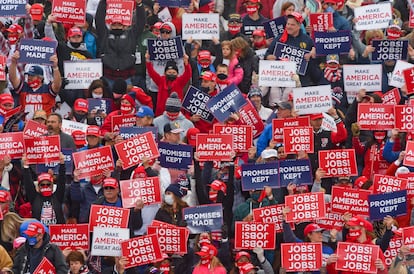
Fortier responds: “I have the impression that members of the Republican Party overestimate their strength and underestimate the resistance that this political violence will provoke. American citizens value peace of mind. They supported Trump for security… not to live in fear of a police force.” If we add inflation, soaring healthcare costs, tax cuts for the wealthy and foreign wars, the population may well become distrustful. “It remains to be seen whether it will be too late by then. We’ll have a first indication of an answer in the [2026 midterms],” the sociologist opines.
If things don’t change course, the future could become one of those dystopias that we love to watch from the comfort of our sofas. “We’re facing a [potential] world that I wouldn’t want to leave to my daughters; [it’s one] where authoritarianism would be the norm, where freedoms would be curtailed, where inequality would grow to the point of creating two social classes in two parallel dimensions. A world where human dignity will be disregarded,” Franco Delle Donne concludes.
Sign up for our weekly newsletter to get more English-language news coverage from EL PAÍS USA Edition
