
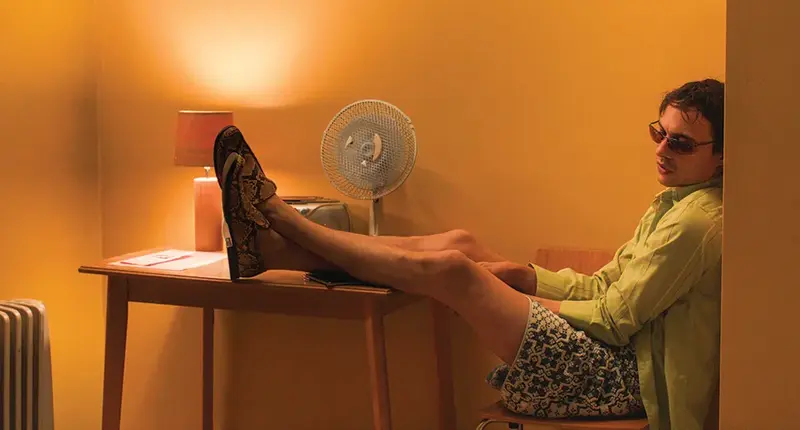
He’s the skin-crawlingly loathsome drug dealer in County Lines, the gloriously luvvy Richard Attenborough in See How They Run, the feckless father in Scrapper and the object of Nicole Kidman’s obsession in Babygirl, who manipulates her with a simple glass of milk. From low-budget independent movies to working alongside some of the industry’s biggest talents, it seems there’s nothing Harris Dickinson can’t do in front of the camera. If Urchin, his feature debut as a director, is anything to go by, the same applies when he’s behind the camera as well.
As writer and director, as well as playing a pivotal cameo role, Dickinson brings us the story of Mike (Frank Dillane), who has been sleeping on the streets, begging for money from passersby who look straight through him and trying much worse means as well. After what cash he has is stolen, he attacks and robs a compassionate stranger who’s tried to help him and finds himself back in prison. It appears to be a chance for a fresh start. He’s given a hostel room, gets a kitchen job and makes an effort to concentrate on himself with self-help tapes, but things start to unravel. Now, with litter picking as a means to earn some money, he starts a relationship with the savvy Andrea (Megan Northam) and makes some new friends, but they offer him ketamine, and he can’t resist. Everything is out of control and going downhill. Fast.
In a film and a world where there are so many questions, answers are in short supply, and Dickinson leaves it up to his audience to find them, if they can. While it makes Mike’s story enigmatic, it’s an approach that’s utterly true to the man himself, introducing us to his more endearing side as Urchin opens. Constantly on edge and twitchy, his obvious intelligence and openly vulnerable smile immediately encourage sympathy and understanding. But, as we learn, he’s cultivated it for that very reason: it conceals a slipperiness and, more importantly, an inability to respond to any efforts to help him or, indeed, understand them. Ironically, while it’s one of those attempts that gives him the chance to bring some order to his life, he can’t allow himself to stick with it, and although we see the moment that causes that internal snap, the reason behind it is as opaque as Mike himself.
Its main character is homeless, and his threateningly edgy world is presented in a stark documentary style which nods in the direction of Ken Loach, but Urchin isn’t primarily a film about homelessness. This is a character study, with Dillane constantly on the screen trying to turn all of his interactions to his advantage, regardless of whether they’re with his sympathetic but professionally detached social worker, Nadia (Shonagh Marie) or total strangers. It’s a remarkable performance, one that both capitalises on the sketchiest of back stories – he says he’s adopted and his accent points to a comfortable background – but makes it clear that he’s deliberately erased that past from his mind. It’s a portrayal that always keeps us at arm’s length – which is exactly how Mike treats people.
For all its documentary style, there’s an unexpectedly dream-like quality to Urchin. Mike can’t escape nagging memories and dreams – again, we’re left to work them out for ourselves – and the film’s final moments can be interpreted in a number of ways. There are so many layers to explore throughout: genuine humour, engaging characters who are acted with honesty and decidedly impressive camera work, but, ultimately, it’s a look inside someone who, ultimately, may simply be a lost soul.
★★★★
In cinemas from October 3rd / Frank Dillane, Megan Northam, Okezie Morror, Amr Waked, Harris Dickinson, Shonagh Marie, Karyna Khymchuk, / Dir: Harris Dickinson / Picturehouse Entertainment / 15
Related
Discover more from
Subscribe to get the latest posts sent to your email.
