
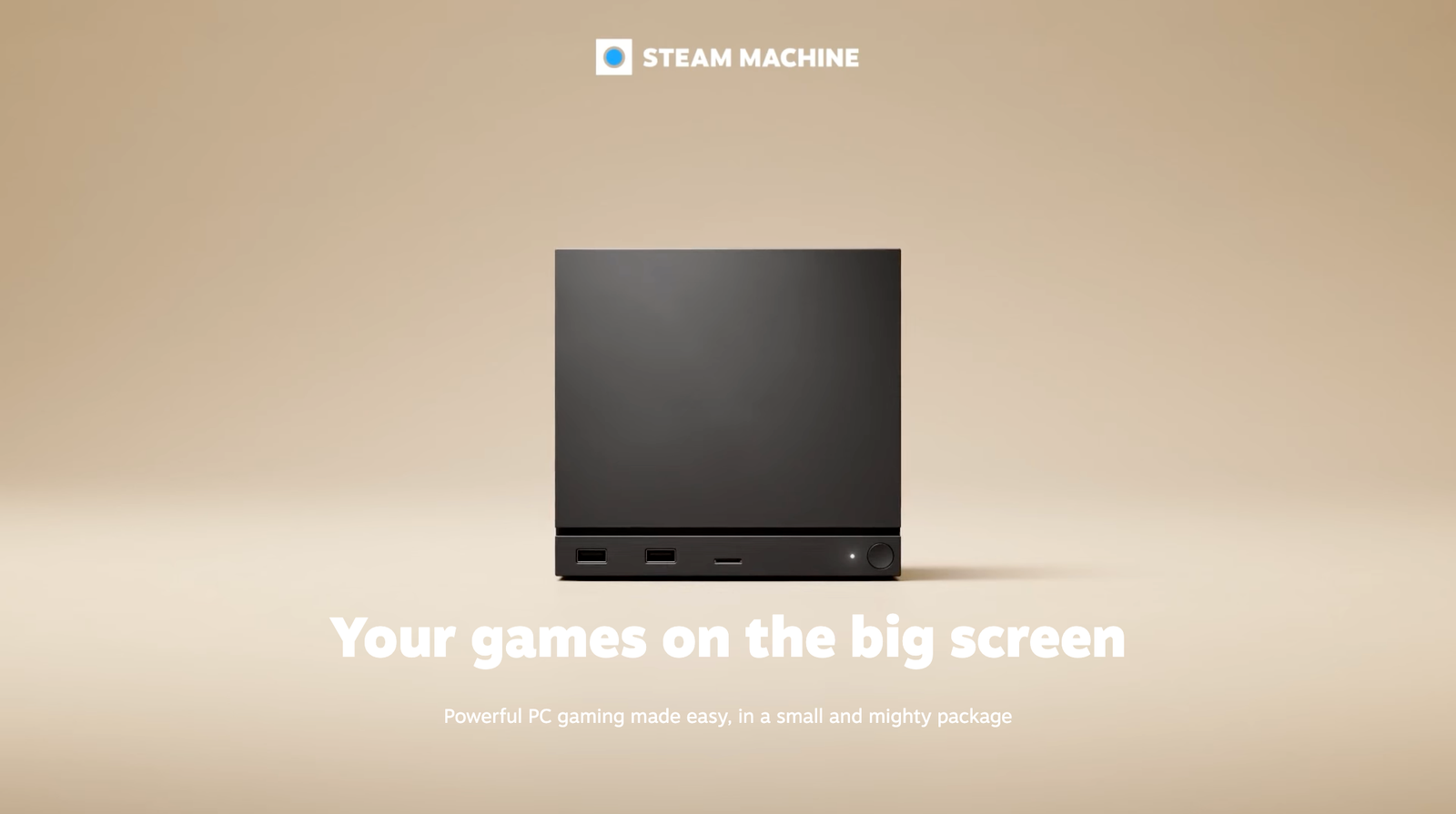
After the success of the Steam Deck, Valve, the company behind Steam, is now releasing a new home console, aptly named the Steam Machine. There will also be a new Steam Controller and a VR headset called the Steam Frame, all launching in 2026.
The most exciting to me is the new console since I love living room PC gaming, but hate Windows on a TV. That said, the Steam Frame is a new all-wireless headset to compete with the likes of the Meta Quest line, so that will also be interesting to VR gamers.
Don’t call it a comeback
A decade after Valve’s first attempt at making PC living-room gaming happen with the original line of Steam Machines, it’s back with a new custom-built living room PC packed inside a small black cube.
This new machine runs SteamOS like the current Steam Deck (and the new Steam Frame) so it should operate pretty much exactly the same as the current Steam Deck that’s on the market. The only difference is that this new console is much more powerful and is meant to go on your desk or in your living room.
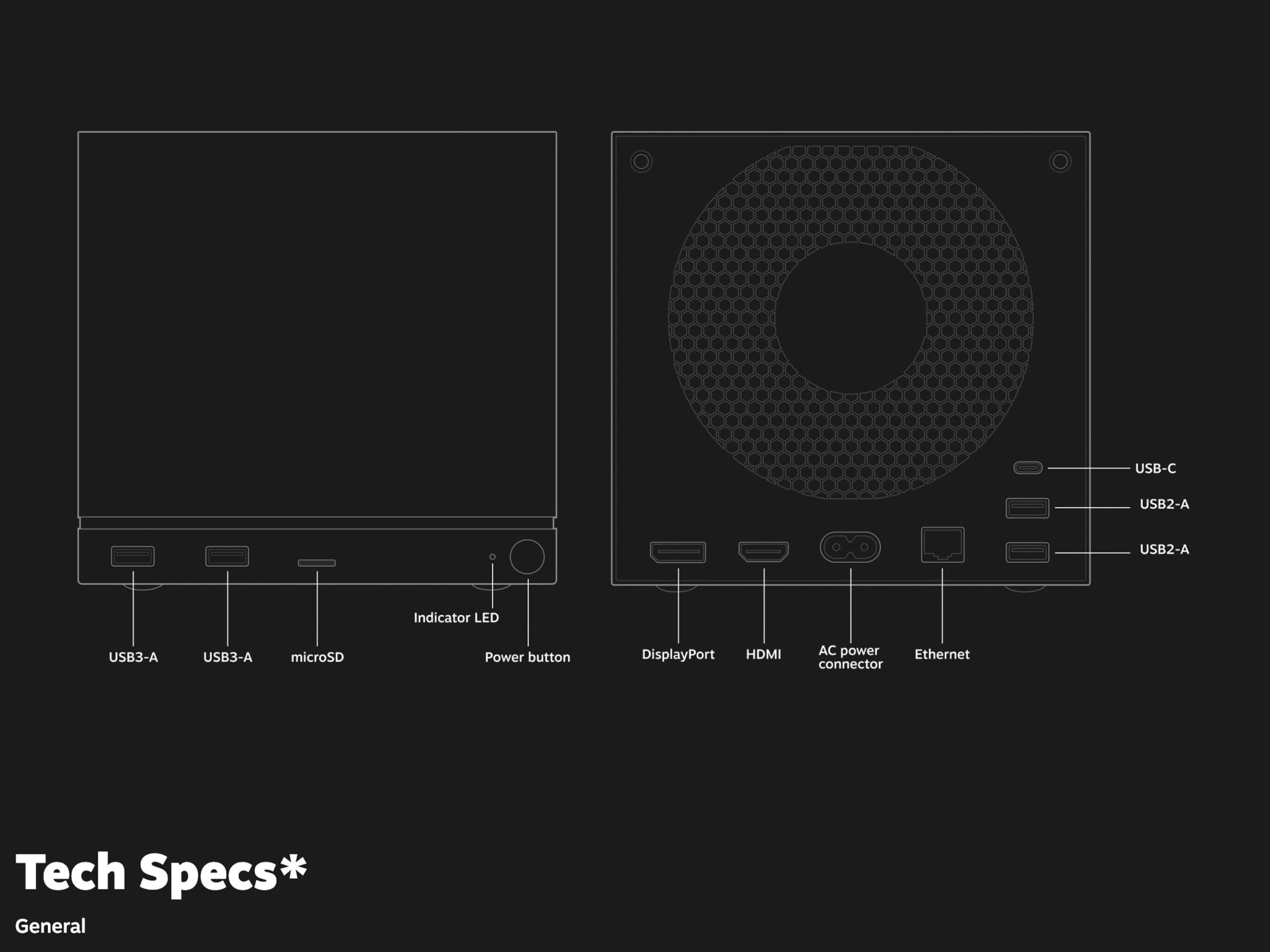
The hardware itself is a cube that’s roughly six inches on each side. It’s quite small, but I’d guess it has one big fan on top or bottom to help circulate air while remaining quiet. I’m sure there will be cool hardware features we’ll discover when it releases, but I was surprised to see that it doesn’t seem to share similarities with the Xbox Series X or the Mac Studio when it comes to cooling its desktop-class components. Instead, there appears to be a large fan on the back and a giant heatsink inside to manage heat.
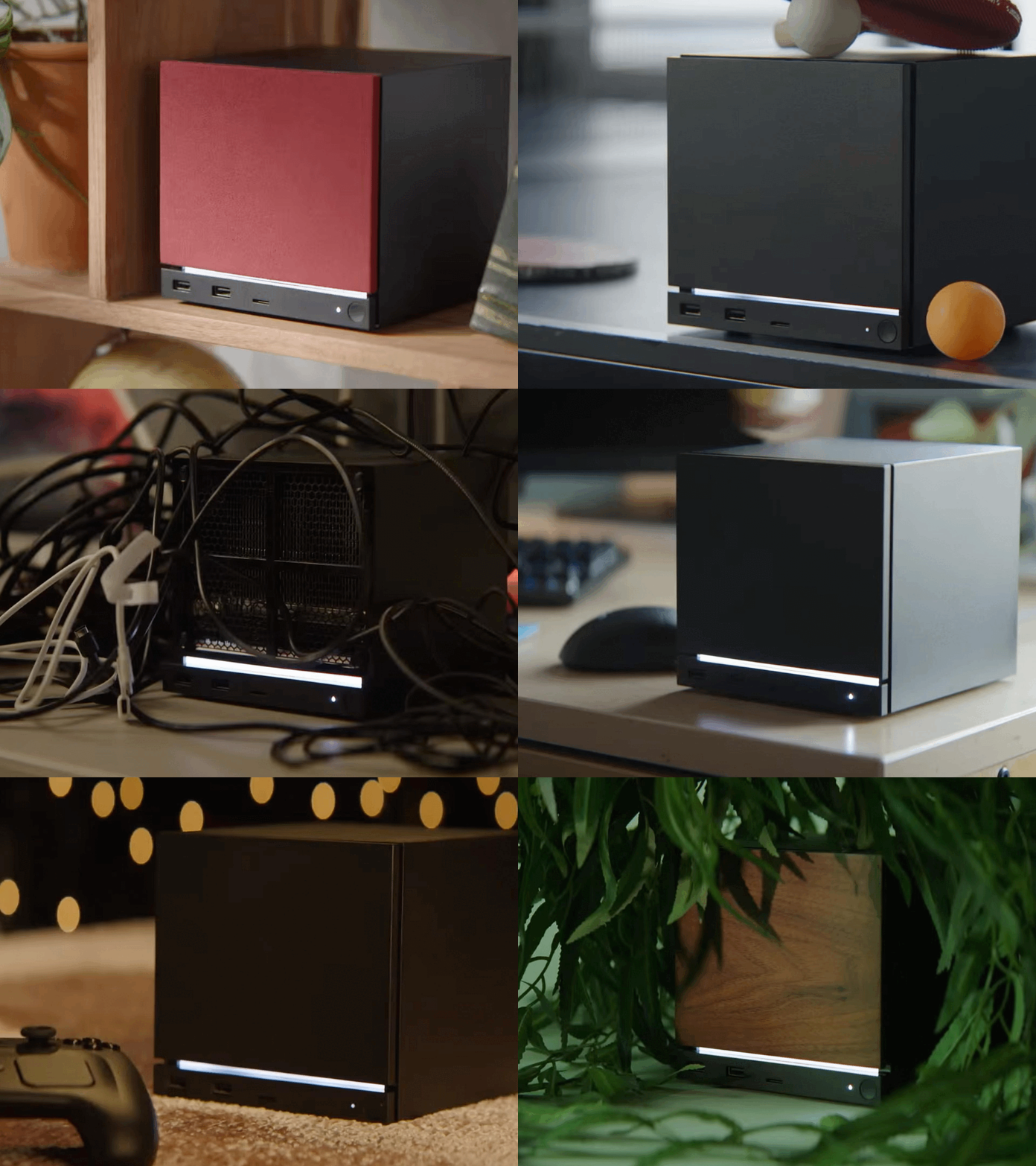
You can make your own custom faceplates for the new console.
On the outside, Valve has added a fun LED light strip that pulses when the machine is downloading or updating games automatically in the background. There’s also a Gigabit Ethernet port, 1 USB-C and four USB-A ports – two on the front and two on the back. There’s also a microSD card slot, and to connect to a TV, you can use HDMI 2.0 or DisplayPort 1.4.
In terms of specs, the machine is running custom AMD chips. The CPU is reportedly very similar to the AMD Ryzen 5 8540U, but the GPU is more unique and seems more similar to the power in some eGPUs or a high-end spec of the Framework laptop, according to The Verge. Overall, it should perform close to the PS5 Pro in terms of power.
Valve says it’s rated for 4K 60fps gaming, which is still a fairly ambitious target in 2025, but it also plans to achieve this using AMD’s FSR 3 upscaling technology. This should add up nicely, and I’ll mention that using my gaming PC with an RTX 5070, I need to use a little bit of upscaling (DLSS Quality mode) to hit 4K 60fps in Arc Raiders at max settings.
At a hands-on event, The Verge reports that the console benchmarked Cyberpunk 2077 at the medium graphics preset using FSR 3 at 4 K 65fps. However, it doesn’t specify whether FSR was set to balanced, quality, or performance. It did mention that the game was upscaling from 1080p to 4K, which makes me think it was using either Balanced or Performance mode.
If you plan to buy one, it will come in either a 512GB version or 2TB, and Valve says it will be easy to expand the storage with MicroSD cards. It’s still unclear if you can easily swap out or add another SSD or RAM inside. The Steam Machine has 16GB of DDR5 RAM as a base and 8GB of VRAM on its custom GPU.
We still don’t know the price yet or when specifically it will launch beyond early 2026. That said, Valve is open to letting anyone install the desktop version of SteamOS on their hardware. The Verge notes that in their interview with Valve, the company hinted that the price would be comparable to an entry-level PC with similar performance. This suggests to me that it might be in the $1,000-1,200 range when it launches in Canada. That said, to make a PC this small usually costs a lot more when you build it yourself, so you might be getting a nice advantage with the Steam Machine’s small footprint and portability.
