
With Chinese electric vehicles (EVs) set to come to Canada later this year, prospective buyers are already crunching numbers to see if they’ll be a truly affordable option. But one number you might want to consider is insurance cost, with a new study suggesting Chinese EVs will cost more to insure than other options.
The study was conducted by Toronto-based Insurtech company MyChoice using thousands of EV auto insurance quotes collected through the company’s website in 2025. To estimate insurance costs, the team at MyChoice used provincial EV insurance averages, vehicle classification logics, and vehicle repair data on EV calibration and battery complexity, as well as international insurance benchmarks from markets where Chinese EV manufacturers BYD and MG already operate.
According to the study, Chinese EVs are estimated to cost 20 to 30 per cent more to insure initially than other EV models currently on the market. However, costs should start to come down as early as 2028 once more insurance claim data is available, and the vehicles become easier to service.
Insurance would be the cheapest for the MG4 Electric in Atlantic Canada, ranging from C$1,780 to C$2,550 per year. The second-cheapest plan would also be in Atlantic Canada for the BYD Dolphin, ranging from C$1,813 to C$2,573 per year.
Image Credit: MyChoice.ca
The most expensive insurance plans are in Alberta, with the Chery Omoda E5 estimated to cost between C$3,679 and C$5,019. The second-most expensive is also in Alberta, with the BYD Seal estimated at between C$3,679 and C$4,810.
Interestingly, MyChoice also noted that Chinese EVs remain significantly more expensive than other EVs on the market. As an example, the Nissan Leaf is recorded on the chart at C$1,900/year, while the BYD Dolphin is noted at approximately C$3,200/year.
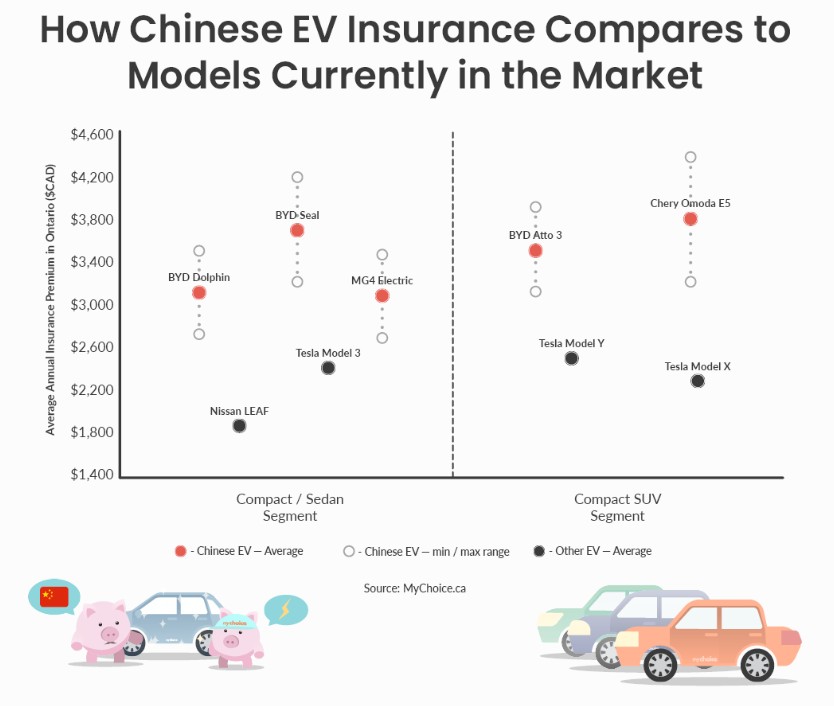
Image Credit: MyChoice.ca
Last month, Prime Minister Mark Carney announced the federal government reached a deal with China to allow up to 49,000 EVs into Canada at a reduced tariff rate each year. While some (like Ontario Premier Doug Ford) disliked the move, it also brought the promise of potentially more affordable EVs.
Carney’s government has since announced other initiatives to lower the cost of EVs, including bringing back the EV rebate program. To qualify for the rebate, vehicles must have a final transaction value of $50,000 or less, though this limit is waived for Canadian-made EVs. Unfortunately for prospective Chinese EV buyers, those vehicles are excluded from the new rebate program.
Those interested can read the full study on MyChoice’s website.
Header image credit: BYD
