
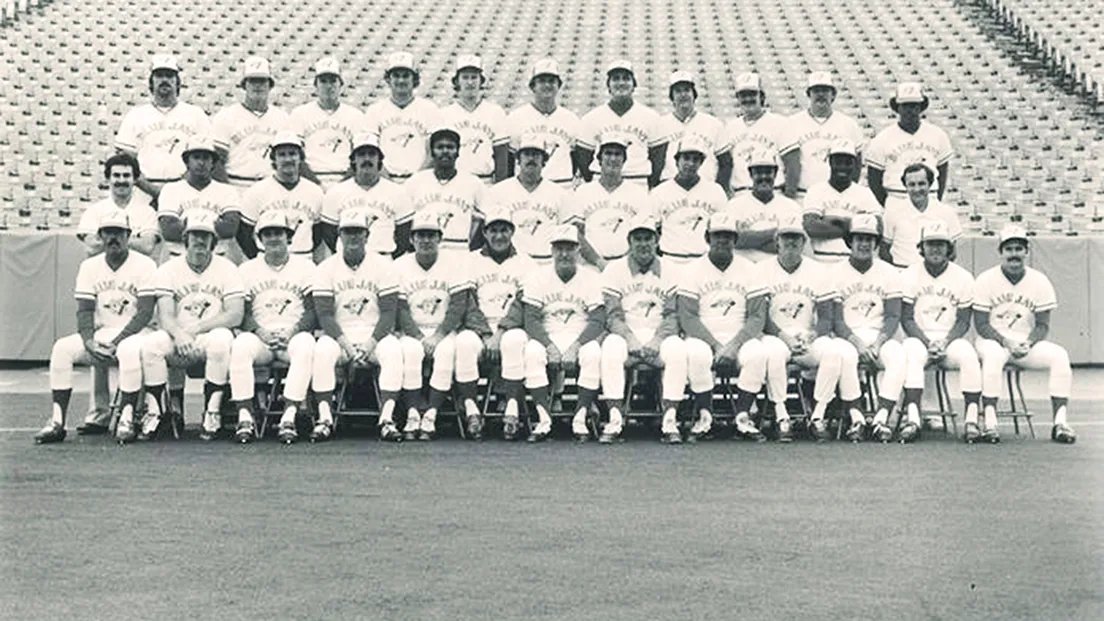
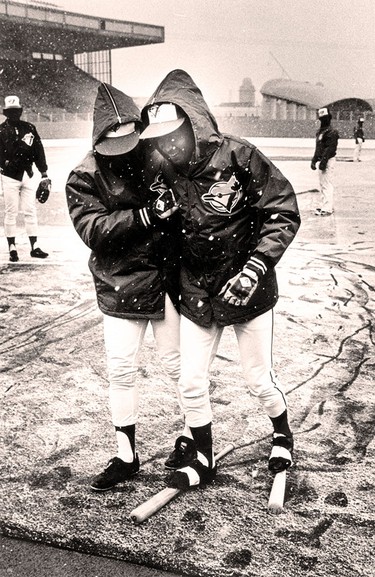
On the eve of the Toronto MLB team’s 50th season, we tracked down the little-remembered men of that famously frigid first opening day
Article content
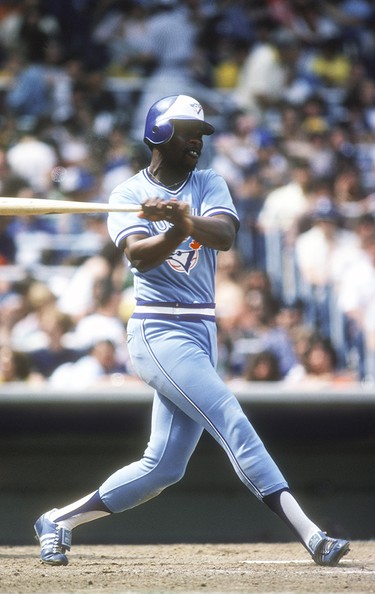
COMPTON, CA — On a quiet street in the notorious Los Angeles district of Compton, Calif., the first man ever to come to bat for Toronto’s newborn baseball franchise grants his first interview in nearly half a century: Go back to Thursday, April 7, 1977, and here is John Henry Scott snowshoeing to home plate in his superfly sideburns and his virgin white No. 11 on a frosty and historic afternoon.
Advertisement 2

Article content
Now, in Scott’s bungalow on the eve of the Blue Jays’ 50th campaign, I see dozens of photographs of laughing children and successful students, but nary a picture or memento or souvenir of his single season at Toronto’s Exhibition Stadium, that unfit, windswept ballyard by the lake. Friends and relatives clamoured for his uniform shirts and Louisville Sluggers and autographed balls, he says. So he gave them all away.
Article content
Article content

Long Story
Article content
Many Canadians would bid on those tokens today as primordial relics of a franchise that has grown from a lakeshore laughingstock into a multibillion-dollar colossus. In their 49 seasons in the American League, the Blue Jays have reached the World Series three times and won it twice. The Seattle Mariners, birthed at the same moment in 1976 in the American League expansion, have never reached the Series at all. (Neither did the Montreal Expos in their residence in Canada from 1969 to 2004.)
In 1977, the New York Yankees finished 45 games ahead of Toronto’s debut season in the league standings and defeated the Los Angeles Dodgers in the World Series. Last October, the Jays routed the Yankees in the playoff quarterfinals and came within a spike’s length of defeating those same Dodgers in overtime, way past midnight in the final match.
Article content
Article content
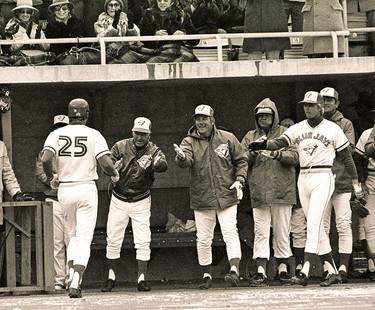
These are mere statistics. Much more profound is the Jays’ status in the national consciousness — at least when they are winning — as an emblem of Canadian wealth, strength and defiant autonomy, even if, just as in 1977, nearly all of their athletes come from somewhere else. This spring, the team will celebrate its inception in grand style and hail the stalwarts of its most successful seasons.
But my goal here is to go back to the agonizing genesis and seek out the men who made it so. Where are they now? What became of these first Blue Jays?
On April 7, 1977, Scott, who had never been to Canada, who had never played left field, and who had never caught a snowflake on his tongue in all of his 25 years, waggled his war club at the Chicago White Sox as tens of thousands of freeze-dried lungs exhorted, “We want beer!” (Official MLB stats say there were 45,000 fans in attendance at Exhibition Stadium on opening day.)
“What do you remember of that day?” I ask him.
“Not very much,” he replies. “Not very much of anything, really. I try to leave that in the past and just carry on.”
“Do you remember that first time at bat at all?”
“Yeah,” the flyhawk painfully grins. “I remember striking out.”
Scott’s major-league career would end a few dozen games later, leading him to Tokyo, to Mexico, to a job at Walmart, to the cab of a grocery delivery truck, and to the loss of his youngest son on a Compton street. No one I asked in Toronto and beyond — not even his old Blue Jays road-trip roommate up in Oakland, Calif. — had a clue where he was or how to find him.
Article content
But I did find him, after weeks of searching and messages to his teammates, family and relatives from California to Louisiana.
He was the very first Toronto hitter in Toronto’s very first game, and that can never be taken away, even as the Jays raise last year’s pennant and the indoor, beery crowd hails younger stars.
“I don’t remember a bunch of the guys,” he says softly. “No contact, nothing. I guess I could take part blame for that.”
“Mexico was the last time I played. Campeche, Mexico. I think that’s where it was. I tried to leave everything there.”
“The stadiums, the cheering, the autographs?” I wonder. “You just said, ‘I’m done with that?’”
“Yep, but it worked both ways. The game’s done with me, so I’m done with the game.”
From Compton to Toronto
In the living room of the house where he lives with his wife of nearly 50 years and two of their surviving children and a grandchild, Scott traces the rise and — in his view, undeserved — descent of a player who once was ranked the second-best prospect not only in L.A. County, not only in California, but in all of the United States. In the driveway is a 1979 Lincoln Town Car, painted sunshine yellow. It was his father’s.
“I can remember guys that I played with, and guys who were a year or two behind me complimenting me and claiming to pattern their game after mine,” he says. “I just remember loving it so much.
Article content
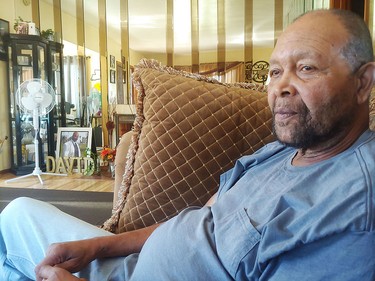
“Growing up here, it was an escape for me. There was a lot of gang violence around here. A lot of my friends got involved in it. I just tried to stay away from that. On the baseball field, all the negative things, they just disappeared and went away.”
Scott was two years old when his father, a welder, upended the family from Mississippi and headed for the City of Angels, to a benighted district called Watts. Scott was 13 when the riots of 1965, sparked by the alleged police clubbing of an unarmed woman, left the district in ashes and dozens of people dead. His parents kept him indoors as the mayhem spread.
“He left Jackson to get away from the racism,” the son relates. “Because there’s times I can remember we took a trip back to Mississippi, and when we stopped for gas, we had to go around the back to use the restroom.
“The place he worked at out here, I believe they manufactured elevators. Then after that, he started his own building maintenance business.”
“Did he escape racism when he got to California?” I ask.
“No,” Scott replies. “That’s unescapable.”
But at an old diamond called Wrigley Field — L.A.’s sibling of the ivied Chicago landmark — the welder and his sons found their release. “There was a league there, and my father, he coached the team and he taught me and my two brothers things that I never heard again until I reached professional baseball,” Scott says.
Article content
“Back then, it was the main sport,” the ex-Jay says. “The Dodgers had just come out here. I had two uncles who played also. And during the course of the years, everything changed. Everybody went to basketball and football.”
In 1970, the San Diego Padres claimed Scott with the second selection in the annual lottery of teenaged prospects. “I remember my father saying he didn’t care what team drafted me as long as I was playing with a California team or a West Coast team,” Scott says. “So, San Diego picked me and they invited my parents and me down. First time I’d ever flown on a plane. And them, too.”
Yet after a couple of seasons in the minor league and only three starts for the parent club, they abandoned him to the expansionists.
“How did you get the news you were a Toronto Blue Jay?” I ask Scott.
“It was in a letter,” he replies.
Toronto, finally a big-league city
Then, suddenly, Toronto, finally a big-league city after so many years of yearning, and John Scott, a young husband and new father driving his ’78 Civic with the Blue Jays logo on the door that a dealership gave all of the players: “I Ioved it. I loved it. I loved the area. Just like in Northern California, it was green, you know. It was green everywhere. The people treated me real nice.”
Article content
But after getting one hit in five times at bat on that unforgettable opening day — and after muffing a ball in left field for a two-base error — Scott started only 57 games for the Jays, hit two home runs, and struck out 39 times. By early summer, he was out of the starting lineup, reduced to part-time pinch-running and full-time bewilderment.
“I can remember the bullpen wasn’t enclosed,” he says of Exhibition Stadium. “This was at the fairgrounds. The pitching mounds were in the foul territory.
“I remember a ball hit down the line and I go over to field the ball. I bent down to get the ball. The ball hit the mound, jumped up, and went between my legs all the way to the fence.
There were fools in the stands with no shirts on.
Al Woods
“I wish the Padres had kept me,” he sighs. “The Toronto coaches, they seemed to have something in for me.”
“What did they think you were? Arrogant? Lazy? All those old stereotypes of Black ballplayers?” I ask.
“Well, yeah. Lazy, whatever. Still, you should put the best players on the field if you want to win games. At the end of the season, they traded me to St. Louis. They just let me go.”
“Did that come in a letter also?”
“Yeah, yeah. In a letter. Nothing was face to face.”
“John,” I tell old No. 11, “you’ve got to stop going to the mailbox.”
Article content
To Puerto Rico, and a retired Jays’ second baseman
Straight into Compton, down to palm-treed Puerto Rico, skimming the San Francisco Bay — the quest to find a few of the ballplayers I once knew as a curly-haired cub reporter is professional and personal.
Little remembered, even by the now-elderly fanatics who suffered through the Jays’ disastrous early years, the men I covered and now rediscover have known their share of woe in the half-century that followed their brief tenure in Toronto. But so have we all.
None of them ever reached a World Series or earned a sweet half-billion dollars, as Vladimir Guerrero Jr. does today, just for swatting a spinning sphere. None of them has been elected to the Baseball Hall of Fame, yet their names are in the encyclopedia alongside Babe Ruth and Jackie Robinson. They competed at the highest level while we in the press box merely joshed.
Now, in the lee of a tropical downpour, into a beachside hotel lobby in the San Juan neighbourhood of Isla Verde, full of vigour and abrazos, bursts Pedro Modesto García, the Blue Jays’ second baseman on that glorious first day, with Carmen, his wife of half a century.
“What hurts?” I tease him by way of greeting; by the age of 76, which García will reach this April, all athletes must pay the toll for their youthful diving, sprinting, sliding.
Article content
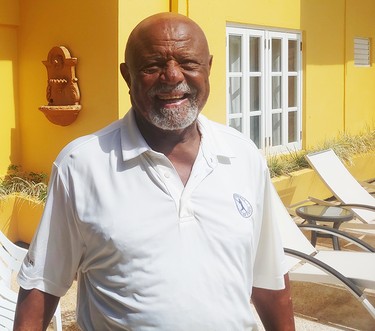
“Everything!” García exults.
“What happened to your hair?”
“I brought it in to be cleaned but I lost the ticket!” the bald old baseman declares.
There is a baseball player’s portrait on the Puerto Rico licence plate, but it isn’t García. (It’s the late Roberto Clemente, Hall of Famer and humanitarian, the island’s immortal.) Like Scott, García was long gone before the Jays began their rise to championship contention in the late ’80s and early ’90s. Like Scott, he has never been back to Toronto. Like Scott, his playing career ended in Mexico, and in winter-league games back home on Puerto Rico. But unlike Scott, he feasts on his former glories. To be a Puerto Rican who made it to the grandes ligas may be the most wonderful thing in the world.
“Everybody knows me!” he boasts. “Everywhere I go, they recognize me. And they say, ‘Hello, how are you?’ You’re somebody. Baseball, they pay attention to you.
“They’re going to name a stadium after me!” he announces. “Can you tell how happy I am?”
García hands me his cellphone. The lock screen shows a young swinger in blue, cocky and confident, coiled at the bat.
“I was in love with baseball,” García sighs. “The excitement of the game. Making good plays. The fans.”
Article content
“Could you still grab a bat and hit a couple of taters?” I jibe him. “Tater” was ’70s slang for a long home run.
“To tell you the truth,” he whispers. “They throw 100 miles an hour now. I’m afraid of the ball.”
The fans, they treat me nice in Toronto
Pedro Garcia, Blue Jays second baseman in 1977
Pedro García remembers being scooped up by the Jays after four creditable years with the Milwaukee Brewers and Detroit Tigers, and coming to spring training in Florida with the rest of the has-beens and never-would-bes. In Dunedin, the team’s field manager, a drawling Georgian named Roy Hartsfield, who broke into pro ball before the Second World War and before racial integration, put his arm around him and said cheerfully, “We’re gonna lose a hundred games with you, and we’re gonna lose a hundred games without you.”
“What the hell was that supposed to mean?” García snaps.
In any event, manager Hartsfield was overly optimistic. His Baby Jays lost 107 games and won only 54. (They lost 102 the next season and 109 the year after that before Hartsfield was shown the door.)
“The fans, they treat me nice in Toronto,” García says. “We went out to eat almost every time we were there. The people know who we are. They gave us a car to ride around. The little blue car with the bird on the door. It was cool. It was cool.
Article content
“In Toronto, I saw a second chance for me to do good. But that team in Toronto, that’s a pretty bad team. I know that it was an expansion team, but you want to win some ball games, too. You should use your best players.
“I could have performed better in Toronto. I believe I could be there for at least five more years playing every day if they let me. But they never let me.
“I have an idea why. One day, we were playing in Kansas City. And in Kansas City, there was the ballpark, the hotel, and the football stadium all together, but we were far away from downtown.
“After the first game, Hartsfield came to the clubhouse and said, ‘I don’t want you guys to go to the hotel bar. That’s mine.’ But me and Otto Vélez, we went to eat. Then we made a mistake. Once we came back from eating, we went to the hotel, and the bar was right there.
“We get into the bar, and who was coming out? Hartsfield! After that, he never talked to me.
“He never said anything to me, but I always kept working hard every day, getting my ground balls, working on my double plays. And then, you know, I was really sad.”
García was released on the 27th of June and never played in the major leagues again. As the years passed, the word around Toronto was that he had moved to Mexico. Or died. But, like Scott, he simply went home.
Article content
“I was 28. Married. Two kids,” he says. “And life continues. The bills are coming. You have to pay them.
“I had to do something. You know what I did? I went to college. I got my degree in computer science. And then I taught college for 15 years after that.
“I worked until I was 62, then I got my social security. I got my major-league pension when I was 45 because I didn’t know if I’m going to be dead by 46.”
Now García’s sliding into birthday number 76 with a bad back and high blood pressure. But even when he goes to the big dugout in the sky, Carmen will keep receiving his monthly cheques as long as she lives, as long as she doesn’t get re-hitched.
“I know my wife will never get married again, even if she falls in love with another man,” García gleams.
“It’s because of the pension!”
Waning and future standouts on the Blue Jays’ first roster
There were some waning and future standouts among the babes that first season in the snow. Outfielder Ron Fairly had played in four World Series for Los Angeles. Pitcher Bill Singer, the opening day starter, had 20-win seasons for the Dodgers and the Angels (with the Jays, he would win exactly two). A rookie from Pennsylvania coal country named Bob Bailor would bat a commendable .310 that first year and go on to a nine-year big-league career. Five years after the frigid opener, pitcher Pete Vuckovich would play in the 1982 World Series with Milwaukee and be named the American League’s pitcher of the year. Shortstop Jim Mason hit a home run for the Yankees in the 1976 World Series. None of these men would be Blue Jays when the team began its climb.
Article content
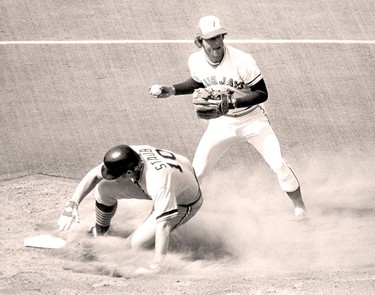
The first Blue Jay roster enfolded three African-American men, two Puerto Ricans, a passel of Mormons. The lone Canadian-born player, third baseman Dave McKay, is still in a baseball uniform after all these decades, as a coach for the Arizona Diamondbacks. A Mexican named Héctor Torres played shortstop, coached for a few years, retired to Dunedin. I hoped to visit Otoniel Vélez — a serious and hard-hitting batsman diminished in our columns to “Otto the Swatto” — when I was in San Juan, but he had gone to Florida for prostate surgery.
The first baseman, Doug Ault, hit two home runs against the White Sox in the opener, lost his batting stroke, was sent to the minors, tried managing with mixed success in the U.S. and Australia, tried selling cars. At 54, bankrupt and divorced, Ault shot himself.
“There’s no foul play apparent here,” the police department said.
For the others, life after baseball went on. The starting centre-fielder, an Oklahoman named Steve Bowling, whose relationship with skipper Hartsfield was “difficult,” failed to make the team in 1978 and went home to Tulsa and a career in construction supply management. Jerry Johnson, the winning pitcher on Day 1, became a Hollywood stuntman. A relief pitcher and midseason call-up named Dennis DeBarr had a particularly bad inning, was yanked by Hartsfield, flung his glove in the dugout, stormed out of the ballpark before the game was over, was relegated to the minors, went home to California, worked in construction, developed Type 2 diabetes, and lost a leg to gangrene.
Article content
The Day 1 catcher was Rick Cerone, who had grown up in suburban New Jersey, just across the Hudson from New York. One day, I asked Cerone if he had attended any of the famous Yankees and Mets games of the ’60s and ’70s.
“No,” Cerone answered. “I was playing baseball.”
To San Francisco to see a former slugger
There is an old saying in baseball that home-run hitters drive Cadillacs, but “Alvis” Woods — it was supposed to be Alvin, but the birth certificate somehow got misprinted — picks me up on the shore of San Francisco Bay in a dark blue Subaru. At Exhibition Stadium on April 7, 1977, in the first major-league at bat of his career, Woods pinch-hit for Steve Bowling in the fifth inning, stared down a Mexican hurler named Francisco Barrios, and hit the ball over the right-field fence. He outlasted John Scott and Pedro García and stuck with the Jays for five more seasons, a success by any measurement.
As it turned out, Barrios got caught with cocaine at a traffic stop a couple of years later and served a long suspension; he died of a heart attack at the age of 28. Woods, meanwhile, is a 72-year-old widower who has been a single dad for decades, a gentle, humble and generous man who learned from baseball that glory is short-lived and that no one hits a home run every time. He worked as a manager for a catering company after baseball. Later, he was a deputy sheriff in San Francisco, escorting prisoners to and from home confinement. He wore a service weapon but never had to use it.
Article content
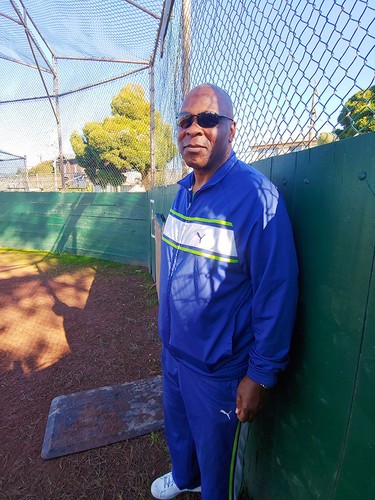
“When I was young, people said I was an outstanding baseball player,” he remembers as we drive through the Oakland neighbourhood where he grew up in a family of 13. “I just played for fun. I guess I didn’t know how good I was.”
What a place and time it was to be a young Black man. In 1967 in Oakland, where only 16 out of 661 police officers were African-Americans, Huey Newton and Bobby Seale were organizing the Black Panther movement for racial and social justice. Across the Bay, in 1967, it was the Summer of Love, headlined by Janis Joplin, Jefferson Airplane, Flower Power, LSD, the Grateful Dead. And on the University of California campus in Berkeley, there were raucous, daily protests against the draft and Lyndon Johnson’s Vietnam War.
“We’d take the bus to Berkeley to look at the hippies. Or we’d watch the Panthers march down San Pablo Avenue, right near where we lived,” Woods recalls. “It wasn’t violent back then, it was just a movement that wanted the government to realize that they have to do more for the Black communities.”
Like Scott down in Compton, young Woods confined himself within the fences and tended to what would become his craft. The diamond sport, he soon understood, is uniquely unforgiving; even the greatest hitter fails two times out of three.
Article content
“But that’s just part of the game,” Woods says. “You know you’re going to fail. There’s nobody in history who’s gotten a hit every time they came to bat.”
“But you did,” I remind him, “50 seasons ago.”
Just like Scott, it was Woods’s first time in Canada: April 7, 1977.
“There was at least a foot of snow on the field,” he exaggerates. “They got a Zamboni and started taking the snow off. It was cold as hell, but it was the first major league baseball game ever in Toronto, so I knew we would play it.
“The only thing I was thinking about was being warm. Even when I hit the home run, running around the bases, it didn’t dawn on me. I didn’t realize it until I got in the dugout and people were saying that I had hit a home run in my first at-bat.”
“I remember there were fools in the stands with no shirts on,” Woods says of that April afternoon.
“I bet you one thing, there were no Black people out there with no shirts on. I bet you that.”
John Scott went home to Compton
Baseball ended for John Scott in 1982. By then, the family had moved to Alexandria, La., Scott’s wife’s hometown.
“Things got a little tough there,” Scott says. “I couldn’t find work. I don’t know if it was prejudice or jealousy or what within the community.”
“Jealousy that you had been a big-league athlete?”
Article content
“Yeah.”
When a new Walmart opened, Scott was hired to run the sporting goods department. But one day he said something to a customer or he rubbed a boss the wrong way, and they fired him.
“Not by letter this time?” I ask.
“No, this was verbally, face-to-face.”
“Sometimes life gets in the way,” I philosophize.
“Sometimes people get in the way,” says Scott.
“After that, I even applied for truck driving, you know, at quite a few places,” Scott says. “Nobody would hire me.”
“Did you go into those places and say, ‘I used to play major league baseball?’”
“No. But the college there, I would go there and help out with their baseball team, and I wanted to work there with them. They claimed they would help me with furthering my education, but they wouldn’t hire me on a salary. So I said, ‘No, thank you. I’ve got a family and I need employment.’
“Then one day, I get up in the morning, I’m the first one up. I go to the front door.
“Somebody had spray-painted ‘KKK’ at the end of my driveway.
“And this is in the 1980s!”
And so, like Pedro Garcia, John Scott went home to Compton.
Grief and celebration
Baseball ended for Al Woods in 1986 after he briefly returned to the team that signed him as a teenager, the Minnesota Twins.
Article content
“That was my mistake,” he says. “They wanted to take me off the roster and invite me to training camp and I would have made the team. But I got prideful and I told them I didn’t want to do it. That’s how my professional career ended.”
Like John Scott and Pedro García, he had nothing to fall back on. A friend with TV connections tried to get him a gig as a sportscaster, but he “kind of messed up and got nervous” and he never tried again.
“Were you wealthy at that point?” I ask, thinking of the fantastical riches of today’s Guerreros and Springers and Bichettes. “Had you saved hundreds of thousands of dollars from the Blue Jays?”
“I didn’t even make hundreds of thousands,” Woods replies.
We are parked on a side street in Oakland, right beside the wood-walled sandlot where a young Woods first absorbed baseball’s lessons of symmetry and futility, of beauty and cruelty.
In that way, the game is the mirror of every man’s life — the grief and celebration, the cheering and the tears, the home runs and the sad walks home.
In the car, Woods tells me of the day that his first child was four years old and strapped snugly in the back seat when her mother crashed their car into a light pole on the way home from a birthday party.
Article content
The girl survived. The mom did not. Woods carried on.
I didn’t even make hundreds of thousands
Al Woods, an original Toronto Blue Jay in 1977
John Scott’s oldest son became a firefighter; number two chose to serve with the police. Scott’s third son, David, was 31 when he was shot to death in Compton in May 2014.
“Tell me about him,” I ask the bereaved father in the quiet bungalow in Compton. There is a shrine to the young man set up by the fireplace, a framed photograph, some flowers, an air of unimaginable loss.
“David was really something,” Scott says. “He was a happy child his whole life. He had friends galore you couldn’t imagine.”
He tells me how the boy grew to six-foot-two, how he loved to swim, how he underwent surgery to correct an aneurysm in his brain, how he avoided the menace of the streets, until the very end.
“The guys around here, they wouldn’t bother any of my sons,” Scott says. “My sons would stick up for themselves.
“Well, one evening, David went to celebrate a birthday with a friend. And the house it was at, it was a known hangout for these so-called gang members.
“It was in the evening, maybe around nine, ten o’clock. David was standing outside waiting for the young lady to come out of the house and a car drove by and started shooting and one of the bullets hit him.
“My wife and I were in bed, and somebody called and woke us up and told us David had been shot.”
Article content
A man was arrested and charged with murder, as well as what the police called “a special allegation that the killing was committed for the benefit of a gang.
“It took three trials to convict him,” Scott says.
“I didn’t read anything in David’s obituaries that said he was the son of a former major league baseball player,” I note.
“Not that it matters,” says Scott. “It doesn’t bring him back.”
A journey around the bases of life
“After 50 years, what really matters in a man’s life?” I ask Woods. It is not a question I would have thought of asking back in 1977.
“Family,” Woods replies.
“Do you regret giving your life to a game?” I ask.
“It was something I enjoyed. The friendships, the joy, the memories. It was something you can’t take away.”
“Even when you failed?”
“Even when I failed.”
“Did the Jays’ success last year please you? Did you think, ‘I used to wear that shirt?’”
“I didn’t follow it because I don’t follow baseball hardly at all. But I was happy for the players and for the city.”
Woods and I are motoring around Berkeley in the Subaru when my phone rings.
It is his old roommate, John Scott, answering a voice message I had left him the week before. Woods has been trying to find him, too. They haven’t spoken in 48 years.
Article content
“It’s good to hear your voice,” Woods says. “I will come down to see you in the spring,”
So, these are your heroes of an ancient April, rounding third and heading for home.
“My first major-league home run was up in Oakland,” says John Scott, who only smashed one more.
“It was June of that first season in Toronto, and I hit it off Vida Blue, who was a pretty good pitcher.
“When I came around third base, I saw my father and my oldest brother sitting there in the stands.”
I imagine a proud dad in that long yellow Lincoln that still waits in a Compton driveway.
“That really got me,” says the first of the Blue Jays.
“Seeing them there that day, that’s the fondest memory that I have.”
Article content
