

A WOMAN’S name and the letters ‘RIP’ were scrawled across a historic Spanish monument last month – vandalism that many argue was anything but random.
The monument is a tribute to 13 women executed by a fascist firing squad at the end of the Spanish Civil War, while the name was Sarah Santaolalla, a Spanish journalist, who has become the latest target of a growing pattern of coercive intimidation aimed at silencing women who challenge far-right narratives.
The defacing of Madrid’s 13 Roses memorial, at the Almudena cemetery, has since sparked a widespread debate – not only because of its personal nature, but for the heavy symbolism it invokes.
Santaolalla is no stranger to hostile attacks.
READ MORE: The Spanish Indiana Jones: How a ten-year-old boy from Granada became a hero in Italy after unearthing rare Roman coin
Former Podemos leader Pablo Iglesias recently highlighted a remark made by a conservative PP party deputy, who dismissed the journalist with the comment: “Para simples, tus fotos mostrando los cocos con el escote,” – a crude insinuation that she relies on displaying her cleavage rather than professional merit.
Why would a media commentator, political analyst, and activist be targeted with such overt hostility and threat?
The answer reveals much about Spain’s past – and its unresolved tensions in the present.
Researchers who study gender-based political violence argue that such acts are rarely isolated incidents.
READ MORE: Time for revenge? Spain and England drawn to play each other in UEFA Nations League for first time since Euro 2024 final
Instead, they function as warnings: attempts to force women out of public debate through fear, humiliation, and intimidation – tactics increasingly documented both online and offline.
The memorial itself commemorates Las Trece Rosas, the 13 young women who were executed by firing squad in August 1939, just months after the Spanish Civil War ended.
Aged between 18 and 29, the women were accused of supporting left-wing resistance groups and became victims of Franco’s brutal post-war repression.
Their deaths came to symbolise both the regime’s cruelty and the political courage of women who refused to submit to authoritarian rule.
READ MORE: Flamenco star Estrella Morente fronts near sell-out charity concert in Granada
For decades, the 13 Roses – whose tragic deaths were turned into an award-winning film – have stood as a stark reminder of Spain’s struggle with historical memory.
To supporters, they represent resistance, democratic values and women’s right to political participation.
To critics of Spain’s memory laws, they remain a contested symbol – one that continues to provoke anger more than 80 years later.
That symbolism hit hard when thugs explicitly named Santaolalla, a journalist known for reporting on far-right movements.

READ MORE: Four remarkable Spanish women – A gallega painter and a malagueña philosopher; a child and a tennis star
Santaolalla responded publicly online, stating it was ‘no coincidence’ that women murdered for standing up to fascism were invoked in an attempt to intimidate a woman doing the same today.
Political leaders across the spectrum swiftly condemned the attack.
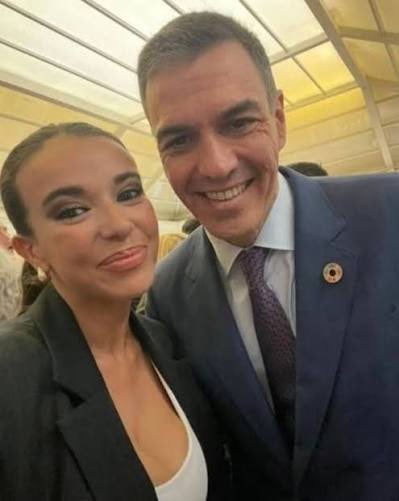
Prime Minister Pedro Sanchez expressed his solidarity with Santaolalla, denouncing the use of threats to undermine democratic debate.
He has long supported women’s rights – most recently reaffirming abortion as a right for all women in Spain – and his intervention signals the incident is being taken seriously by the government.
Several cabinet members and regional politicians also echoed that stance, warning that vandalism and threats are not forms of protest but acts of violence.
Others stressed the importance of protecting sites of historical memory, arguing that democracy cannot be defended through intimidation or hatred.
Support has also been poured in from civil society and the media.
The hashtag #YouAreNotAloneSarah has been trending across Spanish social media, accompanied by statements from journalists, unions, and advocacy groups calling for solidarity and visibility in the face of harassment.
Spain currently ranks among the higher-performing countries on the global Press Freedom Index, coming 23rd out of 180 countries.
However, press watchdogs caution that harassment campaigns, particularly those targeting women journalists, risk normalising intimidation and pushing critical voices out of public life if left unchecked.
The desecration of the 13 Roses memorial is therefore more than about vandalism.
It is a reminder that Spain’s unresolved relationship with its past continues to shape its present – and that the fight for press freedom, historical memory and a woman’s place in public debate remains far from settled.
