
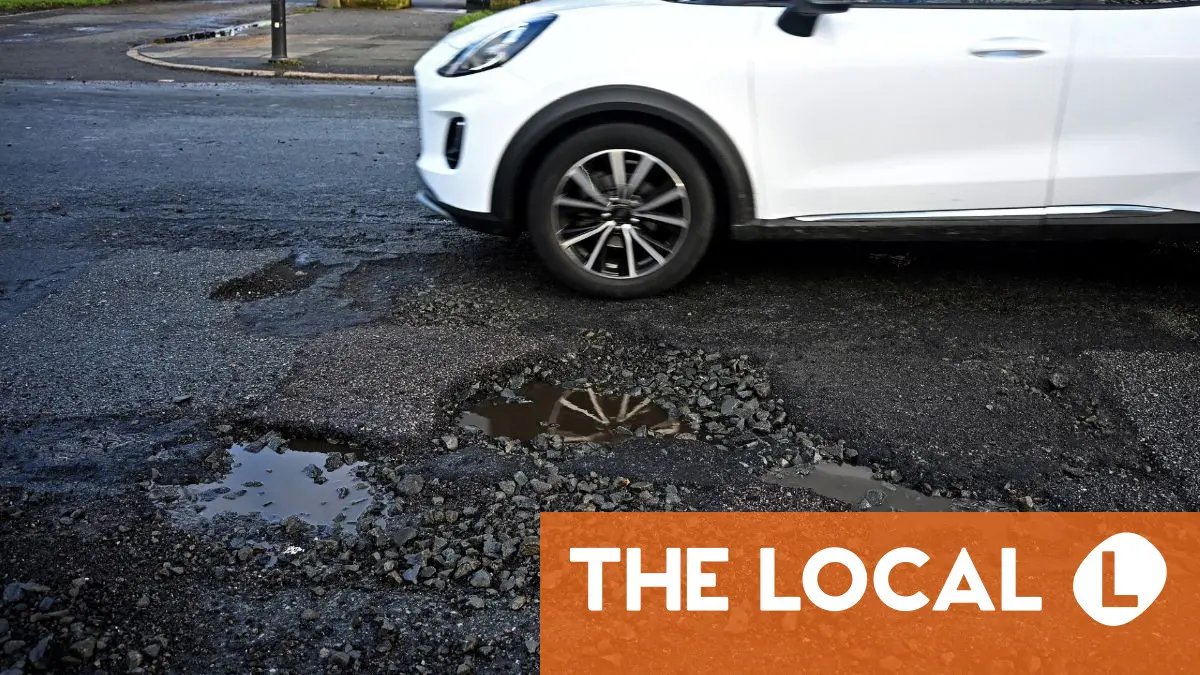
Think the potholes are particularly bad in your part of Spain? A new study has revealed the regions with the most damaged roads in the country.
If you drive in Spain or even if you regularly take public buses, you know it can be frustrating and dangerous when the road conditions are bad. This could include potholes, cracks in the tarmac, faded or missing lines or signs.
The number of severely deteriorated road sections in Spain has tripled in the last three years, according to an audit by the Spanish Road Association (AEC).
Their study found that the 13,000 kilometres of roads with severe deterioration in 2022 had increased to 34,000 km by 2025.
READ ALSO: My city in Spain just got a low-emission zone. What do I have to do?
This situation could be even worse now since the recent spate of storms, which has swept across the country.
According to the AEC report, 33,966 kilometres of roads required urgent reconstruction last summer due to “very serious” alterations, both structural (potholes and cracking) and superficial (longitudinal and transverse cracks, and peeling), while another 20,407 kilometres required works in the next four years due to “serious damage”.
In total, the report revealed that repairs were needed on more than half (52 percent) of Spanish roads (54,373 kilometres out of a total of 101,700). The estimated investment needs in order to repair this amount is €13.4 billion.
The audit showed that the region with the most poor-quality roads was Aragón, which is at a “critical level,” with 68 percent of its network showing serious or very serious deterioration.
Advertisement
This is followed by Galicia and Castilla-La Mancha where 59 percent of roads in each region were damaged and needed attention.
Another five regions also have more than half of their road network severely damaged. These include Murcia and Asturias with 58 percent each, followed by La Rioja and Castilla y León with 57 percent.
In seventh place is Catalonia with just over half or 52 percent of its roads in poor condition.
READ ALSO: Nine questions to ask when buying a second-hand car in Spain
Advertisement
Those regions with roads considered to be in an “acceptable” condition (less than 40 percent deteriorated), are Extremadura with 40 percent, Madrid with 38 percent and Valencia with 32 percent.
Looking at absolute terms, the ranking changes slightly because the largest regions are those with the most extensive road networks.
In this case Castilla y León comes out on top as having the most roads in poor condition with almost 10,000 kilometres of its network in urgent need of repair (9,954km).
This is followed by Castilla-La Mancha with 7,387km of roads in poor condition and then Andalusia with 6,974km. This time Aragón comes in fourth place with 5,848km of damaged roads.
In fifth place is Galicia with 4,410km and then Catalonia with 4,025km.
Advertisement
On the other end of the scale are the smaller regions and those with fewer deteriorated roads. These are La Rioja with 1,028km, Madrid with 1,091km and Cantabria with 1,141km.
This means that Castilla y León would require the largest share of the €13.491 billion needed to upgrade its road network – a total investment of €2.705 billion, followed by Castilla-La Mancha needing €1.801 billion.
Andalusia would need a total of €1.743 billion spent on its roads, followed by Aragón which would need €1.342 billion and then Galicia with €1.125 billion.
All the other regions would require less than €1 billion to repair their roads.
The ones that would need the least investment are La Rioja with €226 million, Cantabria with €256 million and Madrid with €288 million.
