
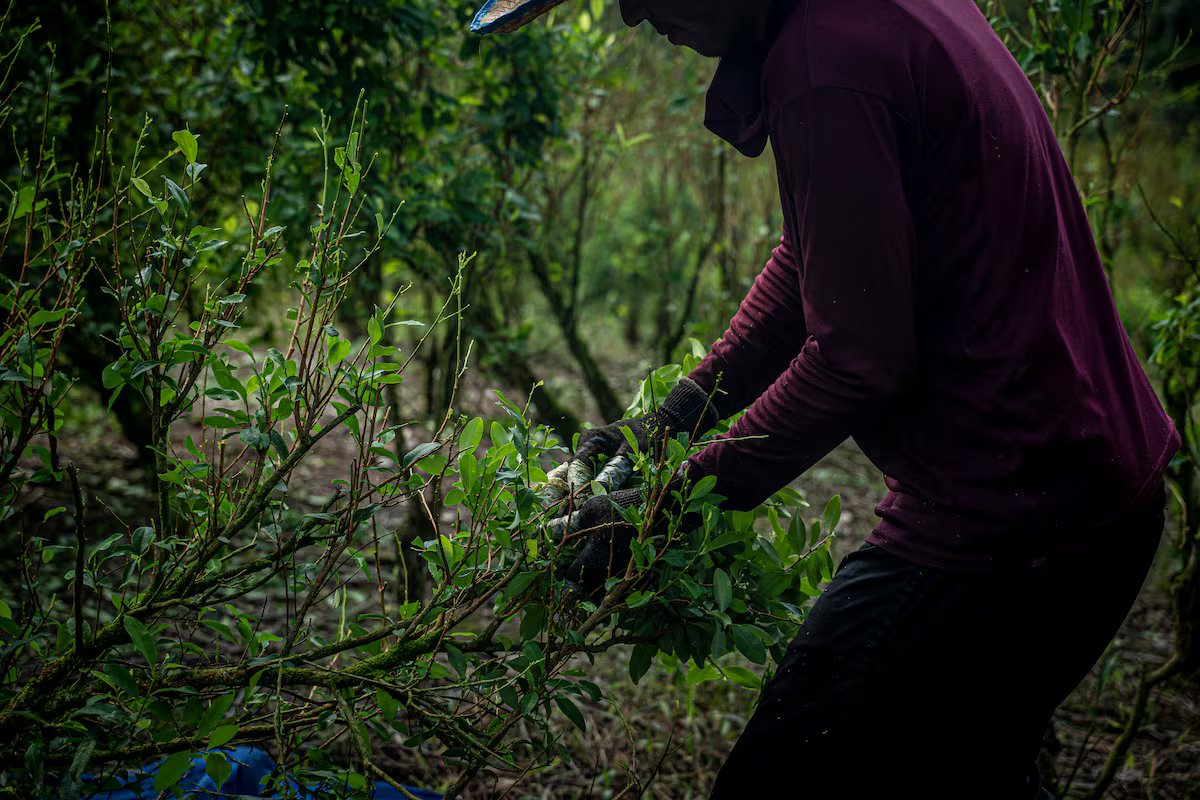
Coca leaves will remain on the list of highly dangerous substances, where they have been for over 60 years. The window of opportunity that had opened for their removal has just been shut: the World Health Organization (WHO) has recommended keeping them on Schedule I — the most restrictive — of the 1961 Single Convention on Narcotic Drugs. Bolivia’s request to declassify coca leaves, which Colombia had enthusiastically supported, has been met with a major setback. The two countries’ campaign to destigmatize coca, differentiate it from cocaine, and promote its alternative and traditional uses has suffered a significant blow. The decision by the UN agency is now being questioned by a wide range of civil society organizations that had expected the opposite from an institution focused on health issues.
The Bolivian government formally requested in June 2023 that coca leaves be removed from the list of controlled substances alongside heroin, cocaine, and fentanyl. “The coca leaf is like a dry seal that protects the identity of the ancestral Andean-Amazonian peoples,” argued Bolivian Vice President David Choquehuanca at the time. “There is not a shred of scientific evidence to justify including the coca leaf on that list,” countered Laura Gil, then-Colombian ambassador to Vienna, the headquarters of the United Nations Commission on Narcotic Drugs.
The WHO did not agree with them, pointing to the “ease” with which the leaf can be converted into coca paste, and then into cocaine hydrochloride. “It is estimated that one hectare of coca bush cultivation produces approximately 4.2 tons of fresh coca leaves per year; one ton of fresh leaves produces approximately 1.5 kg of coca paste or 1.4 kg of cocaine base; one kg of cocaine base results in roughly 0.9 kg of cocaine hydrochloride, which typically contains around 85% pure cocaine,” the organization calculates. “Accordingly, as coca leaf is used to manufacture cocaine, one controlled substance (cocaine) is made from another (coca leaf), thereby meeting the Convention’s criterion for convertibility,” reads the document in which the WHO recommends keeping the plant on Schedule I. That recommendation will now be sent to the UN Commission on Narcotic Drugs in Vienna, which ultimately makes the decision, but without the support of the WHO, there is no option to change the category.
The International Drug Policy Consortium (IDPC), based in London and comprising nearly 200 expert organizations from around the world, has vehemently rejected the decision. “The decision ignores clear evidence that, in its natural form, the coca leaf poses minimal health risks, disregarding millennia of Indigenous knowledge by claiming there is no ‘solid basis’ for its therapeutic use,” reads the statement issued last Tuesday.
In fact, the WHO decision cites the report from the expert committee on drug dependence convened for that review, which states that “no studies were found that provided robust evidence to determine the prevalence of coca leaf dependence.” The report also found that the coca leaf possesses antihypertensive, antioxidant, anti-inflammatory, and anticancer properties, as well as stimulant, antidiabetic, and anorexigenic activity, which reduces appetite.
For Luis Felipe Cruz, a drug policy expert and consultant for the human rights organization Elementa DDHH, the WHO recommendation means that scientific research on the coca leaf will continue to face significant obstacles. “It makes it difficult to conduct research on the plant, to obtain permits and licenses for medicinal or alternative uses, and it makes everything much more restrictive,” says Cruz, who participated in preparing the documents that Colombia sent to the WHO for review. “Humanity is being deprived of the opportunity to study the potential benefits of the coca leaf and its derivatives,” he asserts. Isabel Pereira, coordinator of the drug program at Dejusticia, agrees, adding that the decision “sends a disheartening message about the international drug system, as it demonstrates that the skeptics are right: it is impervious to scientific evidence.”
The criminalization of the coca leaf has relegated scientific research on the plant to almost anecdotal status. In Colombia, only three entities have permission from the National Narcotics Fund to conduct applied research: the National Police, the University of Los Andes, and the SENA (National Learning Service) regional office in Cauca. Dora Troyano, an ecologist with a doctorate in ethnobiology and biocultural studies, works with the latter. In northern Cauca, she leads a research project monitoring some 150 products made from the coca plant in South America, across the food, textile, dye, pharmaceutical, and nutraceutical sectors. In the region where she works, the focus has been on coca flour, coca tea, and dried coca leaves. “Imagine having the possibility of developing products or markets, so that in any supermarket in the country, in the medicinal plant aisle, we could find the coca leaf. It would not only be a great opportunity for the producing communities, but also for the users of medicinal plants,” the academic argues.
A questionable origin
Bolivia spearheaded the critical review of the coca leaf not so much for its commercial potential but for its traditional and ancestral value. Their argument is that the original decision to include the plant in 1961 stemmed from biased and racist interpretations that are untenable today. This bias is evident in the dossier that the Andean nation sent to the WHO. In 1948, the UN approved sending a commission of inquiry to Peru to study the effects of chewing the leaf, a mission that was later extended to Bolivia as well. The Argentine physician Pablo Osvaldo Wolff prepared a bibliography for the members of that commission, and in a presentation in 1949 he shared his reflections: “The indio who does not chew coca leaves is clear-sighted, intelligent, and light-hearted, willing to work, vigorous, and resistant to diseases; the coquero, on the contrary, is abulic, apathetic, lazy, insensitive to his surroundings, his mind is befogged; his emotional reactions are rare and violent, he is morally and intellectually ‘anaesthetized,’ socially subdued, almost a slave.” He added: “There is no doubt that the habit of chewing coca leaves is one of the most powerful reasons for the backwardness and misery of the Indian population.”
The mission was led by Henry B. Fonda, vice president of the American Pharmaceutical Association, who upon arriving in Lima declared in an interview with a local newspaper that chewing coca was “not just a harmful and pernicious habit, but a cause of racial degeneration of many population groups and the decadence visibly demonstrated by numerous indigenous and even mestizo inhabitants of certain areas of Peru and Bolivia.” More than 70 years later, the WHO continues to consider the coca leaf to be one of the most harmful substances on the planet.
Sign up for our weekly newsletter to get more English-language news coverage from EL PAÍS USA Edition
