
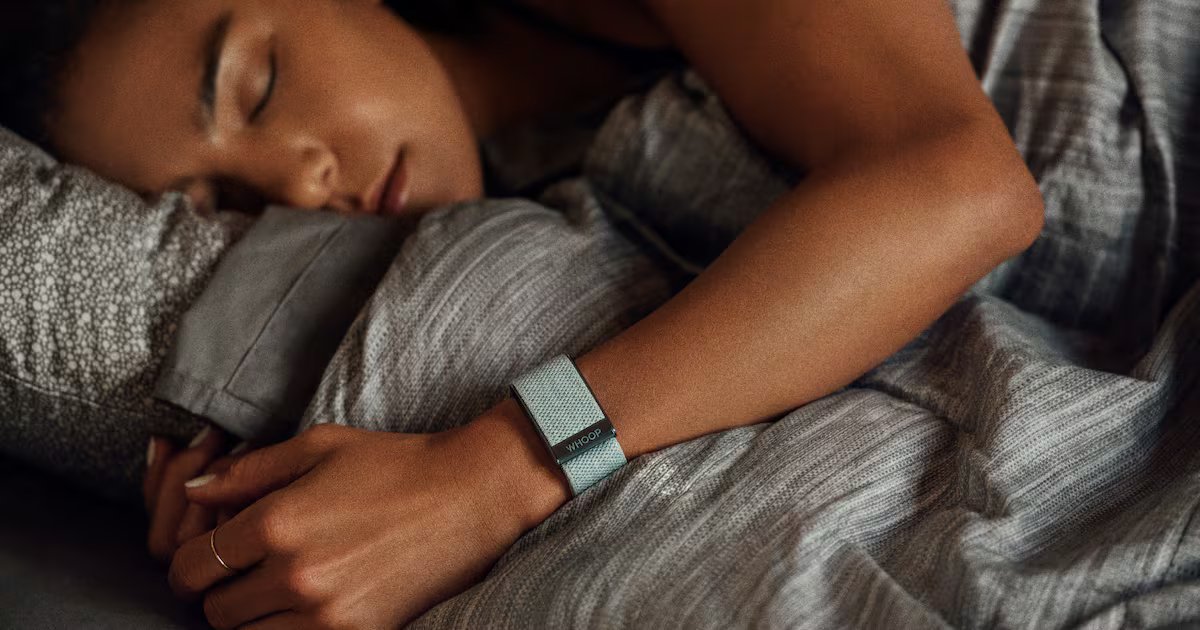
Whoop Inc., the maker of popular screenless fitness bands, plans to increase its staff by as much as 75 percent this year to fuel growth ahead of a potential initial public offering.
The Boston-based company intends to add more than 600 new roles across various departments, including software, research, design, hardware, product development, manufacturing, sales and marketing, founder and chief executive office Will Ahmed said in an interview announcing the expansion.
The majority of the new employees will be based at the company’s headquarters, he said, with additional hiring planned across North America, Europe, the Middle East and Asia. Whoop currently operates in 60 countries, with 60 percent of sales coming from international markets. That marks a relatively recent change for the firm: Just four years ago, the US made up about 70 percent of its member base.
Whoop, founded in 2012, currently employs nearly 800 full-time staff, after hiring almost 300 people over two years.
“We’re investing pretty consistently across the entire business,” Ahmed said. “There isn’t an area we’re not investing in.”
The planned hiring spree is happening at a time when a growing number of publicly traded tech companies are shrinking their staffs, in some cases citing artificial intelligence as an opportunity to streamline operations. Jack Dorsey’s Block Inc. said last week, for example, that it would slash nearly half its workforce after investing heavily in AI tools to run more efficiently.
Other companies have also made deep cuts in recent months. Amazon.com Inc. earlier this year announced plans to shed 16,000 corporate jobs. Meta Platforms Inc. said it would eliminate more than 1,000 jobs from its Reality Labs division to redirect resources to AI wearables and phone features. Pinterest Inc. plans to cut “less than 15 percent” of its workforce and will reduce office space, also in an effort to shift resources toward AI. Autodesk Inc., too, said it would trim about 1,000 positions.
“There’s a lot of companies that are doing layoffs right now and blaming it on AI,” Ahmed said of recent job cuts in the tech sector. “But they’re actually doing layoffs because the businesses aren’t performing particularly well. And it’s a convenient excuse.”
Ahmed added that an aggressive hiring push is necessary for Whoop to add an assortment of product features.
“There’s a lot that we want to build,” he said. “There’s a lot that we think is possible around health monitoring and health care, and creating technology that makes our members healthier. And we want to invest against it.”
Ahmed told Bloomberg in November that Whoop is well-positioned for an IPO, likely “over a horizon of two years.” He said those plans haven’t changed, and that the company continues to see “considerable growth” across the business.
Going public could cement Whoop’s position as a leader in the wearables and wellness space, particularly in a growing subcategory of screenless gadgets positioned as smartwatch alternatives. Oura Health Oy, for example, offers similar health-tracking capabilities in a ring-style device, while Samsung Electronics Co. debuted a smart ring of its own in 2024.
Many of Whoop’s recent product upgrades are intended to offer a sharper gauge of users’ underlying health. Its latest high-end model, the Whoop MG — short for “medical grade” — includes access to blood pressure tracking, an electrocardiogram feature, atrial fibrillation detection and irregular heart rhythm notifications.
In July, the US Food and Drug Administration asked Whoop to remove the blood pressure tracking feature, saying it didn’t have the proper certification to offer medical recommendations. Whoop refused to disable the tool while also negotiating with the agency on a path forward. Since then, the FDA has come out with new guidelines that support the idea that blood pressure can be used in products marketed as wellness devices.
“I would say overall our conversations with the FDA have gotten very constructive,” Ahmed said. “I think that there was a broader understanding that the industry at large needed clarity on the difference between wellness technology and medical technology.”
In addition, Whoop recently introduced a blood work integration tool and Healthspan, a feature that attempts to quantify someone’s biological age. It is also exploring new health features, including integrating data from blood sugar monitors, Bloomberg reported last fall.
By Samantha Kelly
Forget your $285 Nike Alphaflys and that $150 Salomon technical vest. The biggest flex is turning up to run club with a perfect recovery score on Oura or Whoop.
